Tran-Kiem Cécile, Paredes Miguel I, Perofsky Amanda C, Frisbie Lauren A, Xie Hong, Kong Kevin, Weixler Amelia, Greninger Alexander L, Roychoudhury Pavitra, Peterson JohnAric M, Delgado Andrew, Halstead Holly, MacKellar Drew, Dykema Philip, Gamboa Luis, Frazar Chris D, Ryke Erica, Stone Jeremy, Reinhart David, Starita Lea, Thibodeau Allison, Yun Cory, Aragona Frank, Black Allison, Viboud Cécile, Bedford Trevor
Vaccine and Infectious Diseases Division, Fred Hutchinson Cancer Center, Seattle, WA, USA.
Department of Epidemiology, University of Washington, Seattle, WA, USA.
medRxiv. 2024 Nov 7:2024.05.24.24307811. doi: 10.1101/2024.05.24.24307811.
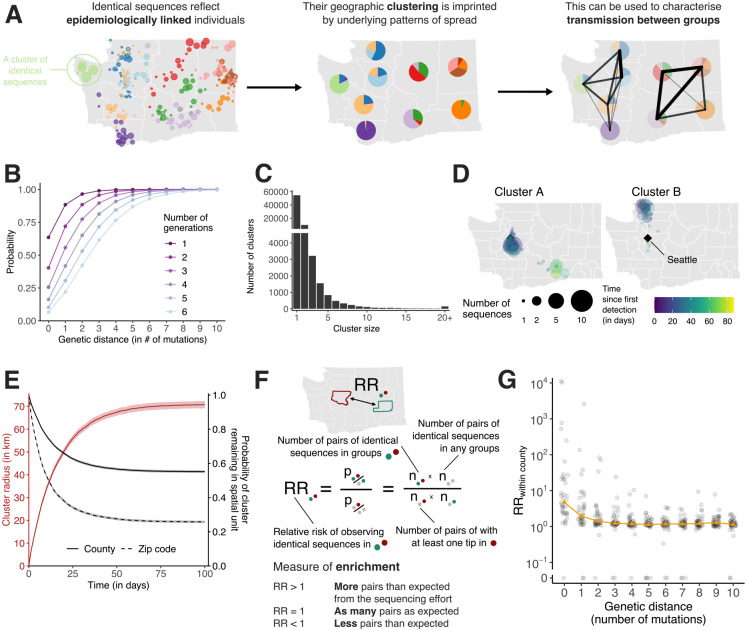
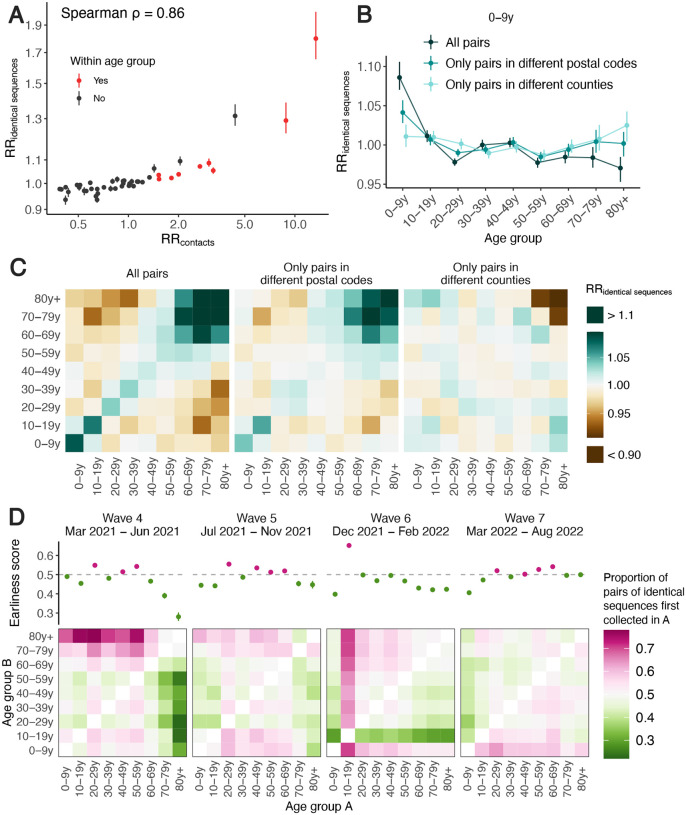
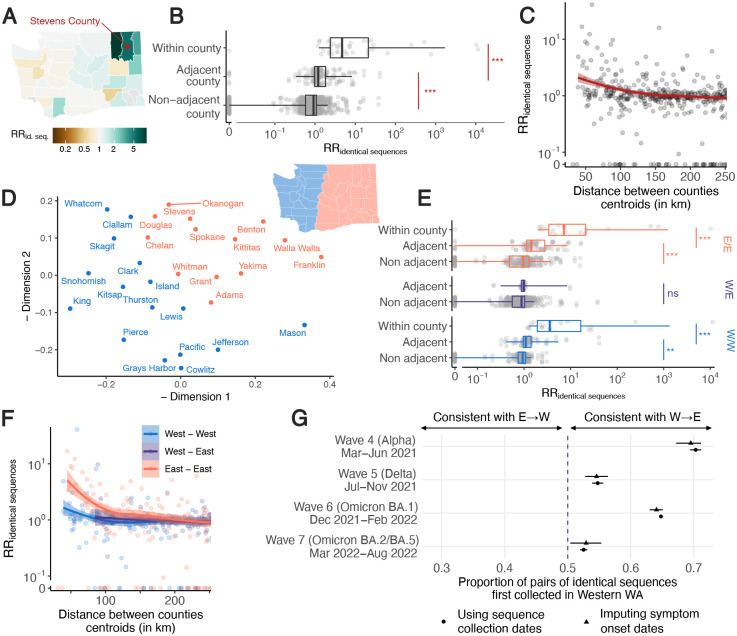
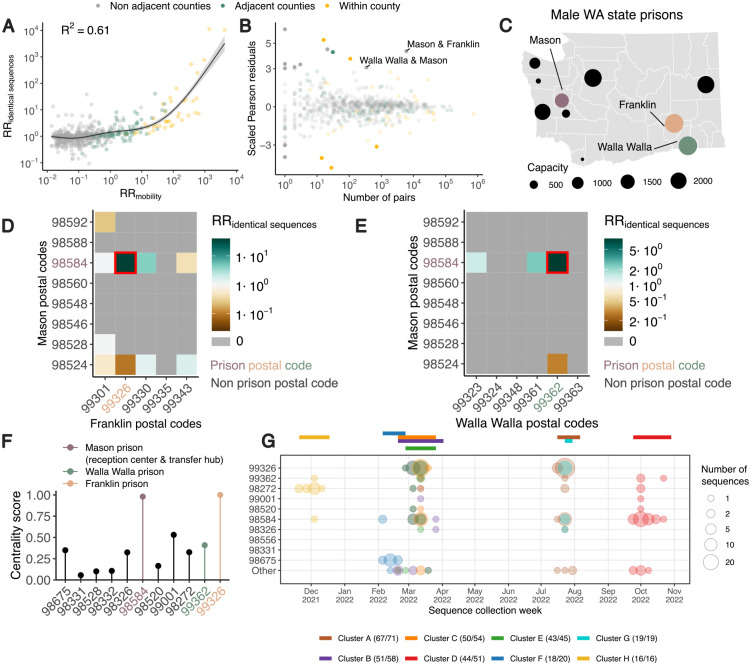
Pathogen genomics can provide insights into underlying infectious disease transmission patterns, but new methods are needed to handle modern large-scale pathogen genome datasets and realize this full potential. In particular, genetically proximal viruses should be highly informative about transmission events as genetic proximity indicates epidemiological linkage. Here, we leverage pairs of identical sequences to characterise fine-scale transmission patterns using 114,298 SARS-CoV-2 genomes collected through Washington State (USA) genomic sentinel surveillance with associated age and residence location information between March 2021 and December 2022. This corresponds to 59,660 sequences with another identical sequence in the dataset. We find that the location of pairs of identical sequences is highly consistent with expectations from mobility and social contact data. Outliers in the relationship between genetic and mobility data can be explained by SARS-CoV-2 transmission between postal codes with male prisons, consistent with transmission between prison facilities. We find that transmission patterns between age groups vary across spatial scales. Finally, we use the timing of sequence collection to understand the age groups driving transmission. Overall, this work improves our ability to leverage large pathogen genome datasets to understand the determinants of infectious disease spread.
病原体基因组学能够为洞察潜在的传染病传播模式提供线索,但需要新的方法来处理现代大规模病原体基因组数据集并充分发挥其潜力。特别是,基因相近的病毒对于传播事件应具有高度的信息价值,因为基因相近表明存在流行病学联系。在此,我们利用相同序列对,通过2021年3月至2022年12月期间美国华盛顿州基因组哨点监测收集的114,298个严重急性呼吸综合征冠状病毒2(SARS-CoV-2)基因组以及相关的年龄和居住位置信息,来描绘精细尺度的传播模式。数据集中有59,660个序列与另一个相同序列配对。我们发现,相同序列对的位置与来自流动性和社会接触数据的预期高度一致。基因与流动性数据之间关系的异常值可以用SARS-CoV-2在设有男性监狱的邮政编码区域之间的传播来解释,这与监狱设施之间的传播情况相符。我们发现不同年龄组之间的传播模式在不同空间尺度上存在差异。最后,我们利用序列收集的时间来了解驱动传播的年龄组。总体而言,这项工作提高了我们利用大型病原体基因组数据集来理解传染病传播决定因素的能力。