Bedford Trevor, Greninger Alexander L, Roychoudhury Pavitra, Starita Lea M, Famulare Michael, Huang Meei-Li, Nalla Arun, Pepper Gregory, Reinhardt Adam, Xie Hong, Shrestha Lasata, Nguyen Truong N, Adler Amanda, Brandstetter Elisabeth, Cho Shari, Giroux Danielle, Han Peter D, Fay Kairsten, Frazar Chris D, Ilcisin Misja, Lacombe Kirsten, Lee Jover, Kiavand Anahita, Richardson Matthew, Sibley Thomas R, Truong Melissa, Wolf Caitlin R, Nickerson Deborah A, Rieder Mark J, Englund Janet A, Hadfield James, Hodcroft Emma B, Huddleston John, Moncla Louise H, Müller Nicola F, Neher Richard A, Deng Xianding, Gu Wei, Federman Scot, Chiu Charles, Duchin Jeff, Gautom Romesh, Melly Geoff, Hiatt Brian, Dykema Philip, Lindquist Scott, Queen Krista, Tao Ying, Uehara Anna, Tong Suxiang, MacCannell Duncan, Armstrong Gregory L, Baird Geoffrey S, Chu Helen Y, Shendure Jay, Jerome Keith R
Fred Hutchinson Cancer Research Center, Seattle, WA USA.
Brotman Baty Institute for Precision Medicine, Seattle, WA USA.
medRxiv. 2020 Apr 6:2020.04.02.20051417. doi: 10.1101/2020.04.02.20051417.
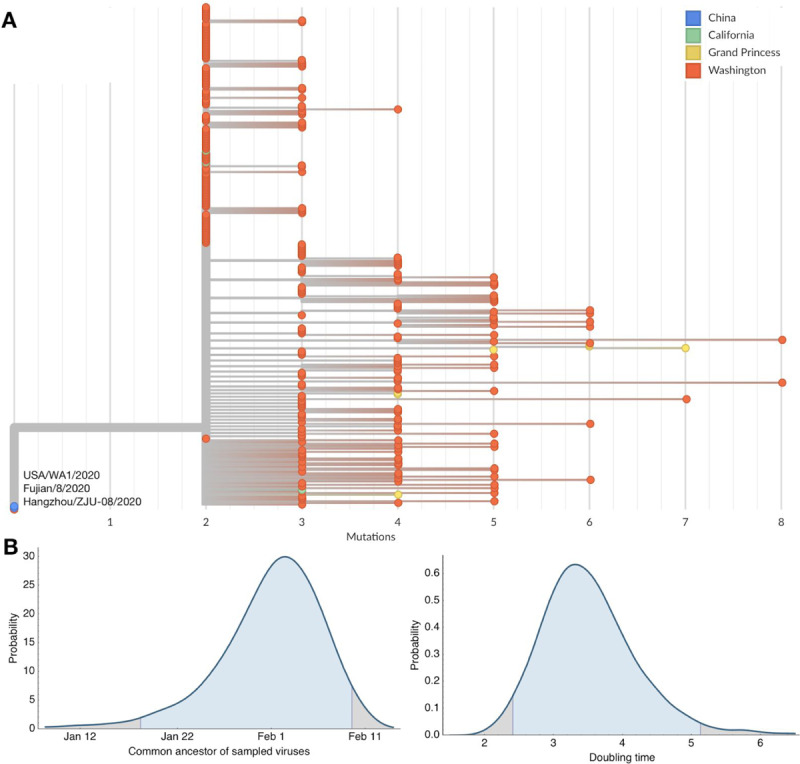
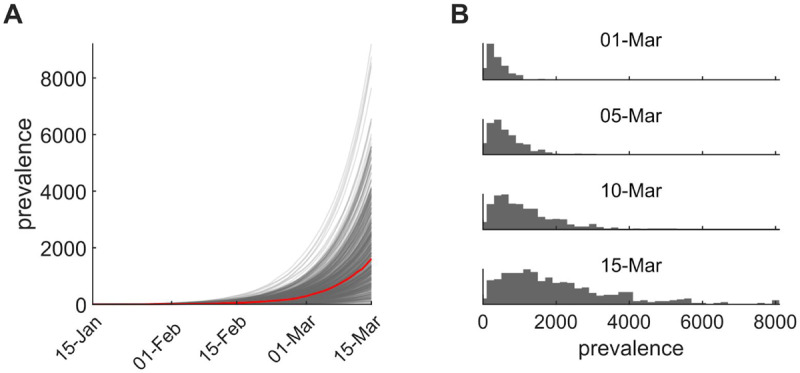
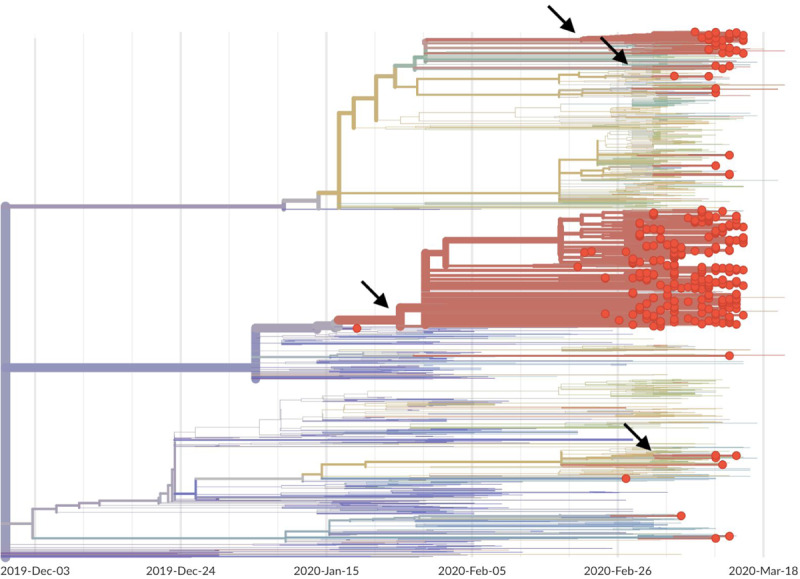
Following its emergence in Wuhan, China, in late November or early December 2019, the SARS-CoV-2 virus has rapidly spread throughout the world. On March 11, 2020, the World Health Organization declared Coronavirus Disease 2019 (COVID-19) a pandemic. Genome sequencing of SARS-CoV-2 strains allows for the reconstruction of transmission history connecting these infections. Here, we analyze 346 SARS-CoV-2 genomes from samples collected between 20 February and 15 March 2020 from infected patients in Washington State, USA. We found that the large majority of SARS-CoV-2 infections sampled during this time frame appeared to have derived from a single introduction event into the state in late January or early February 2020 and subsequent local spread, strongly suggesting cryptic spread of COVID-19 during the months of January and February 2020, before active community surveillance was implemented. We estimate a common ancestor of this outbreak clade as occurring between 18 January and 9 February 2020. From genomic data, we estimate an exponential doubling between 2.4 and 5.1 days. These results highlight the need for large-scale community surveillance for SARS-CoV-2 introductions and spread and the power of pathogen genomics to inform epidemiological understanding.
2019年11月下旬或12月初在中国武汉出现后,严重急性呼吸综合征冠状病毒2(SARS-CoV-2)迅速在全球传播。2020年3月11日,世界卫生组织宣布2019冠状病毒病(COVID-19)为大流行病。对SARS-CoV-2毒株进行基因组测序有助于重建这些感染之间的传播历史。在此,我们分析了2020年2月20日至3月15日期间从美国华盛顿州感染患者样本中获取的346个SARS-CoV-2基因组。我们发现,在此时间段内采样的绝大多数SARS-CoV-2感染似乎源自2020年1月下旬或2月初该州的一次单一引入事件及随后的本地传播,这有力地表明在2020年1月和2月实施积极社区监测之前,COVID-19就已在隐秘传播。我们估计此次疫情分支的共同祖先出现在2020年1月18日至2月9日之间。根据基因组数据,我们估计倍增时间在2.4至5.1天之间呈指数增长。这些结果凸显了对SARS-CoV-2的引入和传播进行大规模社区监测的必要性,以及病原体基因组学在增进流行病学理解方面的作用。