Singh Akanksha, Schooley Benjamin, Mobley Jack, Mobley Patrick, Lindros Sydney, Brooks John M, Floyd Sarah B
University of Alabama at Birmingham.
Ira A. Fulton College of Engineering, Brigham Young University.
Res Sq. 2024 May 21:rs.3.rs-4359437. doi: 10.21203/rs.3.rs-4359437/v1.
Rich data on diverse patients and their treatments and outcomes within Electronic Health Record (EHR) systems can be used to generate real world evidence. A health recommender system (HRS) framework can be applied to a decision support system application to generate data summaries for similar patients during the clinical encounter to assist physicians and patients in making evidence-based shared treatment decisions.
A human-centered design (HCD) process was used to develop a HRS for treatment decision support in orthopaedic medicine, the . We also evaluate the usability and utility of the system from the physician's perspective, focusing on elements of utility and shared decision-making in orthopaedic medicine.
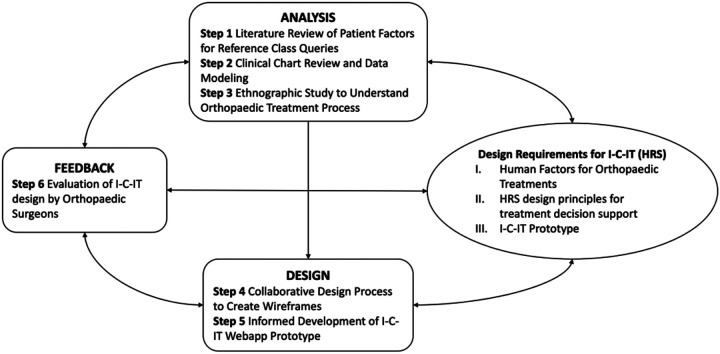
The HCD process for I-C-IT included 6 steps across three phases of analysis, design, and evaluation. A team of informaticians and comparative effectiveness researchers directly engaged with orthopaedic surgeon subject matter experts in a collaborative I-C-IT prototype design process. Ten orthopaedic surgeons participated in a mixed methods evaluation of the I-C-IT prototype that was produced.
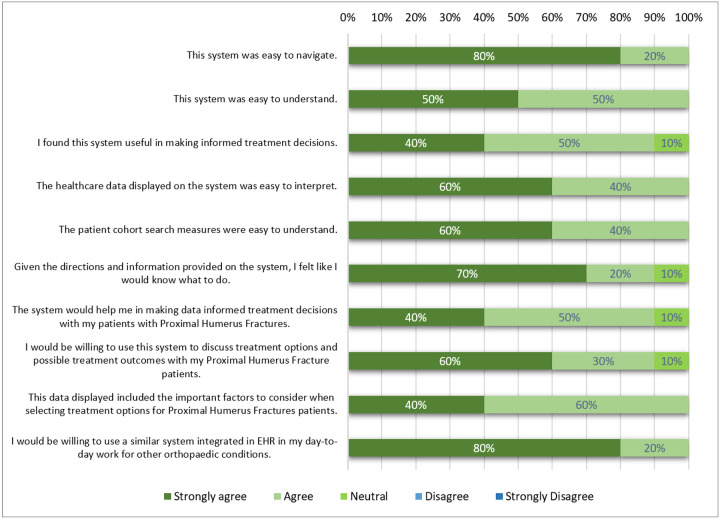
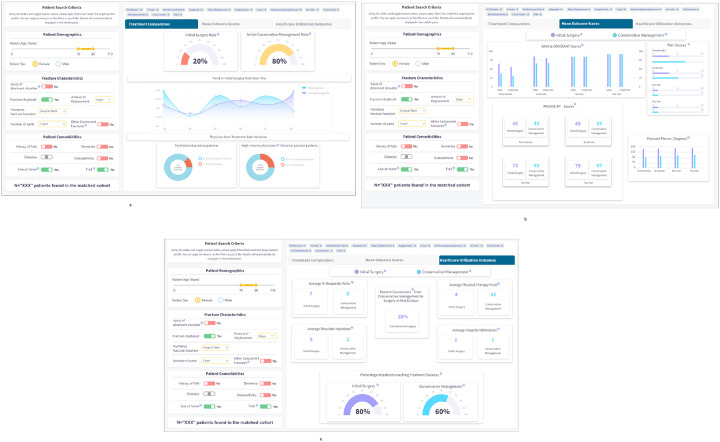
The HCD process resulted in a prototype system, I-C-IT, with 14 data visualization elements and a set of design principles crucial for HRS for decision support. The overall standard system usability scale (SUS) score for the I-C-IT Webapp prototype was 88.75 indicating high usability. In addition, utility questions addressing shared decision-making found that 90% of orthopaedic surgeon respondents either strongly agreed or agreed that I-C-IT would help them make data informed decisions with their patients.
The HCD process produced an HRS prototype that is capable of supporting orthopaedic surgeons and patients in their information needs during clinical encounters. Future research should focus on refining I-C-IT by incorporating patient feedback in future iterative cycles of system design and evaluation.
电子健康记录(EHR)系统中有关不同患者及其治疗和结果的丰富数据可用于生成真实世界证据。健康推荐系统(HRS)框架可应用于决策支持系统应用程序,以便在临床会诊期间为相似患者生成数据摘要,以协助医生和患者做出基于证据的共同治疗决策。
采用以人为本的设计(HCD)流程来开发用于骨科医学治疗决策支持的HRS,即I-C-IT。我们还从医生的角度评估该系统的可用性和实用性,重点关注骨科医学中的实用性和共同决策要素。
I-C-IT的HCD流程包括分析、设计和评估三个阶段的6个步骤。一组信息学家和比较效果研究人员在协作的I-C-IT原型设计过程中直接与骨科外科主题专家合作。10名骨科外科医生参与了对所产生的I-C-IT原型的混合方法评估。
HCD流程产生了一个原型系统I-C-IT,它有14个数据可视化元素以及一组对用于决策支持的HRS至关重要的设计原则。I-C-IT网络应用程序原型的总体标准系统可用性量表(SUS)得分为88.75,表明可用性高。此外,针对共同决策的实用性问题发现,90%的骨科外科医生受访者要么强烈同意要么同意I-C-IT将帮助他们与患者做出基于数据的决策。
HCD流程产生了一个HRS原型,该原型能够在临床会诊期间支持骨科外科医生和患者满足他们的信息需求。未来的研究应侧重于在系统设计和评估的未来迭代周期中纳入患者反馈来完善I-C-IT。