Linder Haley F, Berger Larry L, McCann Joshua C
Department of Animal Sciences, University of Illinois Urbana-Champaign, Urbana, IL 61801, USA.
Transl Anim Sci. 2024 May 27;8:txae084. doi: 10.1093/tas/txae084. eCollection 2024.
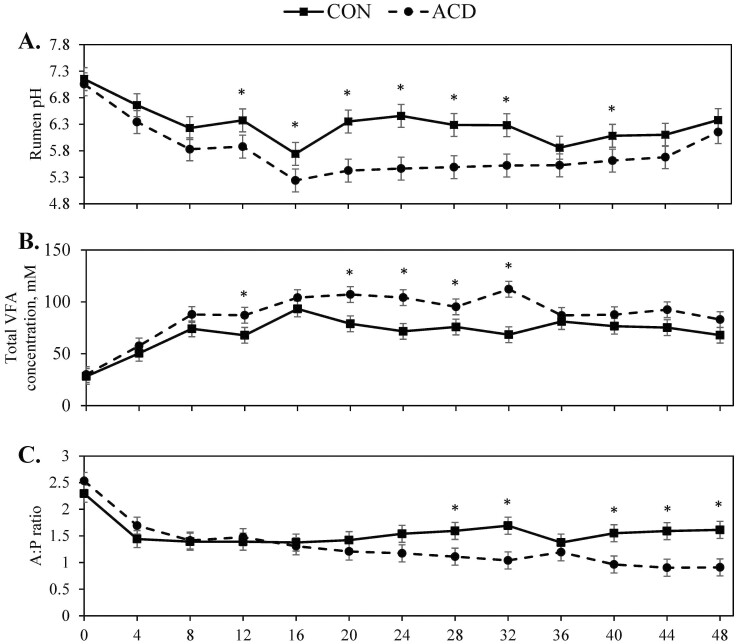
The objective was to determine the effects of induced acidosis in the late-finishing phase on rumen fermentation in feedlot steers. Eleven ruminally cannulated steers (body weight [BW] = 795 kg ± 54) were blocked into two groups based on initial BW. For 195 d prior to the start of the study, cattle were consuming a basal finishing diet (60% dry-rolled corn, 15% modified distillers grains, 15% corn silage, and 10% ground corn-based supplement). Steers were randomly assigned to one of the two treatments: control (), or induced acidosis (). Both treatments were fasted for 24 h then fed the basal finishing diet. Steers on the ACD treatment received 0.05% of BW of wheat starch via rumen cannula at 0800 and 2000 hours on day 1 and ad libitum refeeding following the fast. On days 1 and 2, CON steers were provided 25% of allotted feed every 6 h. Rumen fluid was collected every 4 h during the challenge period (hours 0 to 48), and 0, 6, and 12 h after feeding during the recovery period (hours 54 to 96). Rumen fluid was analyzed for pH, ammonia, volatile fatty acids (), and lactate. Fecal grab samples were collected every 8 h to determine fecal pH. A treatment × day interaction (= 0.03) was observed for dry matter intake during the challenge period with steers on the ACD treatments consuming more on day 1 than CON steers. Intake was not different on day 2 ( = 0.88). A treatment × hour effect (< 0.01) was observed for ruminal pH during the challenge period with the ACD steers having a lesser pH than CON from hours 12 to 32. Duration of time below a pH of 5.6 during the challenge period was greater ( < 0.01) for ACD steers than CON. During the challenge period, a treatment × time interaction (= 0.04) was observed for total VFA concentration with ACD steers having greater total VFA concentration from hours 12 to 36. Acetate to propionate ratio (A:P) was affected by treatment × hour ( = 0.04) with CON steers having greater A:P from hours 28 to 48. Rumen ammonia and lactate concentrations did not differ ( ≥ 0.25) between treatments or the interaction with time. Challenge and recovery period fecal pH were not affected (≥ 0.13) by treatment, time, or their interaction. Recovery period ruminal pH was not different (= 0.99) between treatments. For the recovery period, total VFA and ammonia concentration were not affected by treatment, time, or their interaction (≥ 0.07). Ruminal pH and VFA were affected in the initial 48 h of induced acidosis in the late-finishing phase.
本研究目的是确定育肥后期诱导酸中毒对育肥牛瘤胃发酵的影响。11头安装了瘤胃瘘管的育肥牛(体重[BW]=795千克±54)根据初始体重被分为两组。在研究开始前的195天里,牛群采食基础育肥日粮(60%干碾压玉米、15%改性酒糟、15%玉米青贮和10%玉米粉基补充料)。育肥牛被随机分配到两种处理之一:对照组()或诱导酸中毒组()。两种处理均禁食24小时,然后饲喂基础育肥日粮。诱导酸中毒处理组的育肥牛在第1天的08:00和20:00通过瘤胃瘘管接受0.05%体重的小麦淀粉,并在禁食后自由采食。在第1天和第2天,对照组育肥牛每6小时提供25%的分配饲料量。在挑战期(0至48小时)每4小时采集一次瘤胃液,在恢复期(54至96小时)采食后0、6和12小时采集瘤胃液。分析瘤胃液的pH值、氨、挥发性脂肪酸()和乳酸。每8小时采集一次粪便抓取样本以测定粪便pH值。在挑战期观察到干物质采食量存在处理×日交互作用(=0.03),诱导酸中毒处理组的育肥牛在第1天的采食量高于对照组。第2天的采食量无差异(=0.88)。在挑战期观察到瘤胃pH值存在处理×小时效应(<0.01),诱导酸中毒组育肥牛在12至32小时的pH值低于对照组。诱导酸中毒组育肥牛在挑战期pH值低于5.6的持续时间比对照组更长(<0.01)。在挑战期,观察到总挥发性脂肪酸浓度存在处理×时间交互作用(=0.04),诱导酸中毒组育肥牛在12至36小时的总挥发性脂肪酸浓度更高。乙酸与丙酸比值(A:P)受处理×小时影响(=0.04),对照组育肥牛在28至48小时的A:P更高。瘤胃氨和乳酸浓度在处理间或与时间的交互作用方面无差异(≥0.25)。挑战期和恢复期的粪便pH值不受处理、时间或其交互作用的影响(≥0.13)。恢复期瘤胃pH值在处理间无差异(=0.99)。在恢复期,总挥发性脂肪酸和氨浓度不受处理、时间或其交互作用的影响(≥0.07)。育肥后期诱导酸中毒的最初48小时内瘤胃pH值和挥发性脂肪酸受到影响。