Jawaid Masood, Masood Zubia, Imran Nazish
Masood Jawaid Director Medical Affairs, PharmEvo, Karachi, Pakistan.
Dr. Zubia Masood Associate Professor, Dept. of Surgery, Baqai Medical University, Karachi, Pakistan.
Pak J Med Sci. 2024 May-Jun;40(5):913-917. doi: 10.12669/pjms.40.5.1048.
The variability and opportunistic nature of surgical clinical education is the main problem for effective teaching and training of medical students. Incorporating online mediums including discussion forums, interactive videos/scenarios, static pages, and quizzes is known as blended learning (BL). This study aimed to compare the intrinsic motivation of surgical students enrolled in blended learning to those enrolled in face-to-face teaching (f2f teaching).
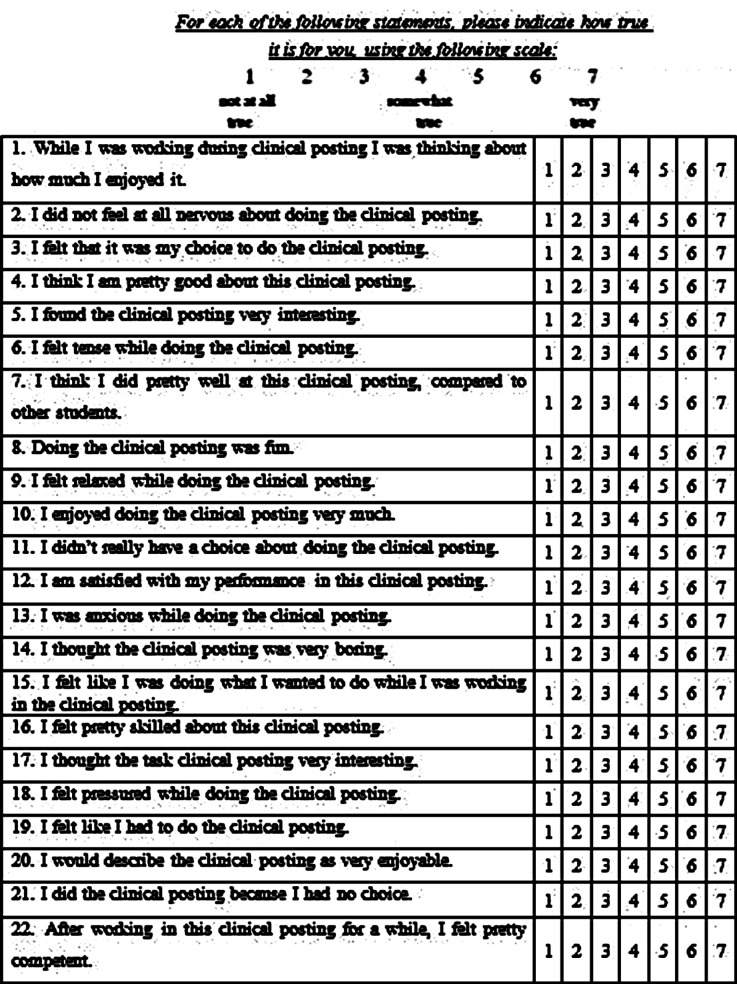
A quasi-experimental, cross-over study was conducted in Surgical Unit-I and Surgical Unit-II of Dow University Hospital, Karachi, from March to August 2014. A total of 31 students participated and were exposed to two different teachings. For the first four weeks, Group A was posted in Surgical-I (f2f teaching) and Group B in Surgical-II (BL). Both groups were taught the same contents with the same schedule. The F2F group had clinical exposure to real patients, and small group discussions (SGDs) while The BL group students were exposed to an additional online learning component. Intrinsic Motivation Inventory (IMI) was administered at the end of four weeks and groups were swapped. Exchanged groups were again taught the same contents with the same schedule for another four weeks and IMI was administered.
Fifty-eight students completed IMI; 28 in f2f and 30 in BL group. There was a significant difference in all four subscales of IMI between the two groups. In three subscales, students in BL were more motivated as compared to f2f (p<0.01). Students in f2f experienced more perceived tension than in BL (p<0.048).
This study concluded that blended surgical learning programs keep medical students more intrinsically motivated to learn. By utilizing online learning, superior educational opportunities for students can be cultivated. It can result in enhanced faculty effectiveness and efficiency as well.
外科临床教育的多变性和机会主义性质是医学生有效教学和培训的主要问题。将包括讨论论坛、交互式视频/场景、静态页面和测验在内的在线媒介纳入其中被称为混合式学习(BL)。本研究旨在比较参加混合式学习的外科学生与参加面对面教学(f2f教学)的学生的内在学习动机。
2014年3月至8月,在卡拉奇道氏大学医院的第一外科病房和第二外科病房进行了一项准实验性交叉研究。共有31名学生参与,接受两种不同的教学。前四周,A组在第一外科病房(f2f教学),B组在第二外科病房(BL)。两组按相同的时间表教授相同的内容。面对面教学组有机会接触真实患者并进行小组讨论(SGDs),而混合式学习组的学生还需参与额外的在线学习内容。四周结束时进行内在动机量表(IMI)测试,然后两组互换。互换后的两组再次按相同时间表教授相同内容,为期四周,之后再次进行IMI测试。
58名学生完成了IMI测试;面对面教学组28名,混合式学习组30名。两组在IMI的所有四个子量表上均存在显著差异。在三个子量表中,混合式学习组的学生比面对面教学组的学生更有学习动力(p<0.01)。面对面教学组的学生比混合式学习组的学生感受到更多的紧张情绪(p<0.048)。
本研究得出结论,混合式外科学习项目能让医学生更有内在学习动力。通过利用在线学习,可以为学生创造更好的教育机会。这也可以提高教师的教学效果和效率。