Perinatal Research Centre, Obstetrics and Gynaecology, School of Medicine, University College Dublin, Dublin, Ireland.
School of Computer Science, University College Dublin, Dublin, Ireland.
J Med Internet Res. 2022 Feb 1;24(2):e30082. doi: 10.2196/30082.
There is a lack of evidence in the literature regarding the learning outcomes of immersive technologies as educational tools for teaching university-level health care students.
The aim of this review is to assess the learning outcomes of immersive technologies compared with traditional learning modalities with regard to knowledge and the participants' learning experience in medical, midwifery, and nursing preclinical university education.
A systematic review was conducted according to the Cochrane Collaboration guidelines. Randomized controlled trials comparing traditional learning methods with virtual, augmented, or mixed reality for the education of medicine, nursing, or midwifery students were evaluated. The identified studies were screened by 2 authors independently. Disagreements were discussed with a third reviewer. The quality of evidence was assessed using the Medical Education Research Study Quality Instrument (MERSQI). The review protocol was registered with PROSPERO (International Prospective Register of Systematic Reviews) in April 2020.
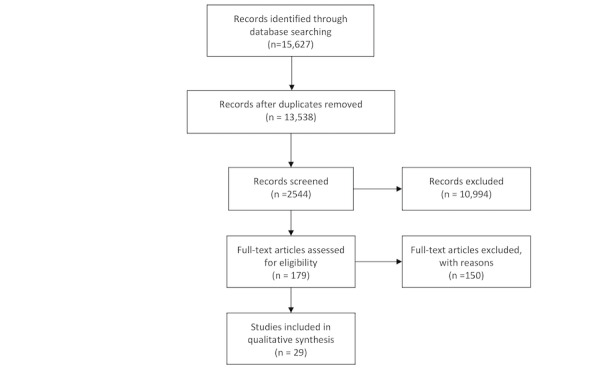
Of 15,627 studies, 29 (0.19%) randomized controlled trials (N=2722 students) were included and evaluated using the MERSQI tool. Knowledge gain was found to be equal when immersive technologies were compared with traditional learning modalities; however, the learning experience increased with immersive technologies. The mean MERSQI score was 12.64 (SD 1.6), the median was 12.50, and the mode was 13.50. Immersive technology was predominantly used to teach clinical skills (15/29, 52%), and virtual reality (22/29, 76%) was the most commonly used form of immersive technology. Knowledge was the primary outcome in 97% (28/29) of studies. Approximately 66% (19/29) of studies used validated instruments and scales to assess secondary learning outcomes, including satisfaction, self-efficacy, engagement, and perceptions of the learning experience. Of the 29 studies, 19 (66%) included medical students (1706/2722, 62.67%), 8 (28%) included nursing students (727/2722, 26.71%), and 2 (7%) included both medical and nursing students (289/2722, 10.62%). There were no studies involving midwifery students. The studies were based on the following disciplines: anatomy, basic clinical skills and history-taking skills, neurology, respiratory medicine, acute medicine, dermatology, communication skills, internal medicine, and emergency medicine.
Virtual, augmented, and mixed reality play an important role in the education of preclinical medical and nursing university students. When compared with traditional educational modalities, the learning gain is equal with immersive technologies. Learning outcomes such as student satisfaction, self-efficacy, and engagement all increase with the use of immersive technology, suggesting that it is an optimal tool for education.
在医学专业学术文献中,沉浸式技术作为大学水平的医疗保健学生教学工具的学习成果证据不足。
本综述旨在评估沉浸式技术的学习成果,与传统学习模式相比,其在医学、助产和护理基础大学教育中的知识和参与者学习体验方面的学习成果。
根据 Cochrane 协作组指南进行系统评价。评估了将虚拟、增强或混合现实与医学、护理或助产学生教育的传统学习方法进行比较的随机对照试验。由 2 位作者独立筛选确定的研究。意见分歧与第三位审稿人讨论。使用医学教育研究研究质量工具(MERSQI)评估证据质量。审查方案于 2020 年 4 月在 PROSPERO(国际前瞻性系统评价注册库)中注册。
在 15627 项研究中,有 29 项(0.19%)随机对照试验(N=2722 名学生)被纳入并使用 MERSQI 工具进行评估。当将沉浸式技术与传统学习模式进行比较时,发现知识的获取是相等的;然而,使用沉浸式技术会增加学习体验。平均 MERSQI 得分为 12.64(SD 1.6),中位数为 12.50,模式为 13.50。沉浸式技术主要用于教授临床技能(15/29,52%),虚拟现实(22/29,76%)是最常用的沉浸式技术形式。知识是 97%(28/29)研究的主要结果。大约 66%(19/29)的研究使用经过验证的工具和量表来评估次要学习结果,包括满意度、自我效能感、参与度和对学习体验的看法。在 29 项研究中,有 19 项(66%)包括医学生(2722 名中的 1706 名,62.67%),8 项(28%)包括护理学生(2722 名中的 727 名,26.71%),2 项(7%)包括医学生和护理学生(2722 名中的 289 名,10.62%)。没有涉及助产学学生的研究。研究基于以下学科:解剖学、基础临床技能和问诊技能、神经病学、呼吸医学、急性医学、皮肤病学、沟通技巧、内科和急诊医学。
虚拟、增强和混合现实在基础医学和护理大学生教育中发挥着重要作用。与传统教育模式相比,沉浸式技术的学习效果相等。学生满意度、自我效能感和参与度等学习成果都随着沉浸式技术的使用而提高,这表明它是一种最佳的教育工具。