• 文献检索
  • 文档翻译
  • 深度研究
  • 学术资讯
  • Suppr Zotero 插件Zotero 插件
  • 邀请有礼
  • 套餐&价格
  • 历史记录
应用&插件
Suppr Zotero 插件Zotero 插件浏览器插件Mac 客户端Windows 客户端微信小程序
定价
高级版会员购买积分包购买API积分包
服务
文献检索文档翻译深度研究API 文档MCP 服务
关于我们
关于 Suppr公司介绍联系我们用户协议隐私条款
关注我们

Suppr 超能文献

核心技术专利:CN118964589B侵权必究
粤ICP备2023148730 号-1Suppr @ 2026

文献检索

告别复杂PubMed语法,用中文像聊天一样搜索,搜遍4000万医学文献。AI智能推荐,让科研检索更轻松。

立即免费搜索

文件翻译

保留排版,准确专业,支持PDF/Word/PPT等文件格式,支持 12+语言互译。

免费翻译文档

深度研究

AI帮你快速写综述,25分钟生成高质量综述,智能提取关键信息,辅助科研写作。

立即免费体验

用于重症监护病房收治的老年患者谵妄早期预测的可解释机器学习模型:一项推导与验证研究。

Interpretable machine learning model for early prediction of delirium in elderly patients following intensive care unit admission: a derivation and validation study.

作者信息

Tang Dayu, Ma Chengyong, Xu Yu

机构信息

Department of Critical Care Medicine, West China Hospital, Sichuan University, Chengdu, China.

出版信息

Front Med (Lausanne). 2024 May 17;11:1399848. doi: 10.3389/fmed.2024.1399848. eCollection 2024.

DOI:10.3389/fmed.2024.1399848
PMID:38828233
原文链接:https://pmc.ncbi.nlm.nih.gov/articles/PMC11140063/
Abstract

BACKGROUND AND OBJECTIVE

Delirium is the most common neuropsychological complication among older adults admitted to the intensive care unit (ICU) and is often associated with a poor prognosis. This study aimed to construct and validate an interpretable machine learning (ML) for early delirium prediction in older ICU patients.

METHODS

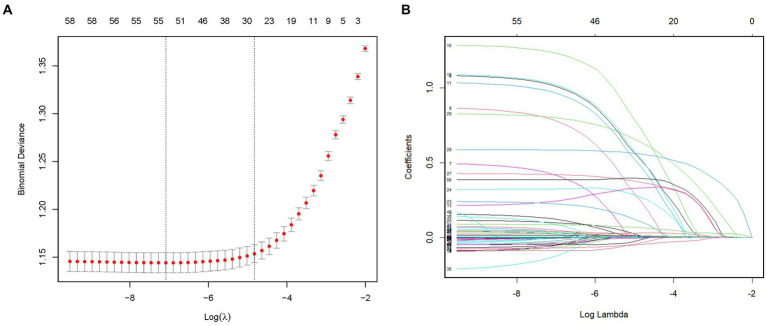
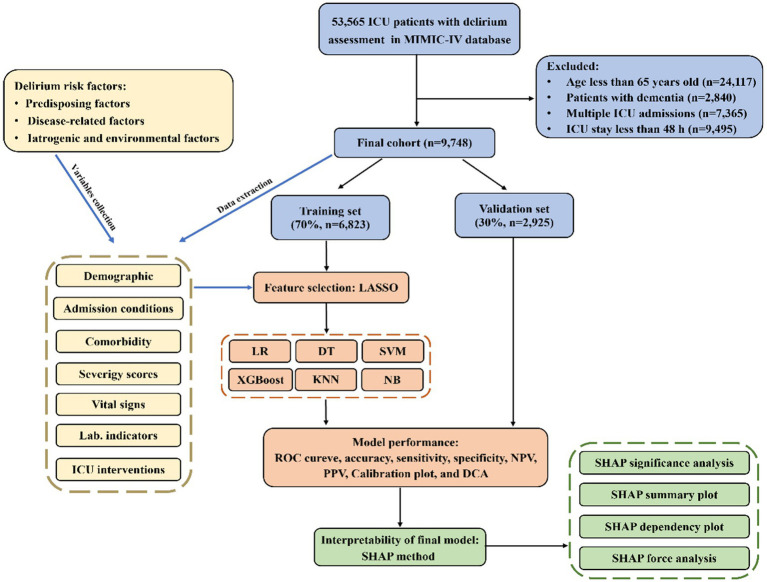
This was a retrospective observational cohort study and patient data were extracted from the Medical Information Mart for Intensive Care-IV database. Feature variables associated with delirium, including predisposing factors, disease-related factors, and iatrogenic and environmental factors, were selected using least absolute shrinkage and selection operator regression, and prediction models were built using logistic regression, decision trees, support vector machines, extreme gradient boosting (XGBoost), k-nearest neighbors and naive Bayes methods. Multiple metrics were used for evaluation of performance of the models, including the area under the receiver operating characteristic curve (AUC), accuracy, sensitivity, specificity, recall, F1 score, calibration plot, and decision curve analysis. SHapley Additive exPlanations (SHAP) were used to improve the interpretability of the final model.

RESULTS

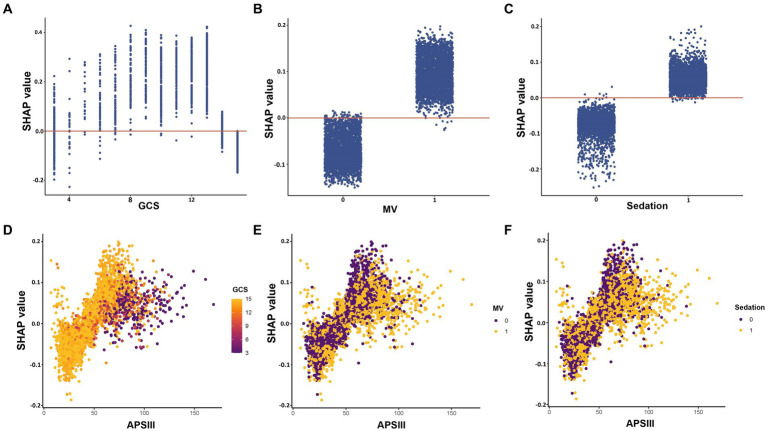
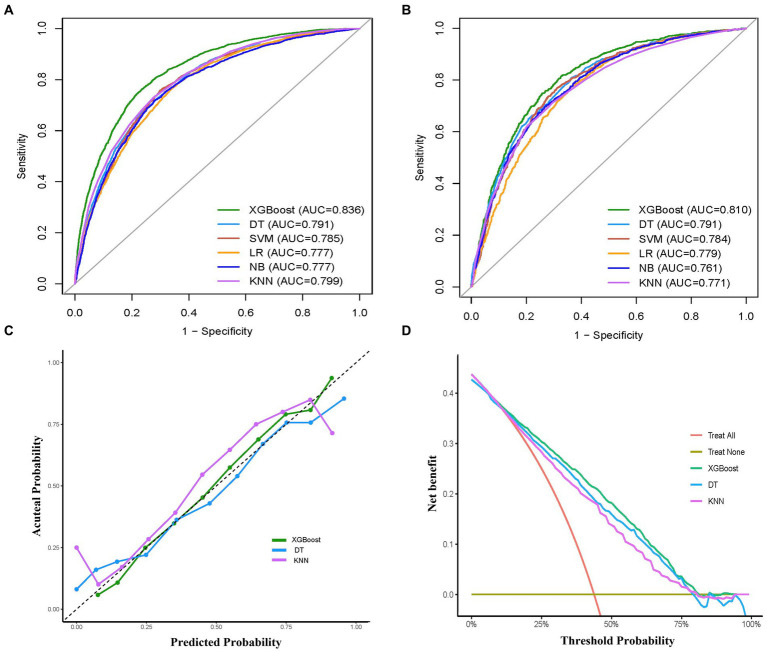
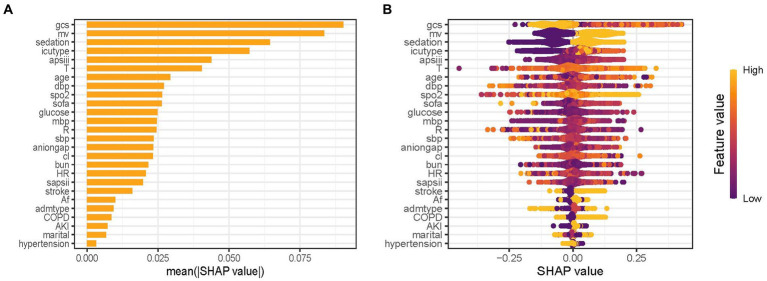
Nine thousand seven hundred forty-eight adults aged 65 years or older were included for analysis. Twenty-six features were selected to construct ML prediction models. Among the models compared, the XGBoost model demonstrated the best performance including the highest AUC (0.836), accuracy (0.765), sensitivity (0.713), recall (0.713), and F1 score (0.725) in the training set. It also exhibited excellent discrimination with AUC of 0.810, good calibration, and had the highest net benefit in the validation cohort. The SHAP summary analysis showed that Glasgow Coma Scale, mechanical ventilation, and sedation were the top three risk features for outcome prediction. The SHAP dependency plot and SHAP force analysis interpreted the model at both the factor level and individual level, respectively.

CONCLUSION

ML is a reliable tool for predicting the risk of critical delirium in elderly patients. By combining XGBoost and SHAP, it can provide clear explanations for personalized risk prediction and more intuitive understanding of the effect of key features in the model. The establishment of such a model would facilitate the early risk assessment and prompt intervention for delirium.

摘要

背景与目的

谵妄是入住重症监护病房(ICU)的老年人中最常见的神经心理并发症,且常与不良预后相关。本研究旨在构建并验证一种可解释的机器学习(ML)模型,用于预测老年ICU患者的早期谵妄。

方法

这是一项回顾性观察队列研究,患者数据从重症监护医学信息集市-IV数据库中提取。使用最小绝对收缩和选择算子回归选择与谵妄相关的特征变量,包括易感因素、疾病相关因素以及医源性和环境因素,并使用逻辑回归、决策树、支持向量机、极端梯度提升(XGBoost)、k近邻和朴素贝叶斯方法构建预测模型。使用多种指标评估模型性能,包括受试者操作特征曲线下面积(AUC)、准确性、敏感性、特异性、召回率、F1分数、校准图和决策曲线分析。使用SHapley加法解释(SHAP)来提高最终模型的可解释性。

结果

纳入9748名65岁及以上的成年人进行分析。选择26个特征构建ML预测模型。在比较的模型中,XGBoost模型在训练集中表现最佳,包括最高的AUC(0.836)、准确性(0.765)、敏感性(0.713)、召回率(0.713)和F1分数(0.725)。在验证队列中,它还表现出良好的区分度,AUC为0.810,校准良好,净效益最高。SHAP汇总分析表明,格拉斯哥昏迷量表、机械通气和镇静是结局预测的前三大风险特征。SHAP依赖图和SHAP力分析分别在因素层面和个体层面解释了模型。

结论

ML是预测老年患者严重谵妄风险的可靠工具。通过结合XGBoost和SHAP,它可以为个性化风险预测提供清晰解释,并更直观地理解模型中关键特征的作用。建立这样的模型将有助于谵妄的早期风险评估和及时干预。
https://cdn.ncbi.nlm.nih.gov/pmc/blobs/ed11/11140063/9d8ab991d4ef/fmed-11-1399848-g005.jpg
https://cdn.ncbi.nlm.nih.gov/pmc/blobs/ed11/11140063/679cf28f374e/fmed-11-1399848-g001.jpg
https://cdn.ncbi.nlm.nih.gov/pmc/blobs/ed11/11140063/87161b063b23/fmed-11-1399848-g002.jpg
https://cdn.ncbi.nlm.nih.gov/pmc/blobs/ed11/11140063/bf35f123754a/fmed-11-1399848-g003.jpg
https://cdn.ncbi.nlm.nih.gov/pmc/blobs/ed11/11140063/c49d16be111c/fmed-11-1399848-g004.jpg
https://cdn.ncbi.nlm.nih.gov/pmc/blobs/ed11/11140063/9d8ab991d4ef/fmed-11-1399848-g005.jpg
https://cdn.ncbi.nlm.nih.gov/pmc/blobs/ed11/11140063/679cf28f374e/fmed-11-1399848-g001.jpg
https://cdn.ncbi.nlm.nih.gov/pmc/blobs/ed11/11140063/87161b063b23/fmed-11-1399848-g002.jpg
https://cdn.ncbi.nlm.nih.gov/pmc/blobs/ed11/11140063/bf35f123754a/fmed-11-1399848-g003.jpg
https://cdn.ncbi.nlm.nih.gov/pmc/blobs/ed11/11140063/c49d16be111c/fmed-11-1399848-g004.jpg
https://cdn.ncbi.nlm.nih.gov/pmc/blobs/ed11/11140063/9d8ab991d4ef/fmed-11-1399848-g005.jpg

相似文献

1
Interpretable machine learning model for early prediction of delirium in elderly patients following intensive care unit admission: a derivation and validation study.用于重症监护病房收治的老年患者谵妄早期预测的可解释机器学习模型:一项推导与验证研究。
Front Med (Lausanne). 2024 May 17;11:1399848. doi: 10.3389/fmed.2024.1399848. eCollection 2024.
2
Construction and validation of prognostic models in critically Ill patients with sepsis-associated acute kidney injury: interpretable machine learning approach.建立和验证脓毒症相关性急性肾损伤危重症患者的预后模型:可解释的机器学习方法。
J Transl Med. 2023 Jun 22;21(1):406. doi: 10.1186/s12967-023-04205-4.
3
Interpretable machine learning model for early prediction of 28-day mortality in ICU patients with sepsis-induced coagulopathy: development and validation.用于脓毒症诱导性凝血病 ICU 患者 28 天死亡率早期预测的可解释机器学习模型:开发与验证。
Eur J Med Res. 2024 Jan 3;29(1):14. doi: 10.1186/s40001-023-01593-7.
4
Clinical decision support systems for 3-month mortality in elderly patients admitted to ICU with ischemic stroke using interpretable machine learning.使用可解释机器学习的针对入住重症监护病房的老年缺血性中风患者3个月死亡率的临床决策支持系统
Digit Health. 2024 Sep 17;10:20552076241280126. doi: 10.1177/20552076241280126. eCollection 2024 Jan-Dec.
5
Development of a machine learning-based prediction model for sepsis-associated delirium in the intensive care unit.基于机器学习的 ICU 相关性脓毒症谵妄预测模型的开发。
Sci Rep. 2023 Aug 4;13(1):12697. doi: 10.1038/s41598-023-38650-4.
6
Twenty-eight-day in-hospital mortality prediction for elderly patients with ischemic stroke in the intensive care unit: Interpretable machine learning models.重症监护病房老年缺血性脑卒中患者 28 天住院死亡率预测:可解释的机器学习模型。
Front Public Health. 2023 Jan 12;10:1086339. doi: 10.3389/fpubh.2022.1086339. eCollection 2022.
7
An explainable machine learning-based model to predict intensive care unit admission among patients with community-acquired pneumonia and connective tissue disease.基于可解释机器学习的模型,用于预测社区获得性肺炎和结缔组织病患者入住重症监护病房的情况。
Respir Res. 2024 Jun 18;25(1):246. doi: 10.1186/s12931-024-02874-3.
8
Interpretable machine learning for 28-day all-cause in-hospital mortality prediction in critically ill patients with heart failure combined with hypertension: A retrospective cohort study based on medical information mart for intensive care database-IV and eICU databases.用于预测心力衰竭合并高血压重症患者28天全因院内死亡率的可解释机器学习:一项基于重症监护医学信息集市数据库-IV和电子重症监护病房数据库的回顾性队列研究
Front Cardiovasc Med. 2022 Oct 12;9:994359. doi: 10.3389/fcvm.2022.994359. eCollection 2022.
9
Disability risk prediction model based on machine learning among Chinese healthy older adults: results from the China Health and Retirement Longitudinal Study.基于机器学习的中国健康老年人残疾风险预测模型:来自中国健康与养老追踪调查的结果。
Front Public Health. 2023 Nov 9;11:1271595. doi: 10.3389/fpubh.2023.1271595. eCollection 2023.
10
Interpretable machine learning for predicting 28-day all-cause in-hospital mortality for hypertensive ischemic or hemorrhagic stroke patients in the ICU: a multi-center retrospective cohort study with internal and external cross-validation.用于预测重症监护病房中高血压性缺血性或出血性中风患者28天全因院内死亡率的可解释机器学习:一项具有内部和外部交叉验证的多中心回顾性队列研究
Front Neurol. 2023 Aug 8;14:1185447. doi: 10.3389/fneur.2023.1185447. eCollection 2023.

引用本文的文献

1
Predicting ICU Delirium in Critically Ill COVID-19 Patients Using Demographic, Clinical, and Laboratory Admission Data: A Machine Learning Approach.利用人口统计学、临床和实验室入院数据预测重症 COVID-19 患者的 ICU 谵妄:一种机器学习方法。
Life (Basel). 2025 Jun 30;15(7):1045. doi: 10.3390/life15071045.
2
Development of a risk prediction model for sepsis-related delirium based on multiple machine learning approaches and an online calculator.基于多种机器学习方法和在线计算器开发脓毒症相关性谵妄风险预测模型。
PLoS One. 2025 Jul 16;20(7):e0323831. doi: 10.1371/journal.pone.0323831. eCollection 2025.
3
Development of a Machine Learning-Based Predictive Model for Postoperative Delirium in Older Adult Intensive Care Unit Patients: Retrospective Study.

本文引用的文献

1
Prediction models for postoperative delirium in elderly patients with machine-learning algorithms and SHapley Additive exPlanations.基于机器学习算法和 SHapley 加法解释的老年患者术后谵妄预测模型。
Transl Psychiatry. 2024 Jan 25;14(1):57. doi: 10.1038/s41398-024-02762-w.
2
Explainable artificial intelligence model for mortality risk prediction in the intensive care unit: a derivation and validation study.用于重症监护病房死亡率风险预测的可解释人工智能模型:推导和验证研究。
Postgrad Med J. 2024 Mar 18;100(1182):219-227. doi: 10.1093/postmj/qgad144.
3
Interpretable machine learning model for early prediction of 28-day mortality in ICU patients with sepsis-induced coagulopathy: development and validation.
基于机器学习的老年重症监护病房患者术后谵妄预测模型的开发:一项回顾性研究。
J Med Internet Res. 2025 Jun 19;27:e67258. doi: 10.2196/67258.
4
Development and internal verification of nomogram for forecasting delirium in the elderly admitted to intensive care units: an analysis of MIMIC-IV database.重症监护病房老年患者谵妄预测列线图的开发与内部验证:MIMIC-IV数据库分析
Front Neurol. 2025 May 13;16:1580125. doi: 10.3389/fneur.2025.1580125. eCollection 2025.
5
Machine learning prediction model with shap interpretation for chronic bronchitis risk assessment based on heavy metal exposure: a nationally representative study.基于重金属暴露的慢性支气管炎风险评估的具有SHAP解释的机器学习预测模型:一项全国代表性研究。
BMC Pulm Med. 2025 May 22;25(1):252. doi: 10.1186/s12890-025-03724-8.
6
Enhanced machine learning predictive modeling for delirium in elderly ICU patients with COPD and respiratory failure: A retrospective study based on MIMIC-IV.针对患有慢性阻塞性肺疾病(COPD)和呼吸衰竭的老年重症监护病房(ICU)患者谵妄的增强型机器学习预测建模:一项基于多机构重症监护医学信息库第四版(MIMIC-IV)的回顾性研究
PLoS One. 2025 Mar 20;20(3):e0319297. doi: 10.1371/journal.pone.0319297. eCollection 2025.
用于脓毒症诱导性凝血病 ICU 患者 28 天死亡率早期预测的可解释机器学习模型:开发与验证。
Eur J Med Res. 2024 Jan 3;29(1):14. doi: 10.1186/s40001-023-01593-7.
4
Interpretable machine learning models for predicting venous thromboembolism in the intensive care unit: an analysis based on data from 207 centers.用于预测重症监护病房静脉血栓栓塞症的可解释机器学习模型:基于来自 207 个中心的数据的分析。
Crit Care. 2023 Oct 24;27(1):406. doi: 10.1186/s13054-023-04683-4.
5
Predictive Modeling Using Artificial Intelligence and Machine Learning Algorithms on Electronic Health Record Data: Advantages and Challenges.基于电子健康记录数据的人工智能和机器学习算法的预测建模:优势与挑战。
Crit Care Clin. 2023 Oct;39(4):647-673. doi: 10.1016/j.ccc.2023.02.001. Epub 2023 Apr 26.
6
Inclusion of frailty improved performance of delirium prediction for elderly patients in the cardiac intensive care unit (D-FRAIL): A prospective derivation and external validation study.纳入衰弱因素可改善心脏重症监护病房老年患者谵妄预测模型的性能(D-FRAIL):一项前瞻性推导和外部验证研究。
Int J Nurs Stud. 2023 Nov;147:104582. doi: 10.1016/j.ijnurstu.2023.104582. Epub 2023 Aug 6.
7
Interpretable machine-learning model for real-time, clustered risk factor analysis of sepsis and septic death in critical care.用于重症监护中脓毒症和脓毒症死亡实时、聚类风险因素分析的可解释机器学习模型。
Comput Methods Programs Biomed. 2023 Nov;241:107772. doi: 10.1016/j.cmpb.2023.107772. Epub 2023 Aug 20.
8
Development of a machine learning-based prediction model for sepsis-associated delirium in the intensive care unit.基于机器学习的 ICU 相关性脓毒症谵妄预测模型的开发。
Sci Rep. 2023 Aug 4;13(1):12697. doi: 10.1038/s41598-023-38650-4.
9
A clinically applicable prediction model for the risk of in-hospital mortality in solid cancer patients admitted to intensive care units with sepsis.一种适用于临床的预测模型,用于预测因败血症入住重症监护病房的实体瘤患者的住院死亡率。
J Cancer Res Clin Oncol. 2023 Aug;149(10):7175-7185. doi: 10.1007/s00432-023-04661-x. Epub 2023 Mar 8.
10
MIMIC-IV, a freely accessible electronic health record dataset.MIMIC-IV,一个可自由访问的电子健康记录数据集。
Sci Data. 2023 Jan 3;10(1):1. doi: 10.1038/s41597-022-01899-x.