Carvalho-Sauer Rita, Costa Maria da Conceição Nascimento, Teixeira Maria Gloria, Flores-Ortiz Renzo, Leal Jessidenes Teixeira de Freitas Mendes, Saavedra Ramon, Paixao Enny S
State Health Department of Bahia, Institute of Collective Health of the Federal University of Bahia, Brazil.
Institute of Collective Health of the Federal University of Bahia, Brazil.
Lancet Reg Health Am. 2024 May 23;35:100774. doi: 10.1016/j.lana.2024.100774. eCollection 2024 Jul.
Few studies have evaluated the effects of the Coronavirus disease 2019 (COVID-19) pandemic, caused by the SARS-CoV-2 virus, on maternal and perinatal health at a populational level. We investigated maternal and perinatal health indicators in Brazil, focusing on the effects of the COVID-19 pandemic, and SARS-CoV-2 vaccination campaign for pregnant women.
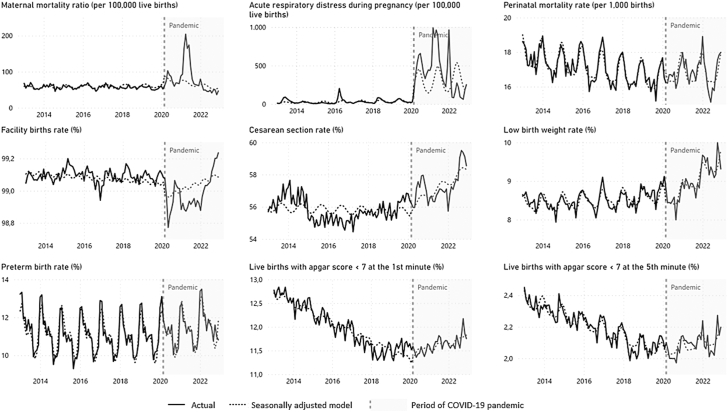
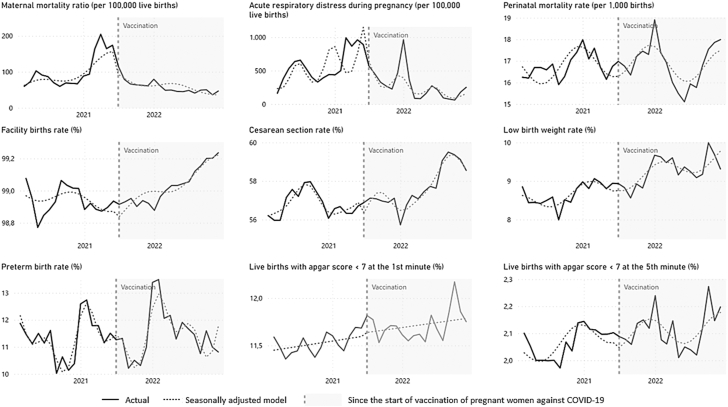
Utilizing interrupted time series analysis (January 2013-December 2022), we examined Maternal Mortality Ratio, Perinatal Mortality Rate, Preterm Birth Rate, Cesarean Section Rate, and other five indicators. Interruptions occurred at the pandemic's onset (March 2020) and pregnant women's vaccination (July 2021). Results were expressed as percent changes on time series' level and slope.
The COVID-19 onset led to immediate spikes in Maternal Mortality Ratio (33.37%) and Perinatal Mortality Rate (3.20%) (p < 0.05). From March 2020 to December 2022, Cesarean Section and Preterm Birth Rates exhibited upward trends, growing monthly at 0.13% and 0.23%, respectively (p < 0.05). Post start of SARS-CoV-2 vaccination (July 2021), Maternal Mortality Ratio (-34.10%) and Cesarean Section Rate (-1.87%) promptly declined (p < 0.05). Subsequently, we observed a monthly decrease of Maternal Mortality Ratio (-9.43%) and increase of Cesarean Section Rate (0.25%) (p < 0.05), while Perinatal Mortality Rate and Preterm Birth Rate showed a stationary pattern.
The pandemic worsened all analyzed health indicators. Despite improvements in Maternal Mortality Ratio, following the SARS-CoV-2 vaccination campaign for pregnant women, the other indicators continued to sustain altered patterns from the pre-pandemic period.
No funding.
很少有研究在人群层面评估由严重急性呼吸综合征冠状病毒2型(SARS-CoV-2)引起的2019冠状病毒病(COVID-19)大流行对孕产妇和围产期健康的影响。我们调查了巴西的孕产妇和围产期健康指标,重点关注COVID-19大流行以及针对孕妇的SARS-CoV-2疫苗接种运动的影响。
利用中断时间序列分析(2013年1月至2022年12月),我们研究了孕产妇死亡率、围产期死亡率、早产率、剖宫产率以及其他五个指标。中断发生在大流行开始时(2020年3月)和孕妇接种疫苗时(2021年7月)。结果以时间序列水平和斜率的百分比变化表示。
COVID-19大流行开始导致孕产妇死亡率(33.37%)和围产期死亡率(3.20%)立即飙升(p<0.05)。从2020年3月到2022年12月,剖宫产率和早产率呈上升趋势,每月分别增长0.13%和0.23%(p<0.05)。在SARS-CoV-2疫苗接种开始后(2021年7月),孕产妇死亡率(-34.10%)和剖宫产率(-1.87%)迅速下降(p<0.05)。随后,我们观察到孕产妇死亡率每月下降(-9.43%),剖宫产率上升(0.25%)(p<0.05),而围产期死亡率和早产率呈现平稳态势。
大流行使所有分析的健康指标恶化。尽管在针对孕妇的SARS-CoV-2疫苗接种运动后孕产妇死亡率有所改善,但其他指标仍维持与大流行前时期不同的模式。
无资金资助。