Developmental Genetics, Department of Biomedicine, University of Basel, 4058 Basel, Switzerland.
enGene Statistics GmbH, 4052 Basel, Switzerland.
Development. 2024 Jun 1;151(11). doi: 10.1242/dev.202722. Epub 2024 Jun 3.
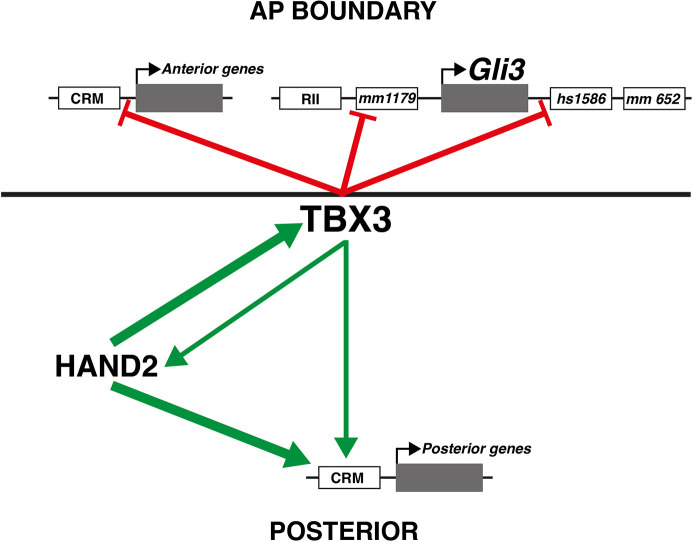
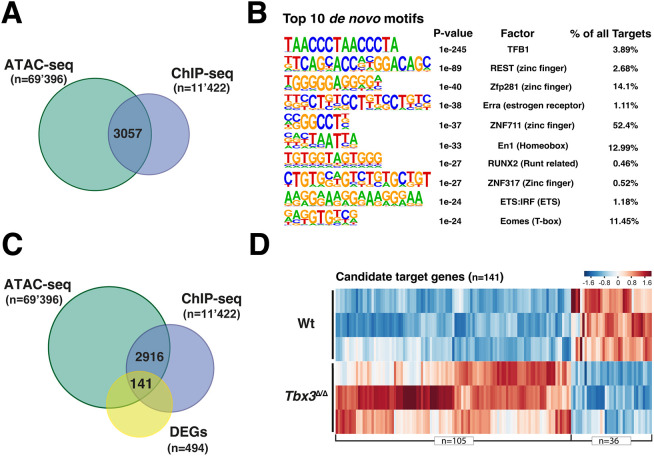
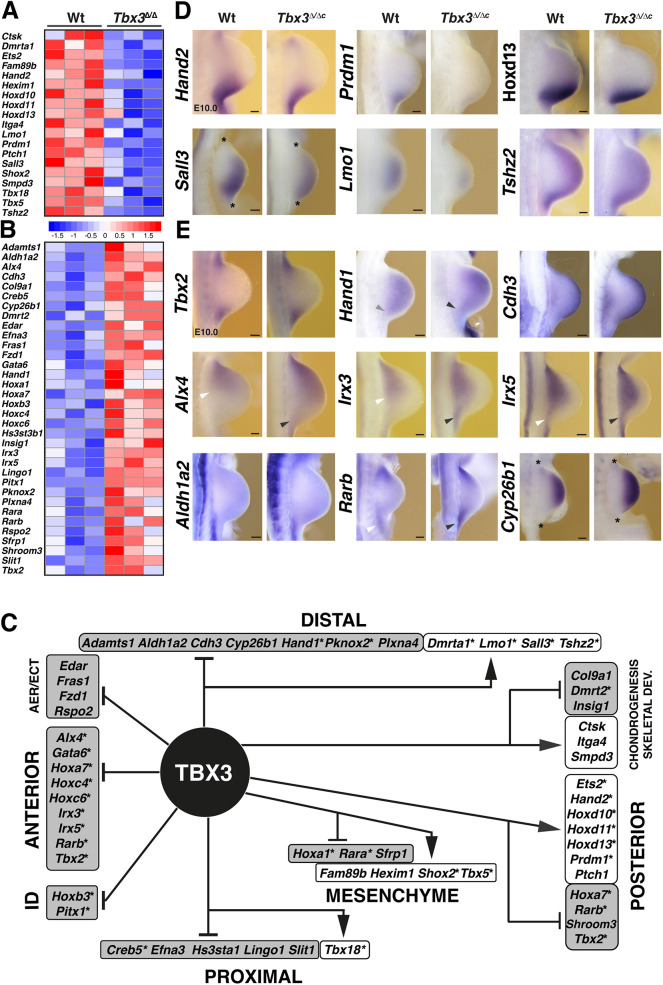
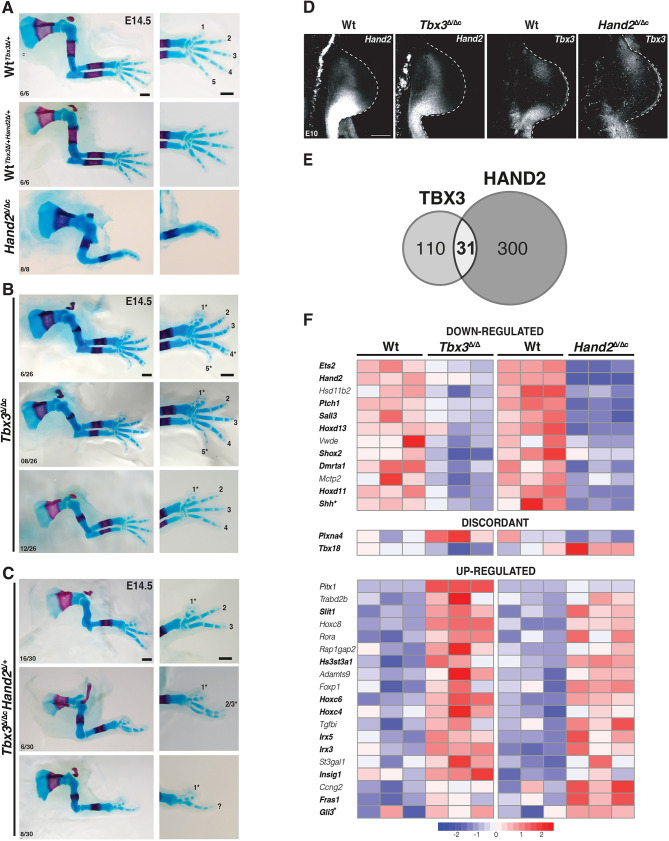
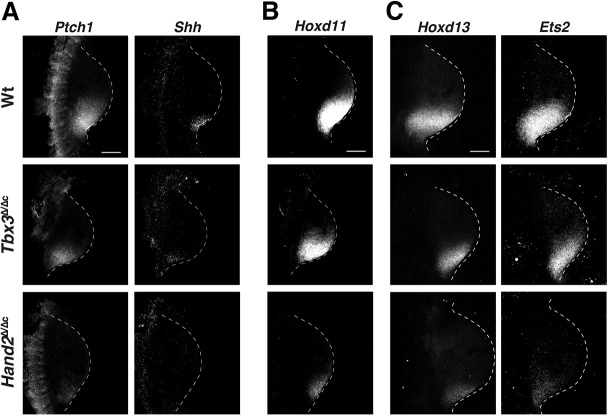
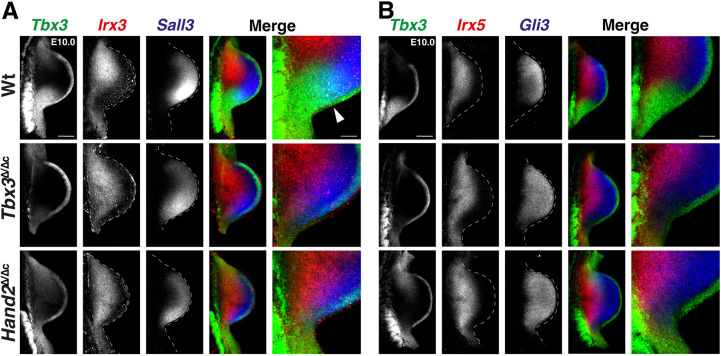
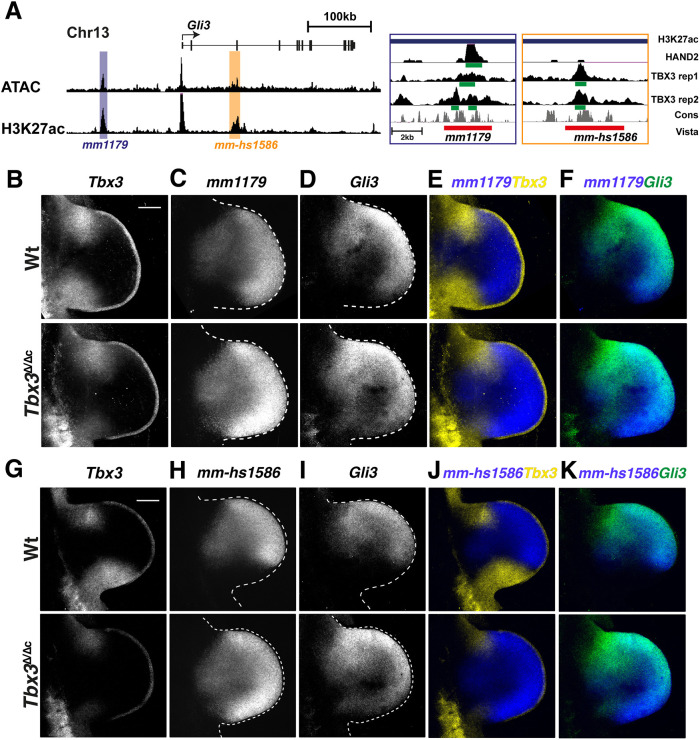
During limb bud formation, axis polarities are established as evidenced by the spatially restricted expression of key regulator genes. In particular, the mutually antagonistic interaction between the GLI3 repressor and HAND2 results in distinct and non-overlapping anterior-distal Gli3 and posterior Hand2 expression domains. This is a hallmark of the establishment of antero-posterior limb axis polarity, together with spatially restricted expression of homeodomain and other transcriptional regulators. Here, we show that TBX3 is required for establishment of the posterior expression boundary of anterior genes in mouse limb buds. ChIP-seq and differential gene expression analysis of wild-type and mutant limb buds identifies TBX3-specific and shared TBX3-HAND2 target genes. High sensitivity fluorescent whole-mount in situ hybridisation shows that the posterior expression boundaries of anterior genes are positioned by TBX3-mediated repression, which excludes anterior genes such as Gli3, Alx4, Hand1 and Irx3/5 from the posterior limb bud mesenchyme. This exclusion delineates the posterior mesenchymal territory competent to establish the Shh-expressing limb bud organiser. In turn, HAND2 is required for Shh activation and cooperates with TBX3 to upregulate shared posterior identity target genes in early limb buds.
在肢芽形成过程中,轴极性得以确立,这一点可从关键调节基因的空间限制表达中得到证明。特别是,GLI3 抑制剂和 HAND2 之间的相互拮抗相互作用导致独特且不重叠的前-远侧 Gli3 和后 Hand2 表达域。这是前后肢轴极性建立的一个标志,同时还有同源域和其他转录调节因子的空间限制表达。在这里,我们表明 TBX3 是小鼠肢芽中前基因后表达边界建立所必需的。野生型和突变型肢芽的 ChIP-seq 和差异基因表达分析确定了 TBX3 特异性和共享的 TBX3-HAND2 靶基因。高灵敏度荧光全胚胎原位杂交显示,前基因的后表达边界由 TBX3 介导的抑制来定位,这将包括 Gli3、Alx4、Hand1 和 Irx3/5 在内的前基因排除在肢芽间充质的后部之外。这种排除划定了具有建立 Shh 表达肢芽组织者能力的后间充质区域。反过来,HAND2 对于 Shh 的激活是必需的,并与 TBX3 合作在早期肢芽中上调共享的后身份靶基因。