Erlacher Rahel, Toepfner Nicole, Dressen Svenja, Berner Reinhard, Bösch Annemarie, Tenenbaum Tobias, Heininger Ulrich
From the Department of Paediatric Infectious Diseases and Vaccinology, University Children's Hospital Basel (UKBB), Basel, Switzerland.
Department of Pediatrics, Faculty of Medicine and University Hospital Carl Gustav Carus, Technische Universität Dresden, Dresden, Germany.
Pediatr Infect Dis J. 2024 Oct 1;43(10):931-935. doi: 10.1097/INF.0000000000004403. Epub 2024 Sep 16.
In winter 2022/2023, a resurgence of invasive group A streptococcal (iGAS) infections in children was observed in Europe, including Germany and Switzerland. While a simultaneous increase in consultations for scarlet fever and pharyngitis was reported in England, leading to the recommendation to treat any suspected GAS disease with antibiotics, guidelines in Germany and Switzerland remained unchanged. We aimed to investigate whether this policy was appropriate.
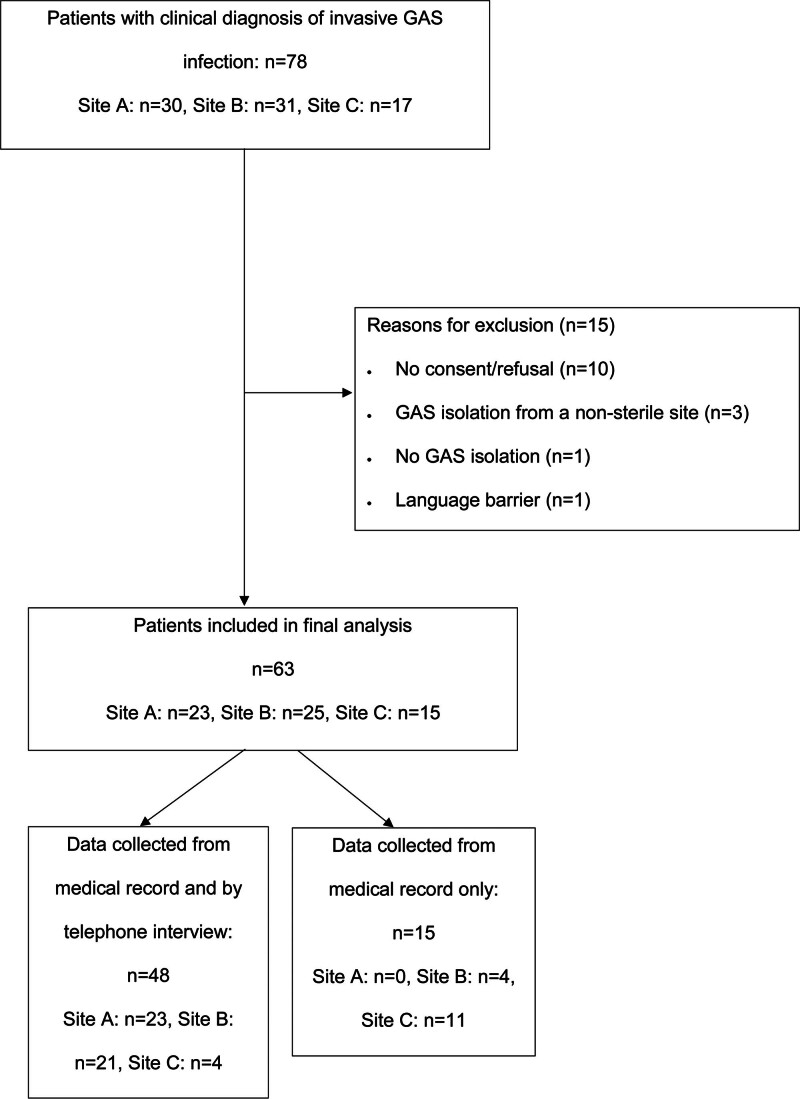
We conducted a retrospective multicenter study of children hospitalized for invasive GAS disease between September 2022 and March 2023 in pediatric departments in Dresden and Berlin (Germany) and Basel (Switzerland). We reviewed medical records and conducted structured telephone interviews to analyze whether suspected GAS infections with or without antibiotic treatment were reported prehospitalization.
In total, 63 patients met the inclusion criteria (median age 4.2 years, 57% males); however, clinical information was not complete for all analyzed characteristics; 32/54 (59%) had ≥1 physician visit ≤4 weeks prehospitalization. In 4/32 (13%) patients, GAS disease, that is, tonsillitis or scarlet fever, was suspected; 2/4 of them received antibiotics, and a positive rapid antigen test for GAS was documented in 1 of them.
A small minority of patients had suspected GAS infection within 4 weeks before iGAS disease. These data suggest that there is little opportunity to prevent iGAS disease by antibiotic therapy, because in most patients-even if seen by a physician-there was either no evidence of GAS disease or when GAS disease was suspected and treated with antibiotics, consecutive invasive GAS disease was not prevented.
在2022/2023年冬季,欧洲观察到儿童侵袭性A组链球菌(iGAS)感染有所复发,包括德国和瑞士。虽然英国报告猩红热和咽炎的就诊人数同时增加,从而建议对任何疑似A组链球菌疾病使用抗生素治疗,但德国和瑞士的指南仍未改变。我们旨在调查这一政策是否恰当。
我们对2022年9月至2023年3月期间在德国德累斯顿和柏林以及瑞士巴塞尔的儿科住院治疗侵袭性A组链球菌疾病的儿童进行了一项回顾性多中心研究。我们查阅了病历,并进行了结构化电话访谈,以分析在入院前是否报告了疑似A组链球菌感染(无论是否接受抗生素治疗)。
共有63例患者符合纳入标准(中位年龄4.2岁,57%为男性);然而,并非所有分析特征的临床信息都完整;32/54(59%)的患者在入院前≤4周有≥1次就诊。在4/32(13%)的患者中,疑似A组链球菌疾病,即扁桃体炎或猩红热;其中2/4接受了抗生素治疗,其中1例记录了A组链球菌快速抗原检测呈阳性。
一小部分患者在侵袭性A组链球菌疾病前4周内疑似A组链球菌感染。这些数据表明,通过抗生素治疗预防侵袭性A组链球菌疾病的机会很小,因为在大多数患者中——即使看过医生——要么没有A组链球菌疾病的证据,要么在疑似A组链球菌疾病并接受抗生素治疗时,并未预防随后的侵袭性A组链球菌疾病。