Division of General Pediatrics, Department of Pediatrics, Gynaecology and Obstetrics, Geneva University Children's Hospital and University of Geneva, Geneva, Switzerland.
Pediatric Infectious Diseases and Vaccinology Unit, Lausanne University Hospital, Lausanne, Switzerland.
Eur J Pediatr. 2024 Nov;183(11):4773-4782. doi: 10.1007/s00431-024-05705-1. Epub 2024 Aug 31.
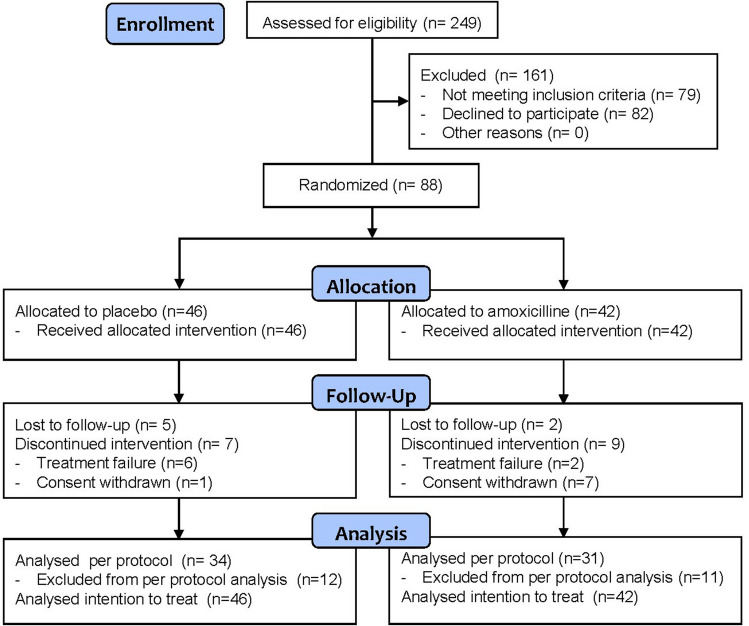
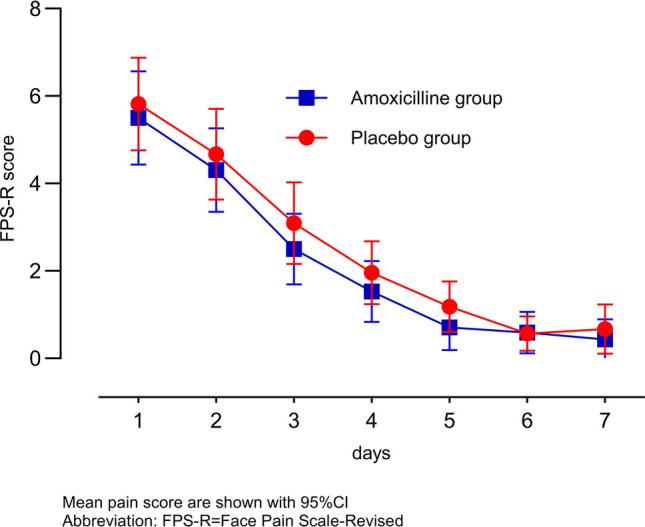
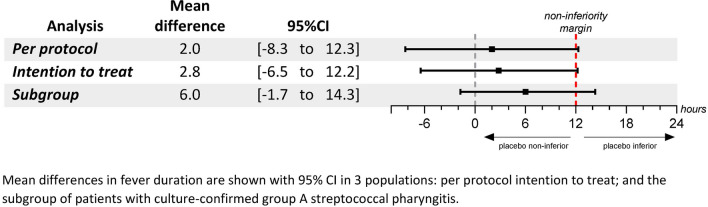
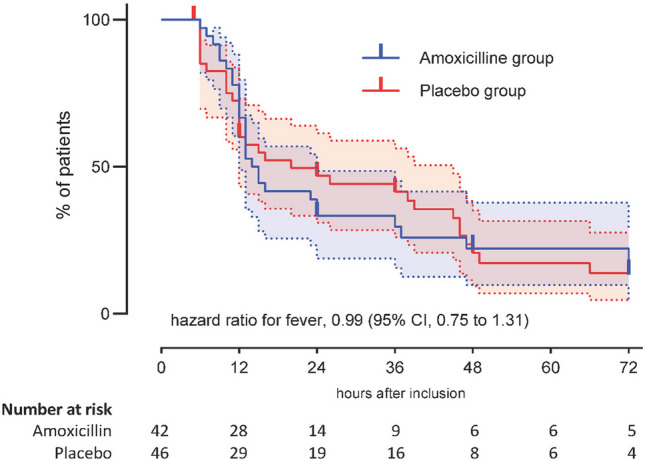
The efficacy of antibiotic therapy for group A streptococcus (GAS) pharyngitis is debated. The role of antibiotics in preventing complications seems limited, with the main potential benefit being symptom duration reduction. Our study aimed to evaluate whether a placebo is non-inferior to amoxicillin in reducing fever duration. We randomized 88 children between 3 and 15 years of age presenting with acute symptoms of pharyngitis and a positive rapid antigen detection test for GAS to receive 6-day treatment with either placebo (n = 46) or amoxicillin (n = 42). The primary outcome was the difference in fever duration, with a non-inferiority threshold set at 12 h. The secondary outcomes included pain intensity and complications of streptococcal pharyngitis. The mean difference in fever duration between the amoxicillin and placebo groups was 2.0 h (95% CI, - 8.3 to 12.3) in the per-protocol analysis and 2.8 h (95% CI, - 6.5 to 12.2) in the intention-to-treat analysis. Treatment failure was observed in six participants in the placebo group and two in the amoxicillin group (relative risk, 2.15; 95% CI, 0.44-10.57). All patients were identified early and recovered well. There was no clinically relevant difference in pain intensity between groups over the 7 days following randomization, with the largest difference of 0.5 (95% CI, - 0.62-1.80) observed on day 3.
Placebo appears to be non-inferior to amoxicillin in reducing fever duration. Pain intensity and risk of complications were similar between the two groups. These findings support the restrictive antibiotic treatment for streptococcal pharyngitis.
• Group A streptococcus pharyngitis is a common reason for prescribing antibiotics in pediatric care. • In high-income countries, while antibiotic treatment has not been effective in preventing non-suppurative complications, the primary justification for their use remains the reduction of symptoms.
• Our results suggest that antibiotics have a limited impact on the duration of fever and the intensity of pain in children with streptococcal pharyngitis. • Considering that suppurative complications can be promptly treated if they arise, we recommend a more judicious approach to antibiotic prescriptions.
The trial is registered at the US National Institutes of Health (ClinicalTrials.gov) # NCT03264911 on 15.08.2017.
关于 A 组链球菌(GAS)咽炎的抗生素治疗效果存在争议。抗生素预防并发症的作用似乎有限,主要潜在益处是缩短症状持续时间。我们的研究旨在评估安慰剂是否不劣于阿莫西林缩短发热持续时间。我们将 88 名 3-15 岁的急性咽炎患儿和 GAS 快速抗原检测阳性的患儿随机分为接受 6 天安慰剂(n=46)或阿莫西林(n=42)治疗的两组。主要结局是发热持续时间的差异,非劣效性界值设定为 12 小时。次要结局包括疼痛强度和链球菌性咽炎的并发症。在方案分析中,阿莫西林组和安慰剂组的发热持续时间平均差异为 2.0 小时(95%CI,-8.3 至 12.3),意向治疗分析中为 2.8 小时(95%CI,-6.5 至 12.2)。安慰剂组有 6 名参与者和阿莫西林组有 2 名参与者治疗失败(相对风险,2.15;95%CI,0.44-10.57)。所有患者均在早期发现并康复良好。随机分组后 7 天内,两组间疼痛强度无临床相关差异,最大差异为 0.5(95%CI,-0.62-1.80),第 3 天观察到。
安慰剂似乎不劣于阿莫西林缩短发热持续时间。两组间疼痛强度和并发症风险相似。这些发现支持对链球菌性咽炎的限制性抗生素治疗。
• A 组链球菌咽炎是儿科抗生素治疗的常见原因。• 在高收入国家,虽然抗生素治疗不能有效预防非化脓性并发症,但使用抗生素的主要理由仍是减轻症状。
• 我们的结果表明,抗生素对儿童链球菌性咽炎发热持续时间和疼痛强度的影响有限。• 考虑到化脓性并发症如果出现可以及时治疗,我们建议更谨慎地开具抗生素处方。
该试验于 2017 年 8 月 15 日在美国国立卫生研究院(ClinicalTrials.gov)注册#NCT03264911。