R Anand, Samiappan Sathishkumar, Prabukumar M
Department of Electrical and Electronics Engineering, Amrita School of Engineering, Coimbatore, Amrita Vishwa Vidyapeetham, India, 641112.
Geosystems Research Institute, Mississippi State University, Starkville, MS, USA.
Sci Rep. 2024 Jun 3;14(1):12675. doi: 10.1038/s41598-024-62403-6.
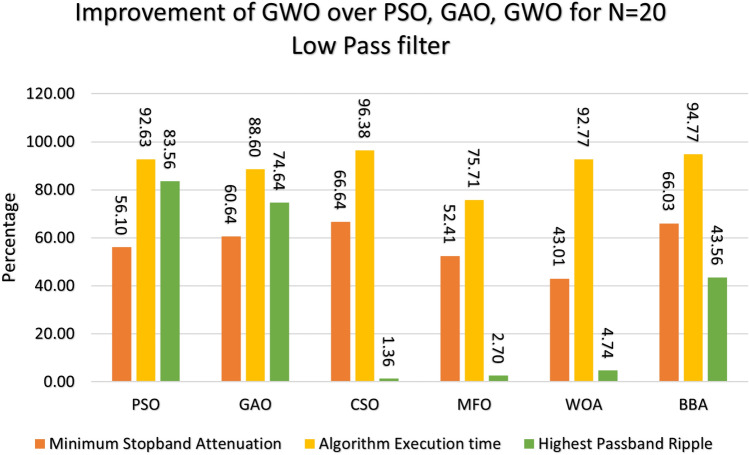
The design of optimum filters constitutes a fundamental aspect within the realm of signal processing applications. The process entails the calculation of ideal coefficients for a filter in order to get a passband with a flat response and an unlimited level of attenuation in the stopband. The objective of this work is to solve the FIR filter design problem and to compare the optimal solutions obtained from evolutionary algorithms. The design of optimal FIR low pass (LP), high pass (HP), and band stop (BS) filters is achieved by the utilization of nature-inspired optimization approaches, namely gray wolf optimization ,cuckoo search, particle swarm optimization, and genetic algorithm. The filters are evaluated in terms of their stop band attenuation, pass band ripples, and departure from the anticipated response. In addition, this study compares the optimization strategies applied in the context of algorithm execution time which is achievement of global optimal outcomes for the design of digital finite impulse response (FIR) filters. The results indicate that when the Gray wolf algorithm is applied to the development of a finite impulse response (FIR) filter, it produces a higher level of performance than other approaches, as supported by enhanced design precision, decreased execution time, and achievement of an optimal solution.
最优滤波器的设计是信号处理应用领域的一个基本方面。该过程需要计算滤波器的理想系数,以便获得具有平坦响应的通带和阻带中无限大的衰减水平。这项工作的目的是解决FIR滤波器设计问题,并比较从进化算法中获得的最优解。通过利用受自然启发的优化方法,即灰狼优化算法、布谷鸟搜索算法、粒子群优化算法和遗传算法,实现了最优FIR低通(LP)、高通(HP)和带阻(BS)滤波器的设计。根据滤波器的阻带衰减、通带纹波以及与预期响应的偏差对其进行评估。此外,本研究还比较了在算法执行时间背景下应用的优化策略,这是数字有限脉冲响应(FIR)滤波器设计实现全局最优结果的情况。结果表明,当将灰狼算法应用于有限脉冲响应(FIR)滤波器的开发时,它比其他方法具有更高的性能水平,这体现在设计精度提高、执行时间减少以及实现最优解等方面。