Cancer Epidemiology Unit, Nuffield Department of Population Health, University of Oxford, Richard Doll Building, Old Road Campus, Oxford, OX3 7LF, UK.
Division of Cancer Epidemiology and Genetics, National Cancer Institute, Rockville, MD, USA.
BMC Cancer. 2024 Jun 3;24(1):676. doi: 10.1186/s12885-023-11425-w.
Circulating total insulin-like growth factor-I (IGF-I) is an established risk factor for prostate cancer. However, only a small proportion of circulating IGF-I is free or readily dissociable from IGF-binding proteins (its bioavailable form), and few studies have investigated the association of circulating free IGF-I with prostate cancer risk.
We analyzed data from 767 prostate cancer cases and 767 matched controls nested within the European Prospective Investigation into Cancer and Nutrition cohort, with an average of 14-years (interquartile range = 2.9) follow-up. Matching variables were study center, length of follow-up, age, and time of day and fasting duration at blood collection. Circulating free IGF-I concentration was measured in serum samples collected at recruitment visit (mean age 55 years old; standard deviation = 7.1) using an enzyme-linked immunosorbent assay (ELISA). Conditional logistic regressions were performed to examine the associations of free IGF-I with risk of prostate cancer overall and subdivided by time to diagnosis (≤ 14 and > 14 years), and tumor characteristics.
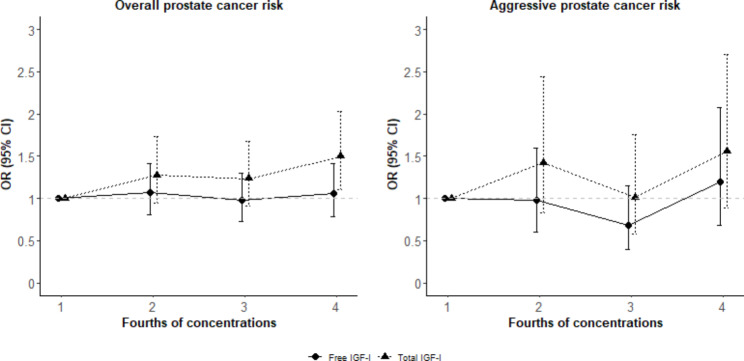
Circulating free IGF-I concentrations (in fourths and as a continuous variable) were not associated with prostate cancer risk overall (odds ratio [OR] = 1.00 per 0.1 nmol/L increment, 95% CI: 0.99, 1.02) or by time to diagnosis, or with prostate cancer subtypes, including tumor stage and histological grade.
Estimated circulating free IGF-I was not associated with prostate cancer risk. Further research may consider other assay methods that estimate bioavailable IGF-I to provide more insight into the well-substantiated association between circulating total IGF-I and subsequent prostate cancer risk.
循环总胰岛素样生长因子-I(IGF-I)是前列腺癌的既定风险因素。然而,只有一小部分循环 IGF-I 是游离的或容易与 IGF 结合蛋白(其生物可利用形式)分离,并且很少有研究调查循环游离 IGF-I 与前列腺癌风险的关联。
我们分析了嵌套在欧洲癌症前瞻性调查和营养队列中的 767 例前列腺癌病例和 767 例匹配对照的数据分析,平均随访时间为 14 年(四分位距=2.9)。匹配变量包括研究中心、随访时间、年龄以及采血时的时间和禁食时间。在招募访问时(平均年龄 55 岁;标准差=7.1)使用酶联免疫吸附测定法(ELISA)测量血清样本中循环游离 IGF-I 浓度。使用条件逻辑回归来检查游离 IGF-I 与前列腺癌总体风险的关联,并按诊断时间(≤14 年和>14 年)和肿瘤特征进行细分。
循环游离 IGF-I 浓度(按四等分和连续变量)与总体前列腺癌风险无关(每 0.1nmol/L 增量的比值比[OR]为 1.00,95%CI:0.99,1.02)或与诊断时间无关,也与前列腺癌亚型无关,包括肿瘤分期和组织学分级。
估计的循环游离 IGF-I 与前列腺癌风险无关。进一步的研究可能会考虑其他估计生物可利用 IGF-I 的测定方法,以更深入地了解循环总 IGF-I 与随后的前列腺癌风险之间的充分关联。