DA Pradeep, Angel L Saraa, Chaudhari Prabhat Kumar, Yadav Subhash C, Duggal Ritu
Division of Orthodontics and Dentofacial Deformities, Centre for Dental Education and Research, All India Institute of Medical Sciences, New Delhi, 110029, India.
Department of Electron Microscopy, All India Institute of Medical Sciences, New Delhi, 110029, India.
J Oral Biol Craniofac Res. 2024 Jul-Aug;14(4):435-440. doi: 10.1016/j.jobcr.2024.05.001. Epub 2024 May 24.
Fluoridated mouth rinses improve anti-cariogenic environment but decrease oral pH below critical value, affecting orthodontic bracket surface topography and causing corrosive changes over prolonged use. This invitro study aimed to quantitatively and qualitatively assess the surface topography and metallic ion release of the stainless steel (SS) brackets at varying acidic and alkaline pH.
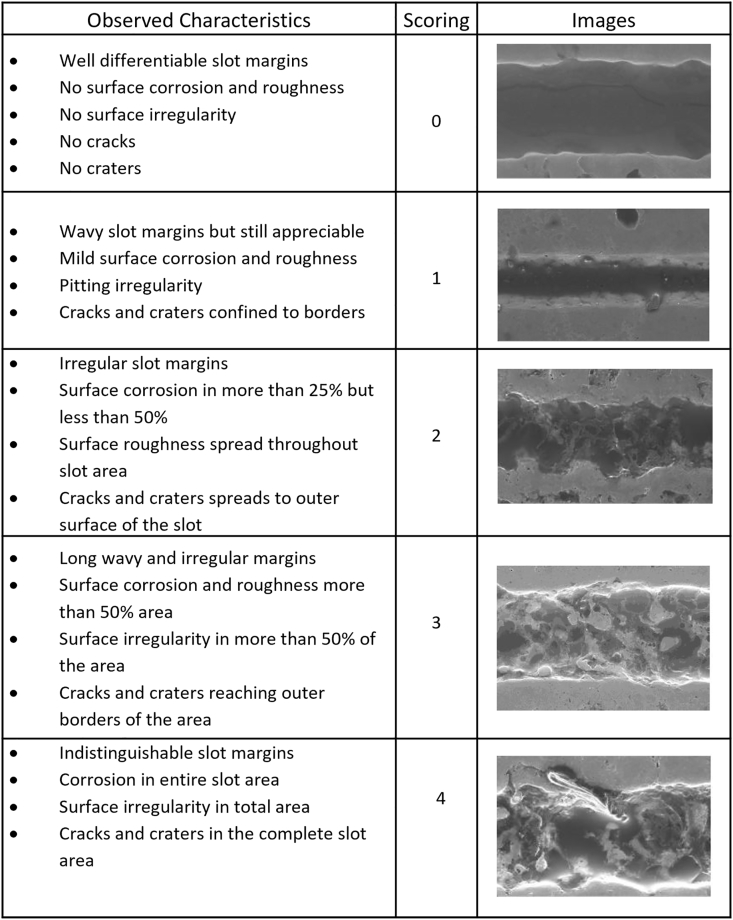
Forty unused SS brackets were divided into four groups (Group A, B, C, D) and immersed for 48- hours in solutions of artificial saliva and sodium fluoride (0.2 %) mouth rinse at varying pH of 5.5,6.7,7 and 8. The surface morphologic changes were analyzed under scanning electron microscope (SEM) at 50×, 150×, and 500× magnification. The changes in slot area were scored using the customized scale. The Energy Dispersive Xray Spectroscopy Analysis (EDAX) was used to estimate the probed elements' atomic and weight percentage.
The mean score of the scale was 3.4 for the brackets immersed in the acidic solution which was statistically significant (p = 0.00)and for alkaline and neutral solutions (p = 0.00). Chromium was found to be significantly higher in the alkaline solution (p = 0.016) followed by the neutral solution. Carbon was found excess in acidic solution than the neutral and alkaline solution.
Quantitative and qualitative analysis of the ion release in stainless steel brackets using SEM and EDAX revealed the corrosive effect of fluoride ion causing maximum surface changes in acidic medium and chromium release in alkaline pH.
含氟漱口水可改善防龋环境,但会使口腔pH值降至临界值以下,影响正畸托槽表面形貌,并在长期使用后导致腐蚀性变化。本体外研究旨在定量和定性评估不同酸性和碱性pH值下不锈钢(SS)托槽的表面形貌和金属离子释放情况。
将40个未使用过的SS托槽分为四组(A组、B组、C组、D组),分别浸泡在pH值为5.5、6.7、7和8的人工唾液和氟化钠(0.2%)漱口水溶液中48小时。在扫描电子显微镜(SEM)下,分别以50倍、150倍和500倍放大倍数分析表面形态变化。使用定制量表对槽沟面积的变化进行评分。采用能量色散X射线光谱分析(EDAX)估算探测元素的原子百分比和重量百分比。
浸泡在酸性溶液中的托槽量表平均得分为3.4,具有统计学意义(p = 0.00),浸泡在碱性和中性溶液中的托槽量表平均得分也具有统计学意义(p = 0.00)。发现碱性溶液中的铬含量显著更高(p = 0.016),其次是中性溶液。发现酸性溶液中的碳含量比中性和碱性溶液中的多。
使用SEM和EDAX对不锈钢托槽中的离子释放进行定量和定性分析,揭示了氟离子的腐蚀作用,其在酸性介质中引起最大的表面变化,在碱性pH值下导致铬释放。