Barclay Nicola L, Català Marti, Jödicke Annika M, Prieto-Alhambra Daniel, Newby Danielle, Delmestri Antonella, Man Wai Yi, Serrano Àlvar Roselló, Moncusí Marta Pineda
Pharmaco- and Device Epidemiology, Centre for Statistics in Medicine, Nuffield Department of Orthopaedics, Rheumatology and Musculoskeletal Sciences, University of Oxford, Oxford, UK.
Centre for Statistics in Medicine, Nuffield Department of Orthopaedics, Rheumatology and Musculoskeletal Sciences, Botnar Research Centre, University of Oxford, Windmill Road, Oxford OX3 7LD, UK.
Ther Adv Med Oncol. 2024 Jun 2;16:17588359241253115. doi: 10.1177/17588359241253115. eCollection 2024.
The COVID-19 pandemic affected cancer screening, diagnosis and treatments. Many surgeries were substituted with bridging therapies during the initial lockdown, yet consideration of treatment side effects and their management was not a priority.
To examine how the changing social restrictions imposed by the pandemic affected incidence and trends of endocrine treatment prescriptions in newly diagnosed (incident) breast and prostate cancer patients and, secondarily, endocrine treatment-related outcomes (including bisphosphonate prescriptions, osteopenia and osteoporosis), in UK clinical practice from March 2020 to June 2022.
Population-based cohort study using UK primary care Clinical Practice Research Datalink GOLD database.
There were 13,701 newly diagnosed breast cancer patients and 12,221 prostate cancer patients with ⩾1-year data availability since diagnosis between January 2017 and June 2022. Incidence rates (IR) and incidence rate ratios (IRR) were calculated across multiple time periods before and after lockdown to examine the impact of changing social restrictions on endocrine treatments and treatment-related outcomes, including osteopenia, osteoporosis and bisphosphonate prescriptions.
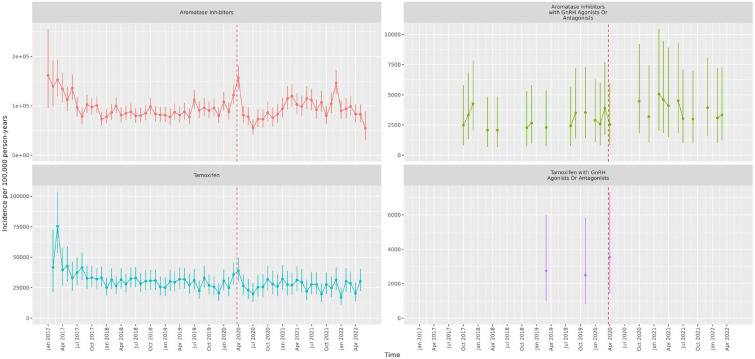
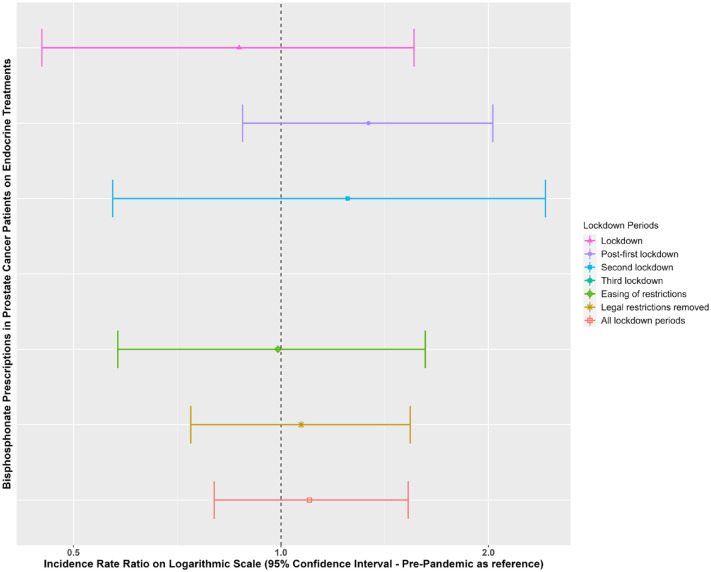
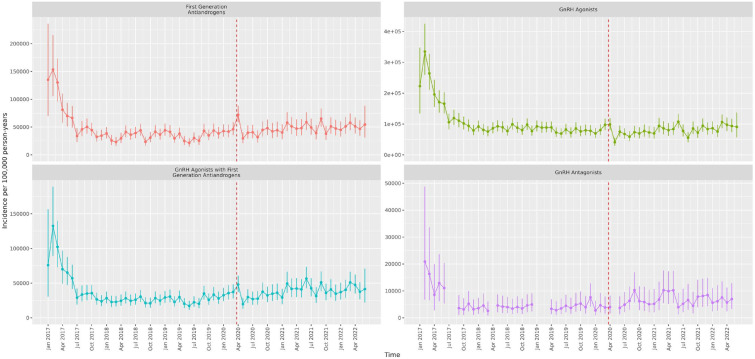
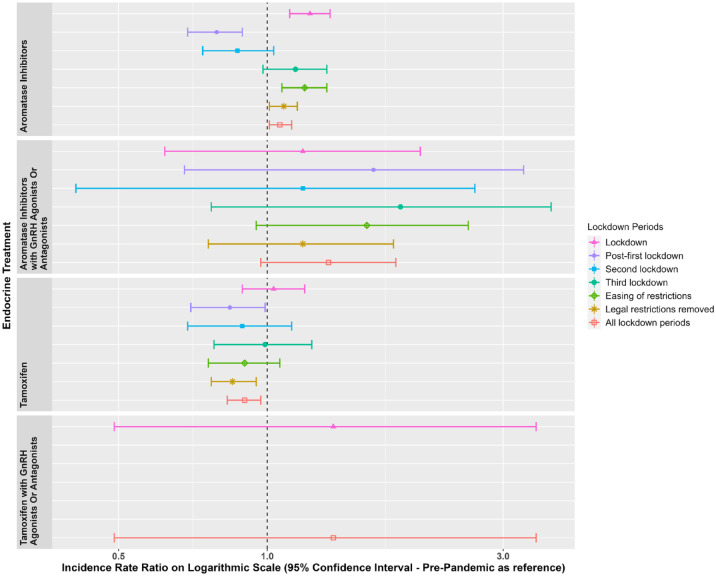
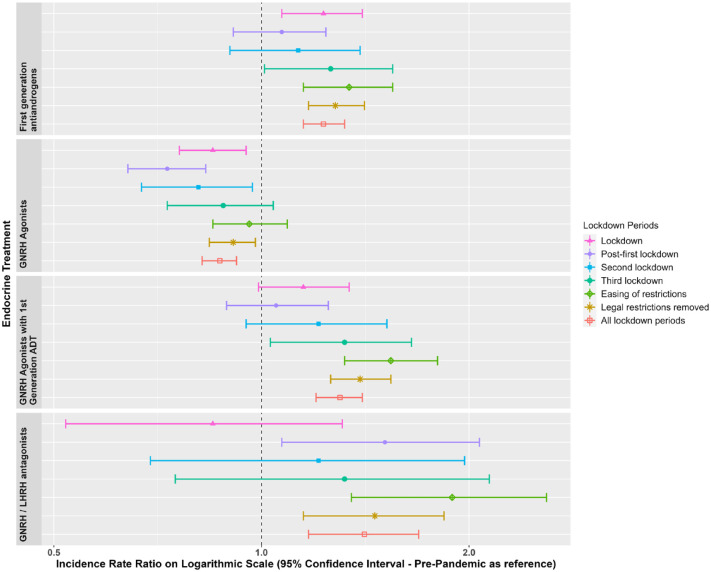
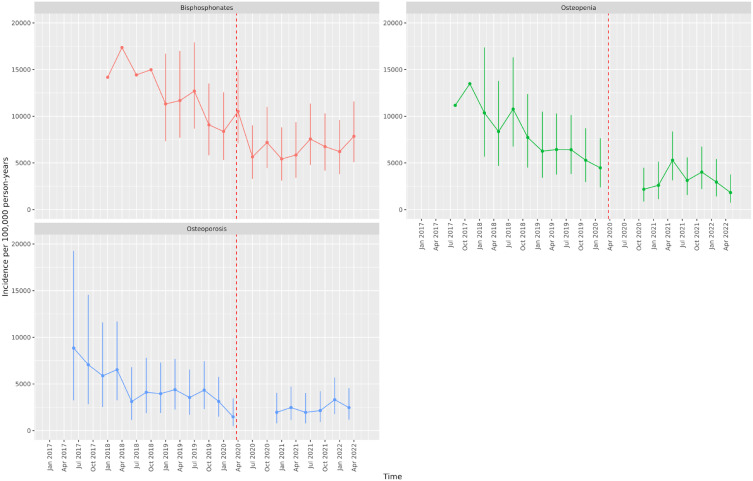
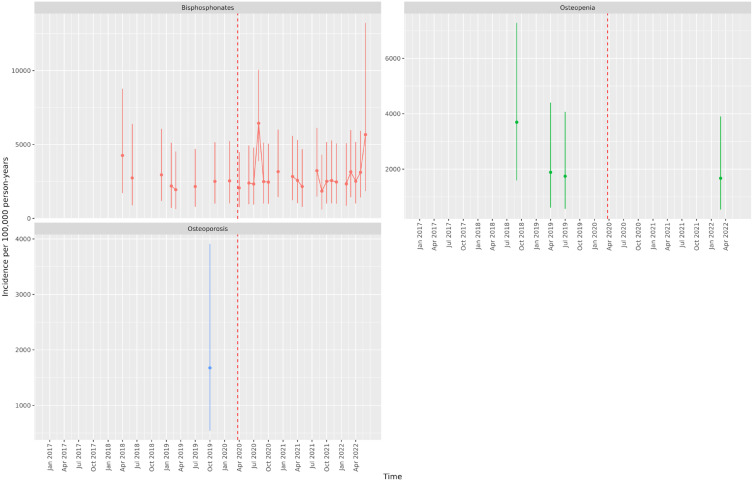
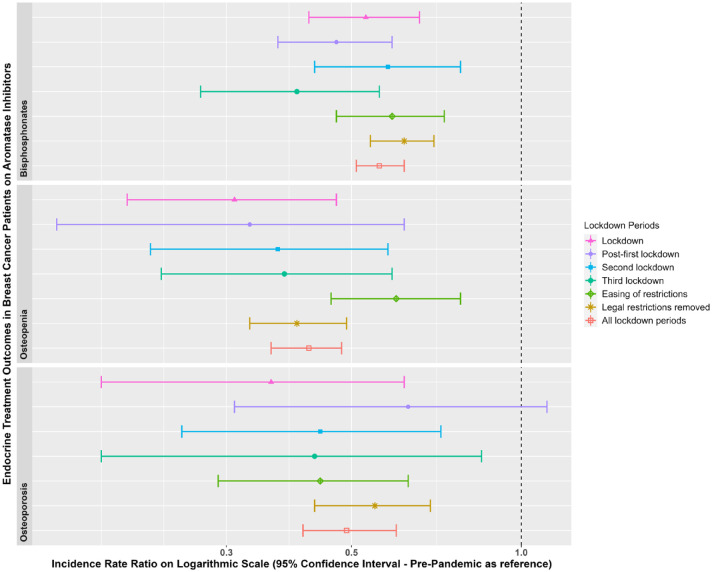
In breast cancer patients, aromatase inhibitor (AI) prescriptions increased during lockdown pre-pandemic [IRR: 1.22 (95% confidence interval (CI): 1.11-1.34)], followed by a decrease post-first lockdown [IRR: 0.79 (95% CI: 0.69-0.89)]. In prostate cancer patients, first-generation antiandrogen prescriptions increased pre-pandemic [IRR: 1.23 (95% CI: 1.08-1.4)]. For breast cancer patients on AIs, diagnoses of osteopenia, osteoporosis and bisphosphonate prescriptions were reduced across all lockdown periods pre-pandemic (IRR range: 0.31-0.62).
During the first 2 years of the pandemic, newly diagnosed breast and prostate cancer patients were prescribed more endocrine treatments compared to pre-pandemic due to restrictions on hospital procedures replacing surgeries with bridging therapies. But breast cancer patients had fewer diagnoses of osteopenia and osteoporosis and bisphosphonate prescriptions. These patients should be followed up in the coming years for signs of bone thinning. Evidence of poorer management of treatment-related side effects will help assess resource allocation for patients at high risk for bone-related complications.
新冠疫情影响了癌症筛查、诊断和治疗。在最初的封锁期间,许多手术被过渡性治疗所取代,但对治疗副作用及其管理的考虑并非优先事项。
研究疫情期间不断变化的社会限制如何影响新诊断(初发)乳腺癌和前列腺癌患者内分泌治疗处方的发生率和趋势,其次研究2020年3月至2022年6月英国临床实践中与内分泌治疗相关的结果(包括双膦酸盐处方、骨质减少和骨质疏松)。
基于人群的队列研究,使用英国初级保健临床实践研究数据链黄金数据库。
在2017年1月至2022年6月期间,有13701例新诊断的乳腺癌患者和12221例前列腺癌患者自诊断后有至少1年的数据可用。计算封锁前后多个时间段的发病率(IR)和发病率比(IRR),以研究社会限制变化对内分泌治疗及与治疗相关结果的影响,包括骨质减少、骨质疏松和双膦酸盐处方。
在乳腺癌患者中,芳香化酶抑制剂(AI)处方在疫情前的封锁期间增加[IRR:1.22(95%置信区间(CI):1.11 - 1.34)],随后在首次封锁后减少[IRR:0.79(95%CI:0.69 - 0.89)]。在前列腺癌患者中,第一代抗雄激素处方在疫情前增加[IRR:1.23(95%CI:1.08 - 1.4)]。对于接受AI治疗的乳腺癌患者,在疫情前的所有封锁期间骨质减少、骨质疏松的诊断和双膦酸盐处方均减少(IRR范围:0.31 - 0.62)。
在疫情的头两年,由于医院程序受限,手术被过渡性治疗取代,新诊断的乳腺癌和前列腺癌患者比疫情前接受了更多的内分泌治疗。但乳腺癌患者骨质减少和骨质疏松的诊断以及双膦酸盐处方较少。未来几年应对这些患者进行随访,观察骨质变薄的迹象。治疗相关副作用管理不善的证据将有助于评估对有骨相关并发症高风险患者的资源分配情况。