
经颈静脉肝内门体分流术(TIPS)前肝相关血管形态学评估预测显性肝性脑病:一项多中心研究。
Hepatic-associated vascular morphological assessment to predict overt hepatic encephalopathy before TIPS: a multicenter study.
机构信息
Zhuhai Interventional Medical Centre, Zhuhai Clinical Medical College of Jinan University (Zhuhai People's Hospital), No. 79 Kangning Road, Zhuhai, 519000, Guangdong Province, China.
Zhuhai Engineering Technology Research Center of Intelligent Medical Imaging, Zhuhai Clinical Medical College of Jinan University (Zhuhai People's Hospital), No. 79 Kangning Road, Zhuhai, 519000, Guangdong Province, China.
出版信息
Hepatol Int. 2024 Aug;18(4):1238-1248. doi: 10.1007/s12072-024-10686-2. Epub 2024 Jun 4.
BACKGROUND
To provide patients the chance of accepting curative transjugular intrahepatic portosystemic shunt (TIPS) rather than palliative treatments for portal hypertension-related variceal bleeding and ascites, we aimed to assess hepatic-associated vascular morphological change to improve the predictive accuracy of overt hepatic encephalopathy (HE) risks.
METHODS
In this multicenter study, 621 patients undergoing TIPS were subdivided into training (413 cases from 3 hospitals) and external validation datasets (208 cases from another 3 hospitals). In addition to traditional clinical factors, we assessed hepatic-associated vascular morphological changes using maximum diameter (including absolute and ratio values). Three predictive models (clinical, hepatic-associated vascular, and combined) were constructed using logistic regression. Their discrimination and calibration were compared to test the necessity of hepatic-associated vascular assessment and identify the optimal model. Furthermore, to verify the improved performance of Model, we compared it with four previous models, both in discrimination and calibration.
RESULTS
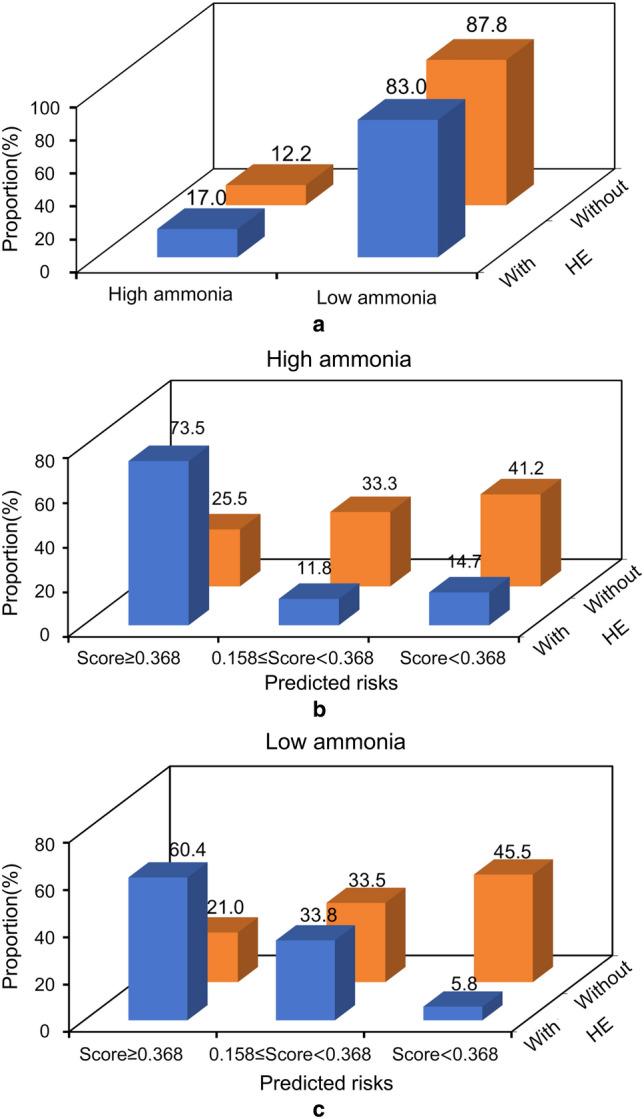
The combined model outperformed the clinical and hepatic-associated vascular models (training: 0.814, 0.754, 0.727; validation: 0.781, 0.679, 0.776; p < 0.050) and had the best calibration. Compared to previous models, Model showed superior performance in discrimination. The high-, middle-, and low-risk populations displayed significantly different overt HE incidence (p < 0.001). Despite the limited ability of pre-TIPS ammonia to predict overt HE risks, the combined model displayed a satisfactory ability to predict overt HE risks, both in the low- and high-ammonia subgroups.
CONCLUSION
Hepatic-associated vascular assessment improved the predictive accuracy of overt HE, ensuring curative chances by TIPS for suitable patients and providing insights for cirrhosis-related studies.
背景
为了为门静脉高压相关静脉曲张出血和腹水患者提供接受治疗性经颈静脉肝内门体分流术(TIPS)而非姑息性治疗的机会,我们旨在评估与肝脏相关的血管形态变化,以提高显性肝性脑病(HE)风险的预测准确性。
方法
在这项多中心研究中,将 621 例接受 TIPS 的患者分为训练集(来自 3 家医院的 413 例)和外部验证数据集(来自另外 3 家医院的 208 例)。除了传统的临床因素外,我们还使用最大直径(包括绝对值和比值)评估了与肝脏相关的血管形态变化。使用逻辑回归构建了三个预测模型(临床、与肝脏相关的血管和联合模型)。比较了它们的判别和校准能力,以测试与肝脏相关的血管评估的必要性,并确定最佳模型。此外,为了验证模型的改进性能,我们比较了模型在判别和校准方面与四个以前的模型的性能。
结果
联合模型优于临床和与肝脏相关的血管模型(训练集:0.814、0.754、0.727;验证集:0.781、0.679、0.776;p<0.050),且具有最佳的校准能力。与以前的模型相比,模型在判别方面表现出更好的性能。高、中、低风险人群的显性 HE 发生率有显著差异(p<0.001)。尽管术前氨水平预测显性 HE 风险的能力有限,但联合模型在低氨和高氨亚组中均具有良好的预测显性 HE 风险的能力。
结论
与肝脏相关的血管评估提高了显性 HE 的预测准确性,通过 TIPS 为合适的患者提供了治疗机会,并为肝硬化相关研究提供了新的思路。


 Zotero 插件