Zhuhai Interventional Medical Centre, Zhuhai Hospital Affiliated with Jinan University (Zhuhai People's Hospital), No. 79 Kangning Road, Zhuhai, 519000, Guangdong Province, China.
Zhuhai Engineering Technology Research Center of Intelligent Medical Imaging, Zhuhai Hospital Affiliated with Jinan University (Zhuhai People's Hospital), Zhuhai, China.
Hepatol Int. 2023 Dec;17(6):1545-1556. doi: 10.1007/s12072-023-10570-5. Epub 2023 Aug 2.
Overt hepatic encephalopathy (HE) should be predicted preoperatively to identify suitable candidates for transjugular intrahepatic portosystemic shunt (TIPS) instead of first-line treatment. This study aimed to construct a 3D assessment-based model to predict post-TIPS overt HE.
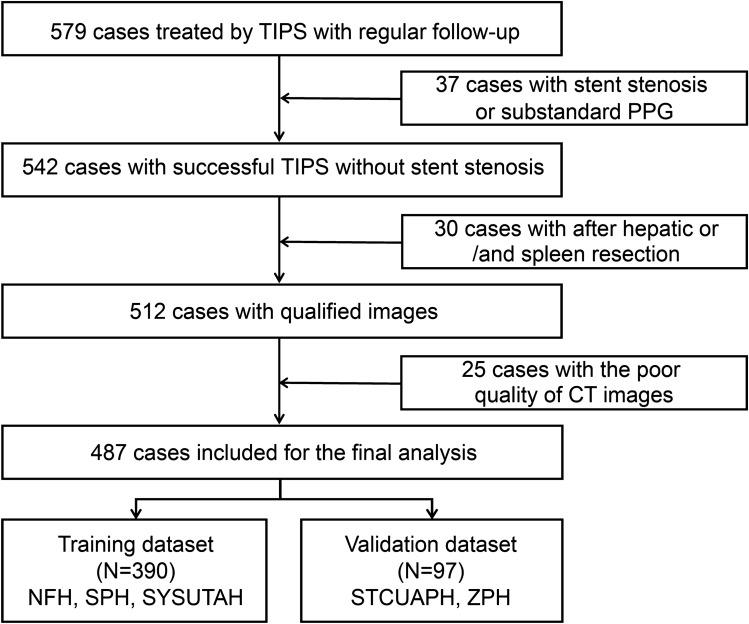
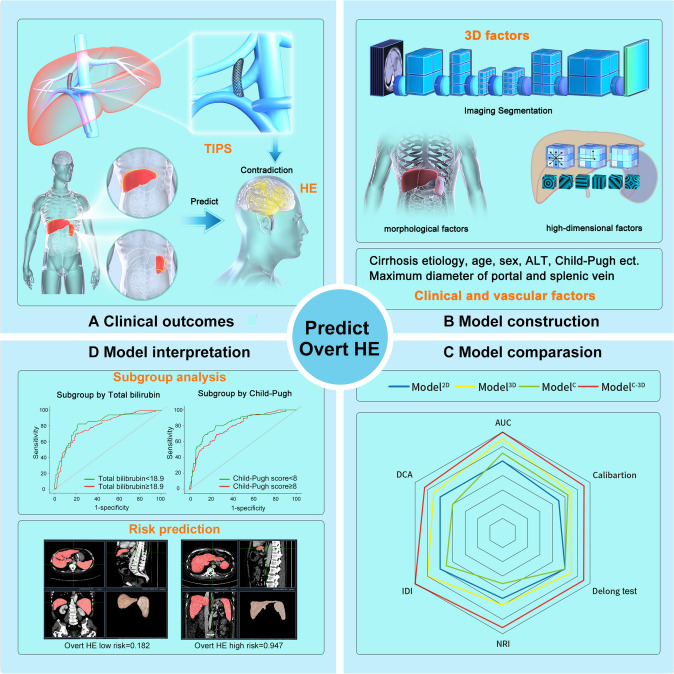
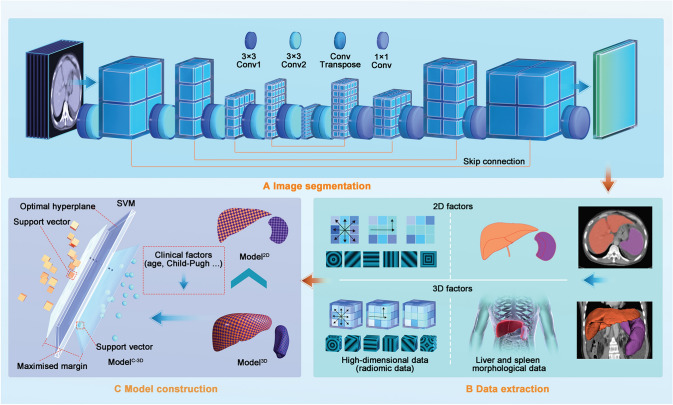
In this multi-center cohort study, 487 patients who underwent TIPS were subdivided into a training dataset (390 cases from three hospitals) and an external validation dataset (97 cases from another two hospitals). Candidate factors included clinical, vascular, and 2D and 3D data. Combining the least absolute shrinkage and operator method, support vector machine, and probability calibration by isotonic regression, we constructed four predictive models: clinical, 2D, 3D, and combined models. Their discrimination and calibration were compared to identify the optimal model, with subgroup analysis performed.
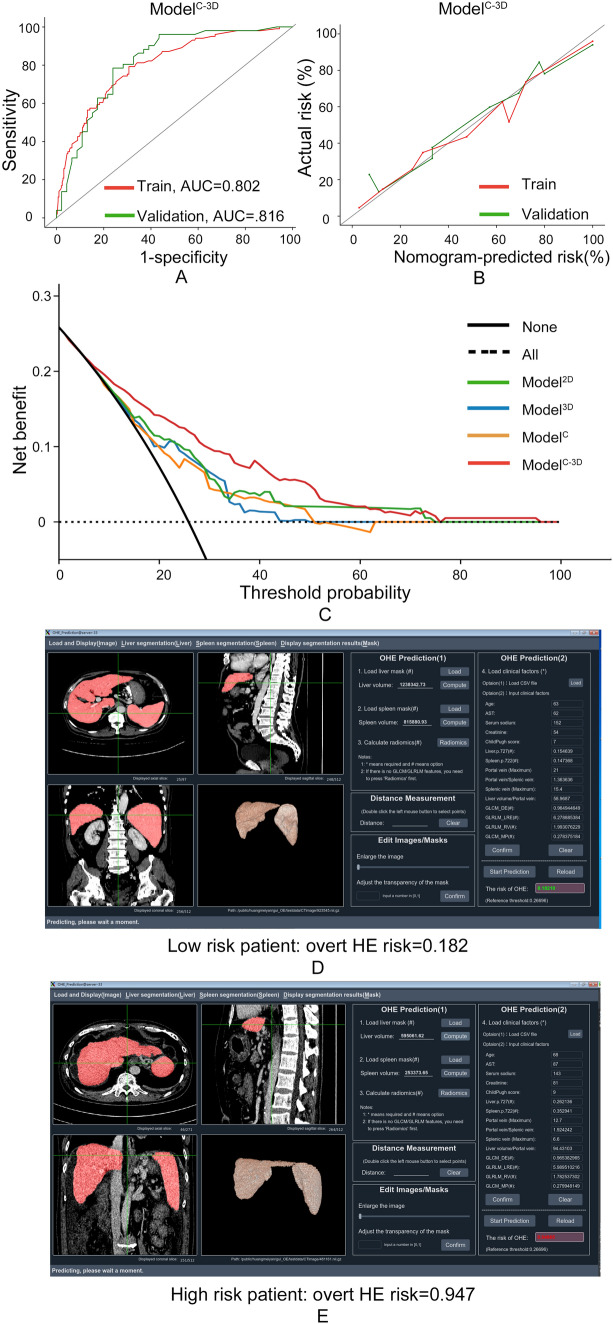
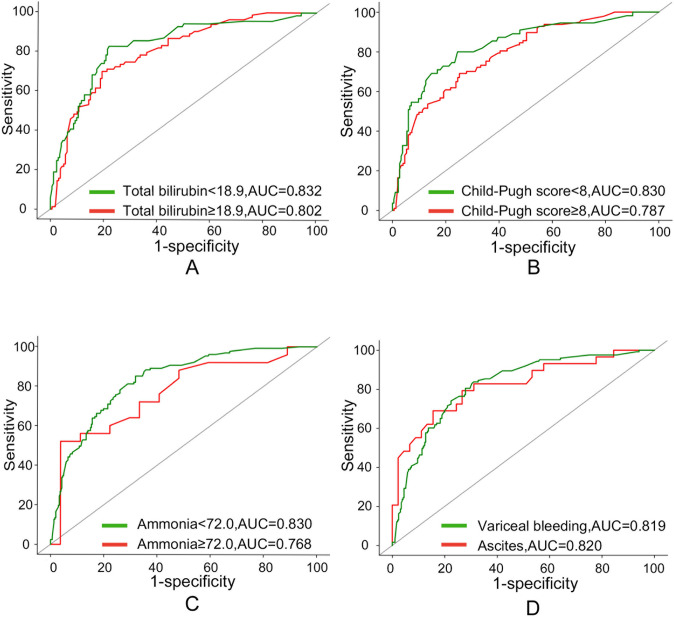
The 3D model showed better discrimination than did the 2D model (training: 0.719 vs. 0.691; validation: 0.730 vs. 0.622). The model combining clinical and 3D factors outperformed the clinical and 3D models (training: 0.802 vs. 0.735 vs. 0.719; validation: 0.816 vs. 0.723 vs. 0.730; all p < 0.050). Moreover, the combined model had the best calibration. The performance of the best model was not affected by the total bilirubin level, Child-Pugh score, ammonia level, or the indication for TIPS.
3D assessment of the liver and the spleen provided additional information to predict overt HE, improving the chance of TIPS for suitable patients. 3D assessment could also be used in similar studies related to cirrhosis.
应预测显性肝性脑病(HE),以确定适合经颈静脉肝内门体分流术(TIPS)的候选者,而非进行一线治疗。本研究旨在构建一种基于 3D 评估的模型,以预测 TIPS 后显性 HE。
在这项多中心队列研究中,将 487 例接受 TIPS 的患者分为训练数据集(来自三所医院的 390 例)和外部验证数据集(来自另外两所医院的 97 例)。候选因素包括临床、血管和 2D 和 3D 数据。我们采用最小绝对收缩和选择算子法、支持向量机以及通过等比回归进行概率校准,构建了四个预测模型:临床模型、2D 模型、3D 模型和联合模型。通过比较其区分度和校准度,以确定最佳模型,并进行亚组分析。
3D 模型的区分度优于 2D 模型(训练:0.719 比 0.691;验证:0.730 比 0.622)。联合临床和 3D 因素的模型优于临床和 3D 模型(训练:0.802 比 0.735 比 0.719;验证:0.816 比 0.723 比 0.730;均 P<0.050)。此外,联合模型具有最佳的校准度。最佳模型的性能不受总胆红素水平、Child-Pugh 评分、氨水平或 TIPS 适应证的影响。
肝脏和脾脏的 3D 评估提供了额外的信息,有助于预测显性 HE,增加了为合适患者进行 TIPS 的机会。3D 评估也可用于与肝硬化相关的类似研究。