Ye Qian-Wen, Liu Yuan-Jie, Li Jia-Qi, Han Mei, Bian Ze-Ren, Chen Tian-Yuan, Li Jie-Pin, Liu Shen-Lin, Zou Xi
Department of Oncology, Affiliated Hospital of Nanjing University of Chinese Medicine, Jiangsu Province Hospital of Chinese Medicine, Nanjing, Jiangsu, PR China; No.1 Clinical Medicial College, Nanjing University of Chinese Medicine, Nanjing, Jiangsu, PR China.
Department of Oncology, Affiliated Hospital of Nanjing University of Chinese Medicine, Jiangsu Province Hospital of Chinese Medicine, Nanjing, Jiangsu, PR China.
Transl Oncol. 2024 Aug;46:102009. doi: 10.1016/j.tranon.2024.102009. Epub 2024 Jun 4.
Colorectal cancer (CRC) is the third most common cancer worldwide. Connexin is a transmembrane protein involved in gap junctions (GJs) formation. Our previous study found that connexin 37 (Cx37), encoded by gap junction protein alpha 4 (GJA4), expressed on fibroblasts acts as a promoter of CRC and is closely related to epithelial-mesenchymal transition (EMT) and tumor immune microenvironment. However, to date, the mechanism concerning the malignancy of GJA4 in tumor stroma has not been studied.
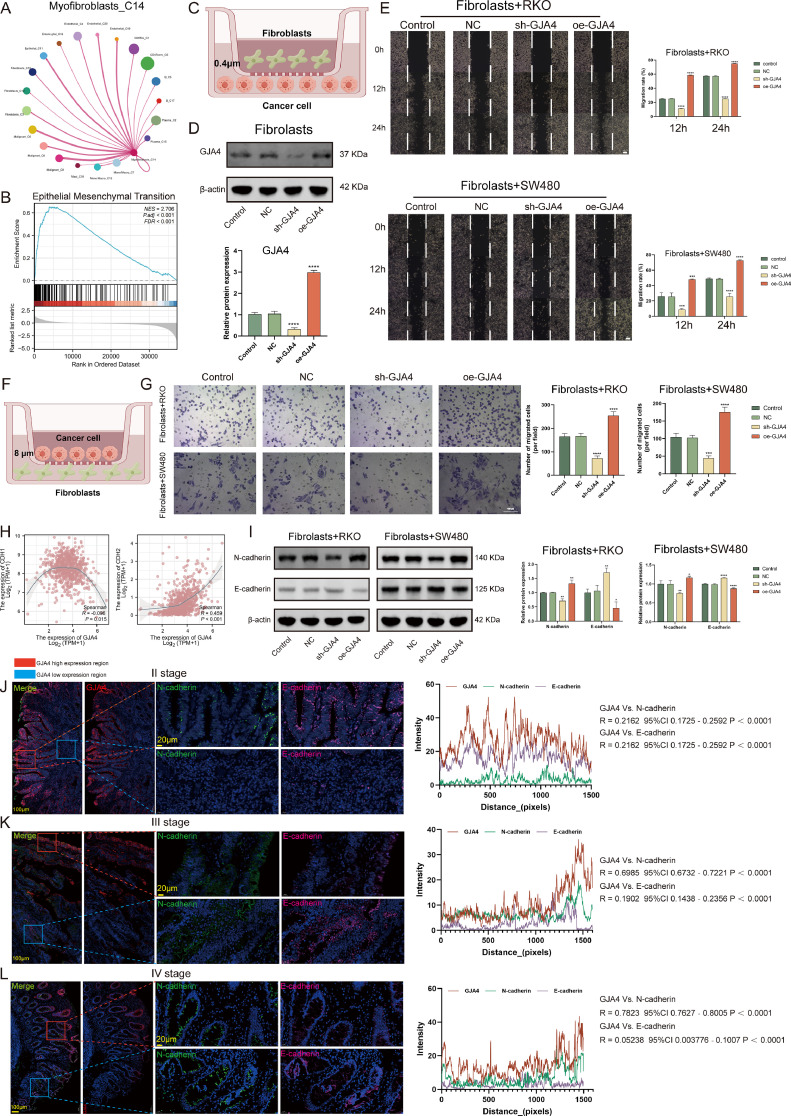
Hematoxylin-eosin (HE) and immunohistochemical (IHC) staining were used to validate the expression and localization of GJA4. Using single-cell analysis, enrichment analysis, spatial transcriptomics, immunofluorescence staining (IF), Sirius red staining, wound healing and transwell assays, western blotting (WB), Cell Counting Kit-8 (CCK8) assay and in vivo experiments, we investigated the possible mechanisms of GJA4 in promoting CRC.
We discovered that in CRC, GJA4 on fibroblasts is involved in promoting fibroblast activation and promoting EMT through a fibroblast-dependent pathway. Furthermore, GJA4 may act synergistically with M2 macrophages to limit T cell infiltration by stimulating the formation of an immune-excluded desmoplasic barrier. Finally, we found a significantly correlation between GJA4 and pathological staging (P < 0.0001) or D2 dimer (R = 0.03, P < 0.05).
We have identified GJA4 expressed on fibroblasts is actually a promoter of the tumor mesenchymal phenotype. Our findings suggest that the interaction between GJA4+ fibroblasts and M2 macrophages may be an effective target for enhancing tumor immunotherapy.
结直肠癌(CRC)是全球第三大常见癌症。连接蛋白是一种参与间隙连接(GJ)形成的跨膜蛋白。我们之前的研究发现,由间隙连接蛋白α4(GJA4)编码的连接蛋白37(Cx37)在成纤维细胞上表达,作为CRC的促进因子,与上皮-间质转化(EMT)和肿瘤免疫微环境密切相关。然而,迄今为止,关于肿瘤基质中GJA4恶性肿瘤的机制尚未得到研究。
采用苏木精-伊红(HE)和免疫组织化学(IHC)染色来验证GJA4的表达和定位。使用单细胞分析、富集分析、空间转录组学、免疫荧光染色(IF)、天狼星红染色、伤口愈合和Transwell实验、蛋白质免疫印迹(WB)、细胞计数试剂盒-8(CCK8)实验和体内实验,我们研究了GJA4促进CRC的可能机制。
我们发现,在CRC中,成纤维细胞上的GJA4通过成纤维细胞依赖性途径参与促进成纤维细胞活化和促进EMT。此外,GJA4可能与M2巨噬细胞协同作用,通过刺激形成免疫排除性促结缔组织增生性屏障来限制T细胞浸润。最后,我们发现GJA4与病理分期(P < 0.0001)或D-二聚体(R = 0.03, P < 0.05)之间存在显著相关性。
我们已经确定在成纤维细胞上表达的GJA4实际上是肿瘤间质表型的促进因子。我们的研究结果表明,GJA4+成纤维细胞与M2巨噬细胞之间的相互作用可能是增强肿瘤免疫治疗的有效靶点。