Department of Laboratory Medicine, Zhongshan Hospital, Fudan University Shanghai, Shanghai, China.
University of the Chinese Academy of Sciences, Beijing, China.
Ann Lab Med. 2024 Sep 1;44(5):385-391. doi: 10.3343/alm.2024.0053. Epub 2024 Jun 5.
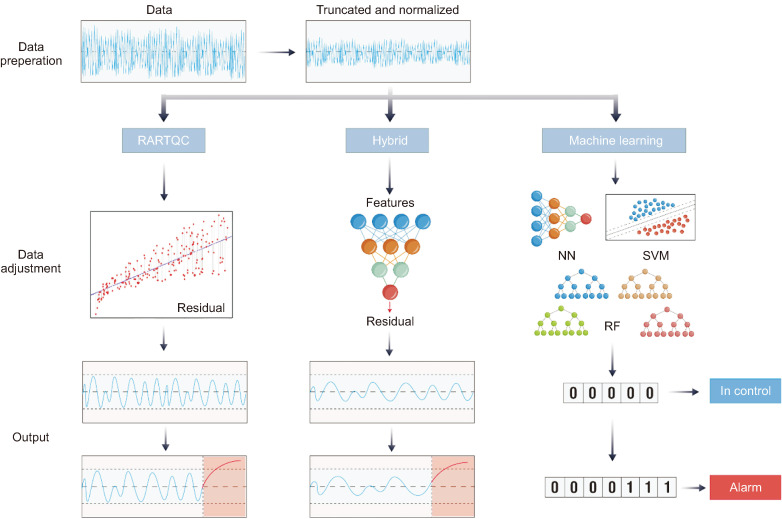
Patient-based real-time QC (PBRTQC) uses patient-derived data to assess assay performance. PBRTQC algorithms have advanced in parallel with developments in computer science and the increased availability of more powerful computers. The uptake of Artificial Intelligence in PBRTQC has been rapid, with many stated advantages over conventional approaches. However, until this review, there has been no critical comparison of these. The PBRTQC algorithms based on moving averages, regression-adjusted real-time QC, neural networks and anomaly detection are described and contrasted. As Artificial Intelligence tools become more available to laboratories, user-friendly and computationally efficient, the major disadvantages, such as complexity and the need for high computing resources, are reduced and become attractive to implement in PBRTQC applications.
基于患者的实时质控(PBRTQC)使用患者衍生数据来评估检测性能。随着计算机科学的发展和更强大计算机的可用性的提高,PBRTQC 算法也得到了发展。人工智能在 PBRTQC 中的应用发展迅速,其相对于传统方法具有许多优势。然而,在此综述之前,尚未对这些方法进行过严格的比较。本文描述并对比了基于移动平均值、回归调整实时质控、神经网络和异常检测的 PBRTQC 算法。随着人工智能工具在实验室中变得越来越容易使用且计算效率更高,其主要缺点(如复杂性和对高计算资源的需求)得以降低,并且在 PBRTQC 应用中实施变得具有吸引力。