
基于单细胞基因组学的研究深入了解细胞类型特异性微生物内化对疾病严重程度的影响。
Single cell genomics based insights into the impact of cell-type specific microbial internalization on disease severity.
机构信息
Division of Immunology and Infectious Disease Biology, INtegrative GENomics of HOst PathogEn (INGEN-HOPE) Laboratory, Council of Scientific & Industrial Research-Institute of Genomics and Integrative Biology (CSIR-IGIB), Delhi, India.
Academy of Scientific and Innovative Research (AcSIR), Ghaziabad, India.
出版信息
Front Immunol. 2024 May 21;15:1401320. doi: 10.3389/fimmu.2024.1401320. eCollection 2024.
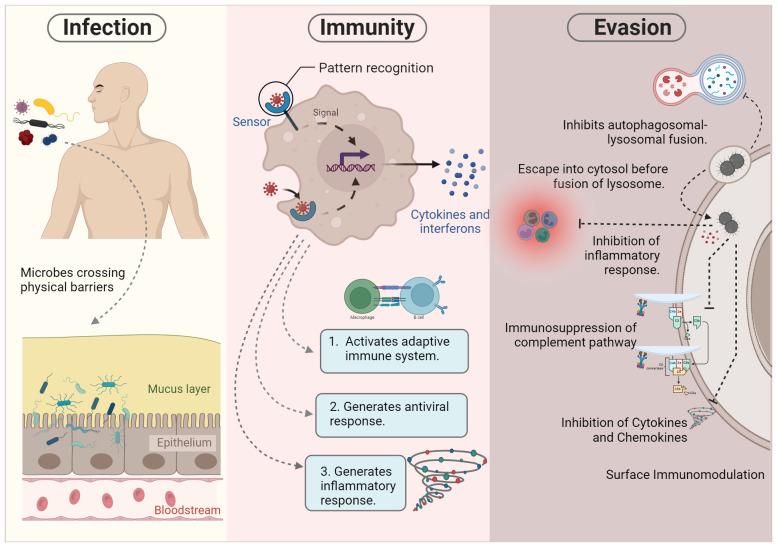
Host-microbe interactions are complex and ever-changing, especially during infections, which can significantly impact human physiology in both health and disease by influencing metabolic and immune functions. Infections caused by pathogens such as bacteria, viruses, fungi, and parasites are the leading cause of global mortality. Microbes have evolved various immune evasion strategies to survive within their hosts, which presents a multifaceted challenge for detection. Intracellular microbes, in particular, target specific cell types for survival and replication and are influenced by factors such as functional roles, nutrient availability, immune evasion, and replication opportunities. Identifying intracellular microbes can be difficult because of the limitations of traditional culture-based methods. However, advancements in integrated host microbiome single-cell genomics and transcriptomics provide a promising basis for personalized treatment strategies. Understanding host-microbiota interactions at the cellular level may elucidate disease mechanisms and microbial pathogenesis, leading to targeted therapies. This article focuses on how intracellular microbes reside in specific cell types, modulating functions through persistence strategies to evade host immunity and prolong colonization. An improved understanding of the persistent intracellular microbe-induced differential disease outcomes can enhance diagnostics, therapeutics, and preventive measures.
宿主-微生物相互作用是复杂且不断变化的,特别是在感染期间,它可以通过影响代谢和免疫功能,对健康和疾病中的人体生理产生重大影响。由细菌、病毒、真菌和寄生虫等病原体引起的感染是全球死亡的主要原因。微生物已经进化出各种免疫逃避策略,以在其宿主内生存,这对检测提出了多方面的挑战。特别是,细胞内微生物针对特定的细胞类型进行生存和复制,并受到功能作用、营养供应、免疫逃避和复制机会等因素的影响。由于传统基于培养的方法的局限性,识别细胞内微生物可能具有挑战性。然而,整合宿主微生物组单细胞基因组学和转录组学的进步为个性化治疗策略提供了有希望的基础。在细胞水平上理解宿主-微生物群相互作用可能阐明疾病机制和微生物发病机制,从而导致靶向治疗。本文重点介绍细胞内微生物如何驻留在特定的细胞类型中,通过持久策略来调节功能,从而逃避宿主免疫并延长定植。更好地了解持久的细胞内微生物诱导的不同疾病结果,可以增强诊断、治疗和预防措施。



 Zotero 插件