Department of Oncology, Hejiang Hospital of Traditional Chinese Medicine, Luzhou, People's Republic of China.
School of Basic Medical Sciences, Southwest Medical University, Luzhou, People's Republic of China.
Cancer Rep (Hoboken). 2024 Jun;7(6):e2116. doi: 10.1002/cnr2.2116.
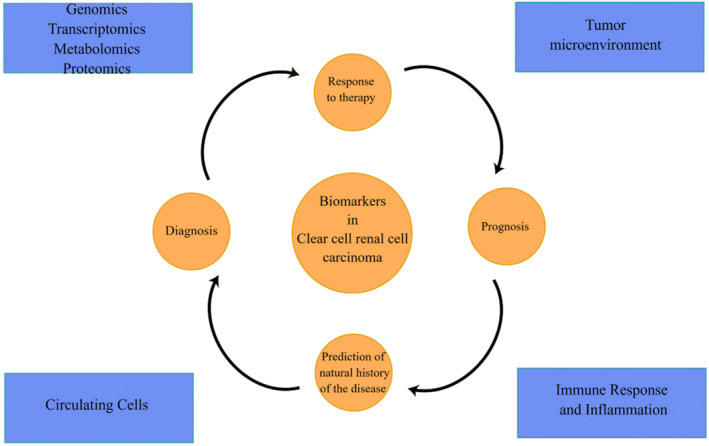
Clear cell renal cell carcinoma (ccRCC) is a common and aggressive subtype of kidney cancer. Many patients are diagnosed at advanced stages, making early detection crucial. Unfortunately, there are currently no noninvasive tests for ccRCC, emphasizing the need for new biomarkers. Additionally, ccRCC often develops resistance to treatments like radiotherapy and chemotherapy. Identifying biomarkers that predict treatment outcomes is vital for personalized care. The integration of artificial intelligence (AI), multi-omics analysis, and computational biology holds promise in bolstering detection precision and resilience, opening avenues for future investigations. The amalgamation of radiogenomics and biomaterial-basedimmunomodulation signifies a revolutionary breakthrough in diagnostic medicine. This review summarizes existing literature and highlights emerging biomarkers that enhance diagnostic, predictive, and prognostic capabilities for ccRCC, setting the stage for future clinical research.
肾透明细胞癌(ccRCC)是一种常见且侵袭性较强的肾癌亚型。许多患者在晚期才被诊断出来,因此早期检测至关重要。不幸的是,目前尚无针对 ccRCC 的非侵入性检测方法,这凸显了对新型生物标志物的需求。此外,ccRCC 通常对放疗和化疗等治疗方法产生耐药性。鉴定预测治疗效果的生物标志物对于个性化治疗至关重要。人工智能(AI)、多组学分析和计算生物学的融合有望提高检测的精准度和弹性,为未来的研究开辟道路。放射组学与基于生物材料的免疫调节的结合代表了诊断医学的革命性突破。本综述总结了现有文献,并强调了一些新兴的生物标志物,这些标志物可增强 ccRCC 的诊断、预测和预后能力,为未来的临床研究奠定了基础。