Holbrook Kiana L, Quaye George E, Noriega Landa Elizabeth, Su Xiaogang, Gao Qin, Williams Heinric, Young Ryan, Badmos Sabur, Habib Ahsan, Chacon Angelica A, Lee Wen-Yee
Department of Chemistry and Biochemistry, University of Texas at El Paso, El Paso, TX 79968, USA.
Division of Health Services and Outcomes Research, Children's Mercy Kansas City, Kansas City, MO 64108, USA.
Metabolites. 2024 Oct 13;14(10):546. doi: 10.3390/metabo14100546.
Clear cell renal cell carcinoma (ccRCC) comprises the majority, approximately 70-80%, of renal cancer cases and often remains asymptomatic until incidentally detected during unrelated abdominal imaging or at advanced stages. Currently, standardized screening tests for renal cancer are lacking, which presents challenges in disease management and improving patient outcomes. This study aimed to identify ccRCC-specific volatile organic compounds (VOCs) in the urine of ccRCC-positive patients and develop a urinary VOC-based diagnostic model.
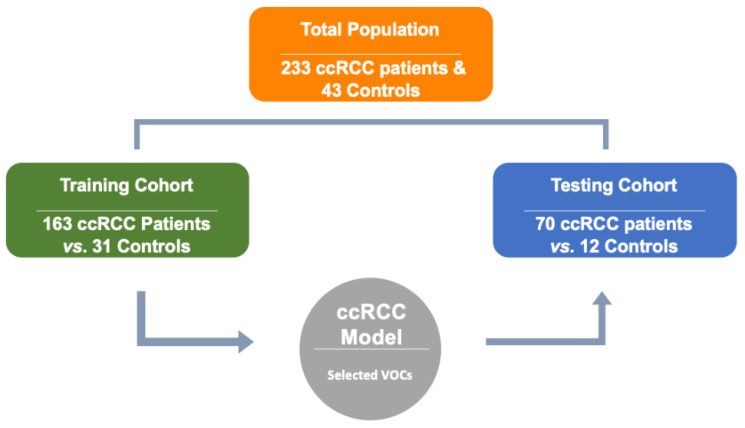
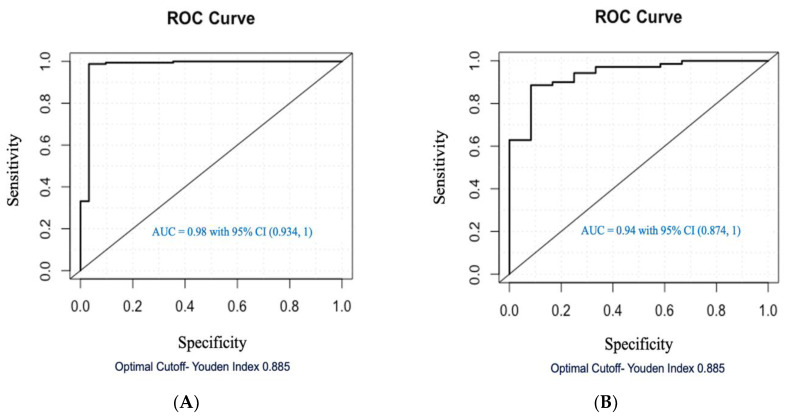
This study involved 233 pretreatment ccRCC patients and 43 healthy individuals. VOC analysis utilized stir-bar sorptive extraction coupled with thermal desorption gas chromatography/mass spectrometry (SBSE-TD-GC/MS). A ccRCC diagnostic model was established via logistic regression, trained on 163 ccRCC cases versus 31 controls, and validated with 70 ccRCC cases versus 12 controls, resulting in a ccRCC diagnostic model involving 24 VOC markers.
The findings demonstrated promising diagnostic efficacy, with an Area Under the Curve (AUC) of 0.94, 86% sensitivity, and 92% specificity.
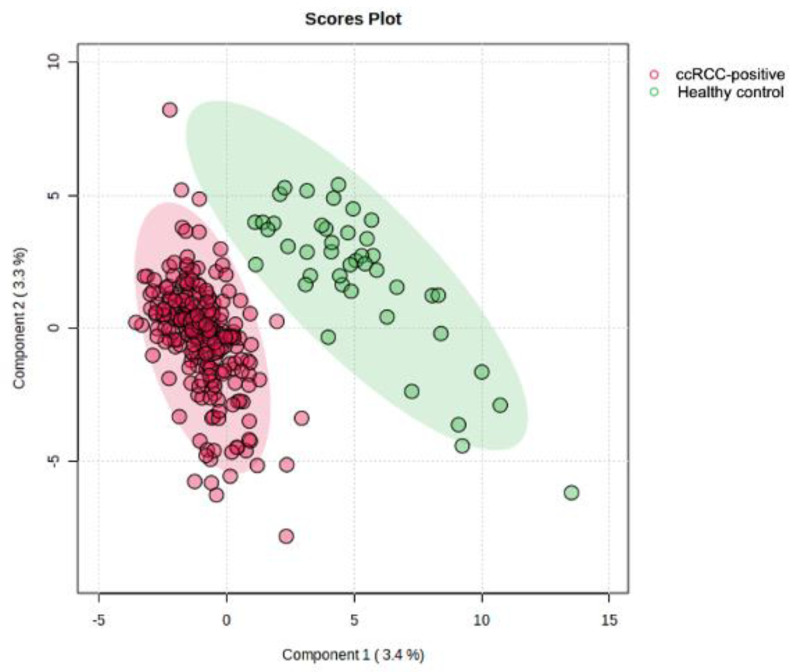
This study highlights the feasibility of using urine as a reliable biospecimen for identifying VOC biomarkers in ccRCC. While further validation in larger cohorts is necessary, this study's capability to differentiate between ccRCC and control groups, despite sample size limitations, holds significant promise.
透明细胞肾细胞癌(ccRCC)约占肾癌病例的70 - 80%,多数情况下在无关腹部影像学检查偶然发现或疾病晚期之前通常无症状。目前,缺乏针对肾癌的标准化筛查测试,这给疾病管理和改善患者预后带来了挑战。本研究旨在识别ccRCC阳性患者尿液中特定的挥发性有机化合物(VOCs),并建立基于尿液VOC的诊断模型。
本研究纳入了233例ccRCC预处理患者和43名健康个体。VOC分析采用搅拌棒吸附萃取结合热脱附气相色谱/质谱联用技术(SBSE - TD - GC/MS)。通过逻辑回归建立ccRCC诊断模型,以163例ccRCC病例与31例对照进行训练,并以70例ccRCC病例与12例对照进行验证,得到一个包含24种VOC标志物的ccRCC诊断模型。
研究结果显示出有前景的诊断效能,曲线下面积(AUC)为0.94,灵敏度为86%,特异性为92%。
本研究强调了将尿液作为一种可靠的生物样本用于识别ccRCC中VOC生物标志物的可行性。尽管需要在更大队列中进行进一步验证,但本研究在样本量有限的情况下区分ccRCC和对照组的能力具有重大前景。