Zhongshan Ophthalmic Center State Key Laboratory of Ophthalmology, Sun Yat-Sen University, Guangzhou, Guangdong, China.
School of Medical Information Engineering, Guangzhou University of Chinese Medicine, Guangzhou, China.
Br J Ophthalmol. 2024 Sep 20;108(10):1423-1429. doi: 10.1136/bjo-2024-325403.
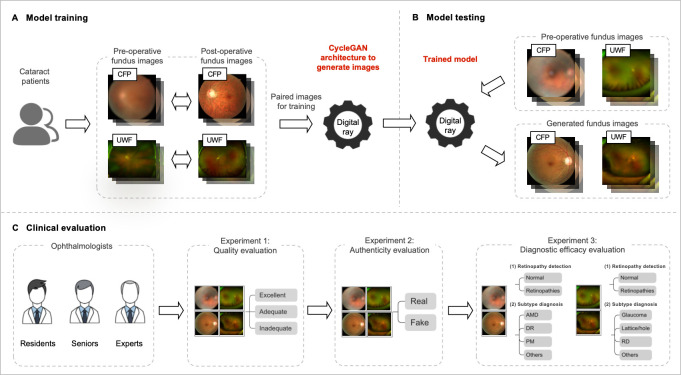
BACKGROUND/AIMS: The aim of this study was to develop and evaluate digital ray, based on preoperative and postoperative image pairs using style transfer generative adversarial networks (GANs), to enhance cataractous fundus images for improved retinopathy detection.
For eligible cataract patients, preoperative and postoperative colour fundus photographs (CFP) and ultra-wide field (UWF) images were captured. Then, both the original CycleGAN and a modified CycleGAN (CycleGAN) framework were adopted for image generation and quantitatively compared using Frechet Inception Distance (FID) and Kernel Inception Distance (KID). Additionally, CFP and UWF images from another cataract cohort were used to test model performances. Different panels of ophthalmologists evaluated the quality, authenticity and diagnostic efficacy of the generated images.
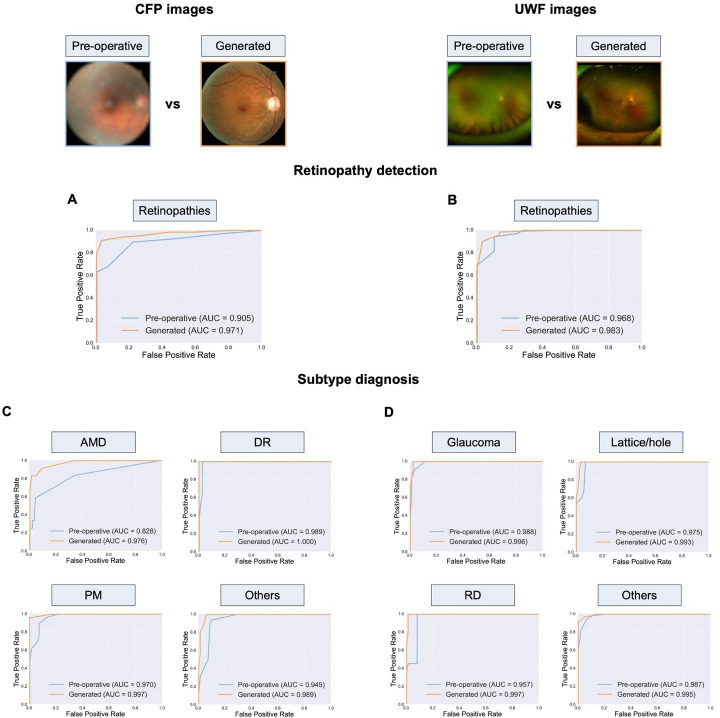
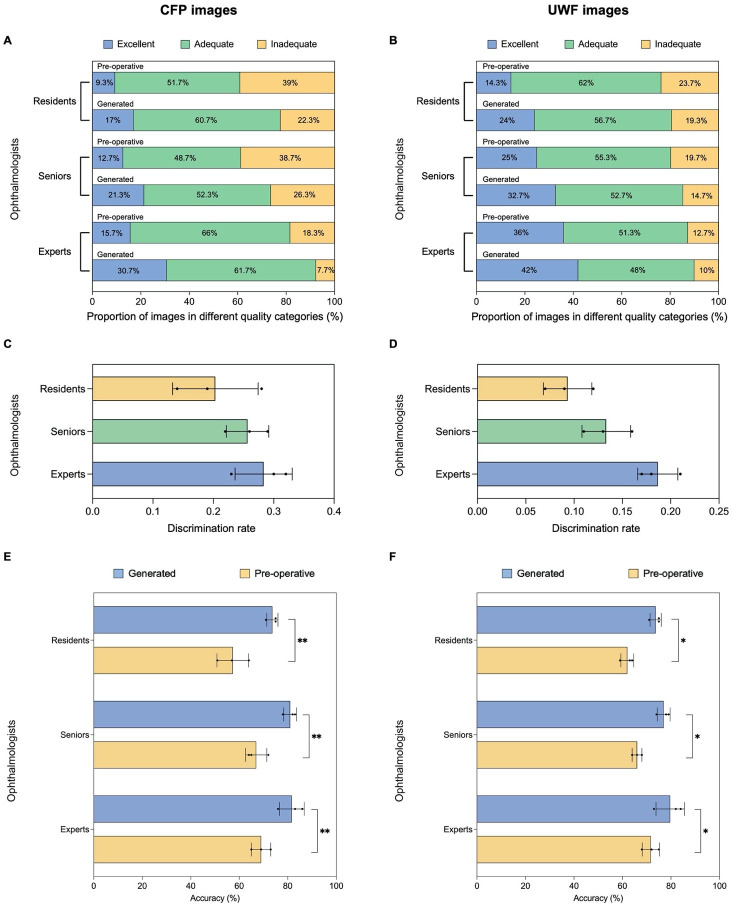
A total of 959 CFP and 1009 UWF image pairs were included in model development. FID and KID indicated that images generated by CycleGAN presented significantly improved quality. Based on ophthalmologists' average ratings, the percentages of inadequate-quality images decreased from 32% to 18.8% for CFP, and from 18.7% to 14.7% for UWF. Only 24.8% and 13.8% of generated CFP and UWF images could be recognised as synthetic. The accuracy of retinopathy detection significantly increased from 78% to 91% for CFP and from 91% to 93% for UWF. For retinopathy subtype diagnosis, the accuracies also increased from 87%-94% to 91%-100% for CFP and from 87%-95% to 93%-97% for UWF.
Digital ray could generate realistic postoperative CFP and UWF images with enhanced quality and accuracy for overall detection and subtype diagnosis of retinopathies, especially for CFP.\ TRIAL REGISTRATION NUMBER: This study was registered with ClinicalTrials.gov (NCT05491798).
背景/目的:本研究旨在开发一种基于术前和术后图像对的数字射线,使用风格转换生成对抗网络(GAN)增强白内障眼底图像,以提高糖尿病视网膜病变的检测效果。
对符合条件的白内障患者进行术前和术后彩色眼底照相(CFP)和超广角(UWF)图像采集。然后,采用原始 CycleGAN 和修改后的 CycleGAN(CycleGAN)框架进行图像生成,并使用 Frechet Inception Distance(FID)和 Kernel Inception Distance(KID)进行定量比较。此外,还使用另一组白内障患者的 CFP 和 UWF 图像来测试模型性能。不同的眼科医生小组评估生成图像的质量、真实性和诊断效果。
共纳入 959 对 CFP 和 1009 对 UWF 图像进行模型开发。FID 和 KID 表明,CycleGAN 生成的图像质量显著提高。根据眼科医生的平均评分,CFP 的低质量图像比例从 32%下降到 18.8%,UWF 的低质量图像比例从 18.7%下降到 14.7%。只有 24.8%和 13.8%的 CFP 和 UWF 生成图像被识别为合成图像。CFP 的糖尿病视网膜病变检测准确率从 78%提高到 91%,UWF 的准确率从 91%提高到 93%。对于糖尿病视网膜病变亚型诊断,准确率也从 CFP 的 87%-94%提高到 91%-100%,从 UWF 的 87%-95%提高到 93%-97%。
数字射线可以生成逼真的术后 CFP 和 UWF 图像,提高图像质量和整体检测的准确性,有助于糖尿病视网膜病变及其亚型的诊断。
本研究在 ClinicalTrials.gov 注册(NCT05491798)。