
全氟和多氟烷基物质(PFAS)的光降解和光催化:近期进展综述
Photodegradation and photocatalysis of per- and polyfluoroalkyl substances (PFAS): A review of recent progress.
作者信息
Verma Sanny, Mezgebe Bineyam, Hejase Charifa A, Sahle-Demessie Endalkachew, Nadagouda Mallikarjuna N
机构信息
Pegasus Technical Services INC., Cincinnati, OH 45219, USA.
Groundwater Characterization and Remediation Division, Center for Environmental Solutions and Emergency Response, US EPA, Ada, OK 74820, USA.
出版信息
Next Mater. 2024 Jan;2:1-12. doi: 10.1016/j.nxmate.2023.100077.
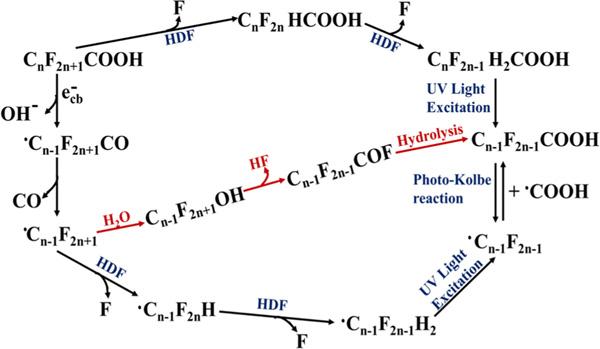
Per- and polyfluoroalkyl substances (PFAS) are oxidatively recalcitrant organic synthetic compounds. PFAS are an exceptional group of chemicals that have significant physical characteristics due to the presence of the most electronegative element (i.e., fluorine). PFAS persist in the environment, bioaccumulate, and have been linked to toxicological impacts. Epidemiological and toxicity studies have shown that PFAS pose environmental and health risks, requiring their complete elimination from the environment. Various separation technologies, including adsorption with activated carbon or ion exchange resin; nanofiltration; reverse osmosis; and destruction methods (e.g., sonolysis, thermally induced reduction, and photocatalytic dissociation) have been evaluated to remove PFAS from drinking water supplies. In this review, we will comprehensively summarize previous reports on the photodegradation of PFAS with a special focus on photocatalysis. Additionally, challenges associated with these approaches along with perspectives on the state-of-the-art approaches will be discussed. Finally, the photocatalytic defluorination mechanism of perfluorooctanoic acid (PFOA) and perfluorooctanesulfonic acid (PFOS) following complete mineralization will also be examined in detail.
全氟和多氟烷基物质(PFAS)是氧化难降解的有机合成化合物。PFAS是一类特殊的化学物质,由于存在电负性最强的元素(即氟),它们具有显著的物理特性。PFAS在环境中持久存在、生物累积,并与毒理学影响有关。流行病学和毒性研究表明,PFAS会带来环境和健康风险,需要将其从环境中彻底消除。为了从饮用水供应中去除PFAS,人们评估了各种分离技术,包括用活性炭或离子交换树脂吸附、纳滤、反渗透以及破坏方法(如声解、热诱导还原和光催化解离)。在本综述中,我们将全面总结以往关于PFAS光降解的报告,特别关注光催化。此外,还将讨论与这些方法相关的挑战以及对最新方法的展望。最后,还将详细研究全氟辛酸(PFOA)和全氟辛烷磺酸(PFOS)完全矿化后的光催化脱氟机理。


 Zotero 插件