School of Engineering, Brown University, Providence, Rhode Island, USA.
Department of Sociology and Institute at Brown for Environment and Society, Brown University, Providence, Rhode Island, USA.
Environ Health Perspect. 2018 Jun 15;126(6):065001. doi: 10.1289/EHP2727. eCollection 2018 Jun.
Multiple Northeast U.S. communities have discovered per- and polyfluoroalkyl substances (PFASs) in drinking water aquifers in excess of health-based regulatory levels or advisories. Regional stakeholders (consultants, regulators, and others) need technical background and tools to mitigate risks associated with exposure to PFAS-affected groundwater.
The aim was to identify challenges faced by stakeholders to extend best practices to other regions experiencing PFAS releases and to establish a framework for research strategies and best management practices.
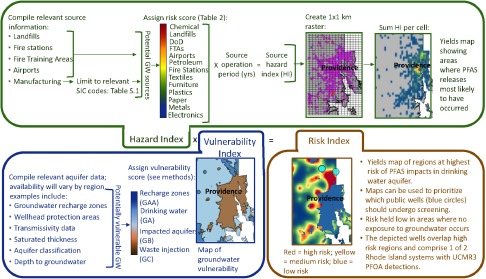
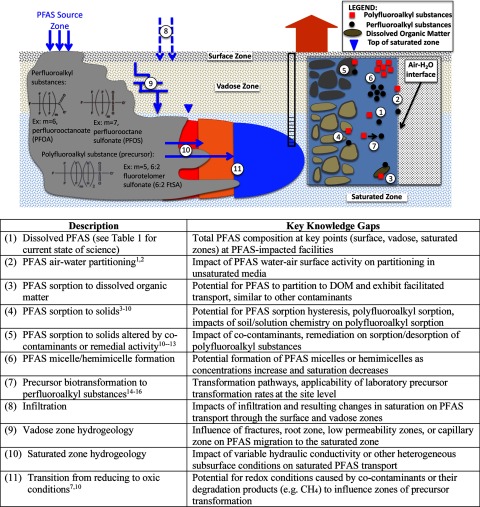
Management challenges were identified during stakeholder engagement events connecting attendees with PFAS experts in focus areas, including fate/transport, toxicology, and regulation. Review of the literature provided perspective on challenges in all focus areas. Publicly available data were used to characterize sources of PFAS impacts in groundwater and conduct a geospatial case study of potential source locations relative to drinking water aquifers in Rhode Island.
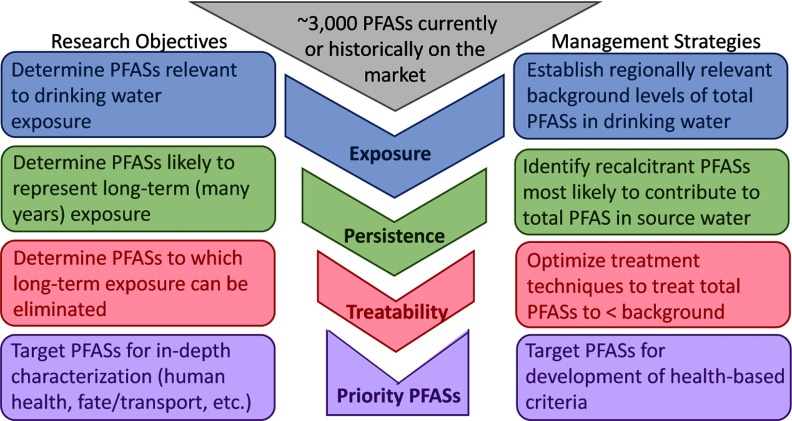
Challenges in managing PFAS impacts in drinking water arise from the large number of relevant PFASs, unconsolidated information regarding sources, and limited studies on some PFASs. In particular, there is still considerable uncertainty regarding human health impacts of PFASs. Frameworks sequentially evaluating exposure, persistence, and treatability can prioritize PFASs for evaluation of potential human health impacts. A regional case study illustrates how risk-based, geospatial methods can help address knowledge gaps regarding potential sources of PFASs in drinking water aquifers and evaluate risk of exposure.
Lessons learned from stakeholder engagement can assist in developing strategies for management of PFASs in other regions. However, current management practices primarily target a subset of PFASs for which in-depth studies are available. Exposure to less-studied, co-occurring PFASs remains largely unaddressed. Frameworks leveraging the current state of science can be applied toward accelerating this process and reducing exposure to total PFASs in drinking water, even as research regarding health effects continues. https://doi.org/10.1289/EHP2727.
美国东北部多个社区的饮用水含水层中都发现了超过基于健康的监管水平或建议的全氟和多氟烷基物质(PFAS)。地区利益相关者(顾问、监管机构和其他人员)需要技术背景和工具来减轻与受 PFAS 影响的地下水接触相关的风险。
目的是确定利益相关者在将最佳实践扩展到其他经历 PFAS 释放的地区时所面临的挑战,并为研究策略和最佳管理实践建立框架。
在将与会者与重点领域的 PFAS 专家联系起来的利益相关者参与活动中,确定了管理挑战,包括命运/传输、毒理学和监管。对文献的审查提供了所有重点领域挑战的视角。利用公开数据对地下水 PFAS 影响的来源进行特征描述,并对罗得岛饮用水含水层的潜在来源地点进行地理空间案例研究。
饮用水中 PFAS 影响管理面临的挑战来自大量相关的 PFAS、关于来源的信息不完整以及对某些 PFAS 的研究有限。特别是,PFAS 对人类健康的影响仍存在相当大的不确定性。依次评估暴露、持久性和可处理性的框架可以优先评估 PFAS 对潜在人类健康影响的评估。一个区域案例研究说明了基于风险的地理空间方法如何有助于解决饮用水含水层中 PFAS 潜在来源的知识空白,并评估暴露风险。
从利益相关者参与中吸取的经验教训可以帮助制定其他地区 PFAS 管理策略。然而,当前的管理实践主要针对具有深入研究的 PFAS 子集。对研究较少、共存的 PFAS 的暴露在很大程度上仍未得到解决。利用当前科学状况的框架可以加速这一进程,并减少饮用水中总 PFAS 的暴露,即使有关健康影响的研究仍在继续。https://doi.org/10.1289/EHP2727.