Rungelrath Viktoria, Ahmed Mushtaq, Hicks Linda, Miller Shannon M, Ryter Kendal T, Montgomery Kyle, Ettenger George, Riffey Alexander, Abdelwahab Walid M, Khader Shabaana Abdul, Evans Jay T
Center for Translational Medicine, University of Montana, 32 Campus Drive, Missoula, MT, 59812, USA.
Department of Biomedical & Pharmaceutical Sciences, University of Montana, Missoula, MT, 59812, USA.
NPJ Vaccines. 2024 Jun 6;9(1):100. doi: 10.1038/s41541-024-00897-x.
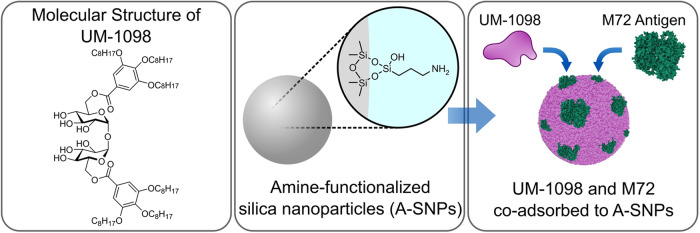
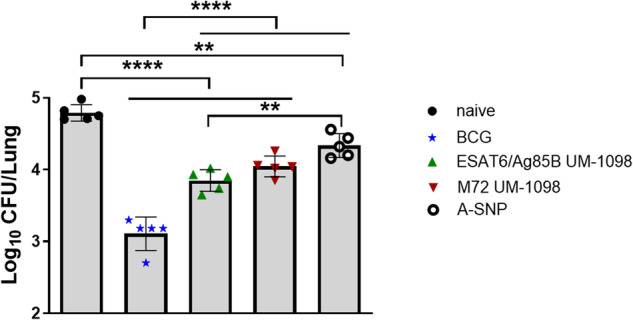
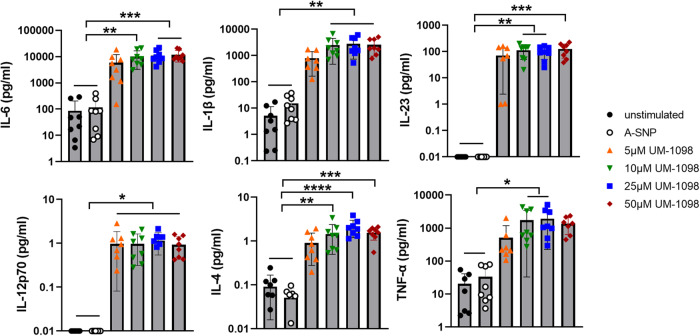
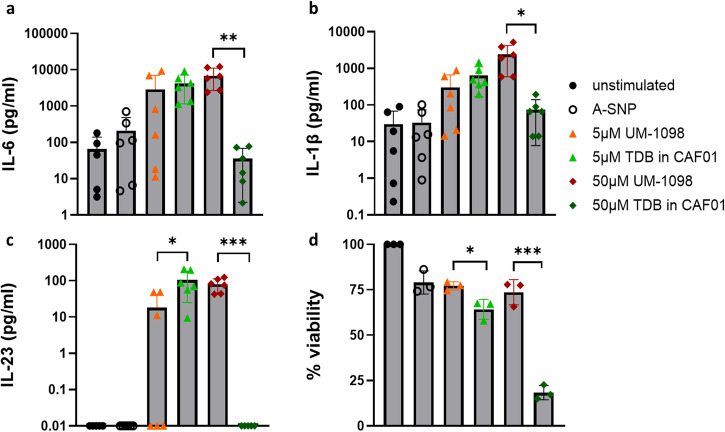
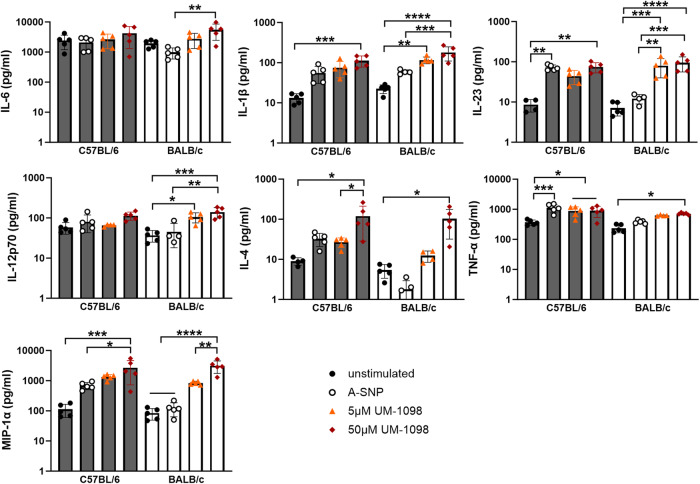
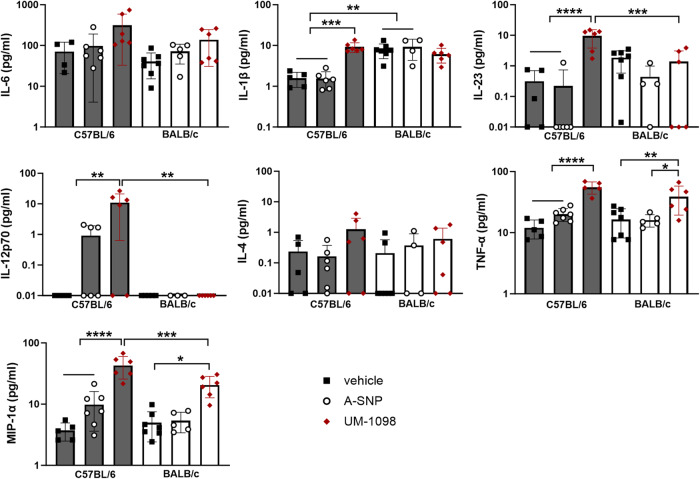
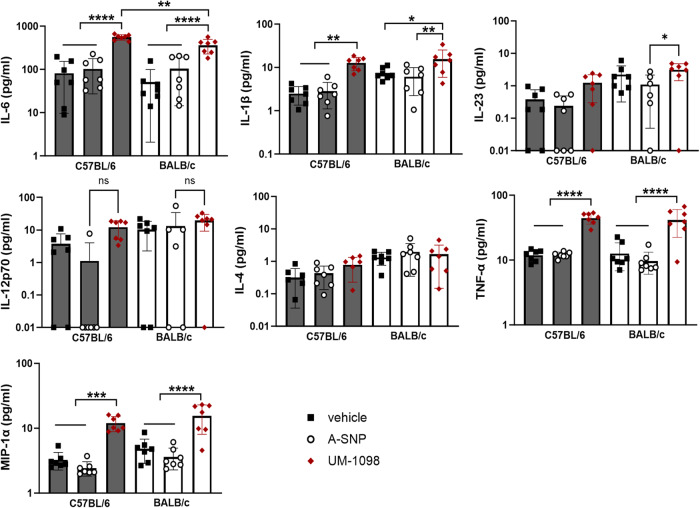
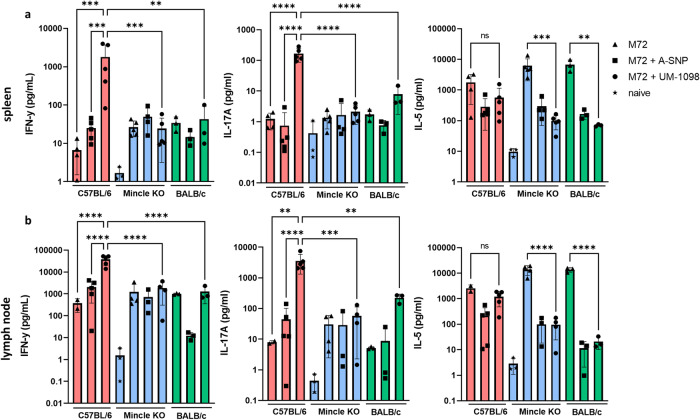
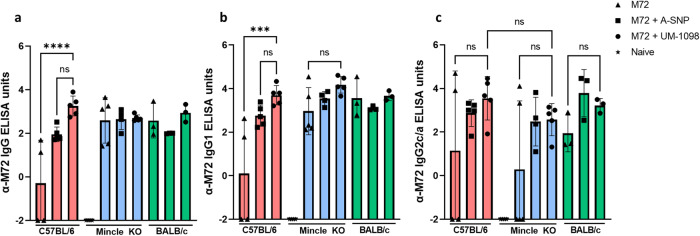
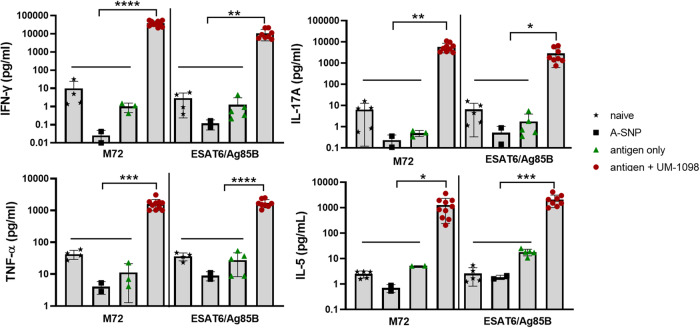
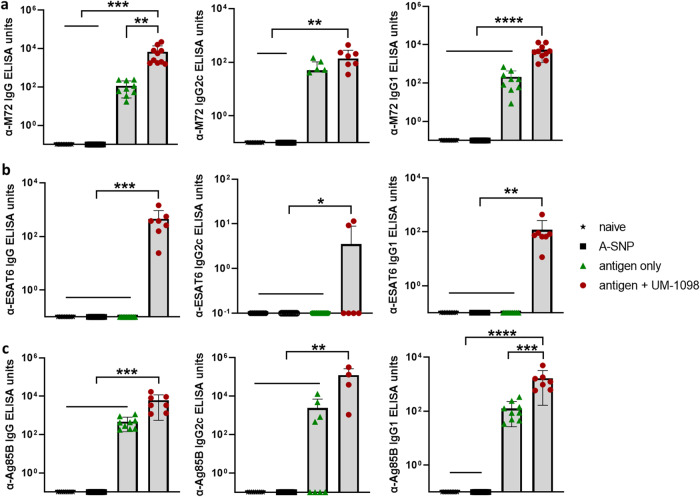
Tuberculosis (TB), caused by Mycobacterium tuberculosis (Mtb), is one of the top infectious killers in the world. The only licensed vaccine against TB, Bacille Calmette-Guérin (BCG), provides variable protection against pulmonary TB, especially in adults. Hence, novel TB vaccine approaches are urgently needed. Both Th1 and Th17 responses are necessary for protection against TB, yet effective adjuvants and vaccine delivery systems for inducing robust Th1 and Th17 immunity are lacking. Herein we describe a synthetic Mincle agonist, UM-1098, and a silica nanoparticle delivery system that drives Th1/Th17 responses to Mtb antigens. Stimulation of human peripheral blood mononuclear cells (hPBMCs) with UM-1098 induced high levels of Th17 polarizing cytokines IL-6, IL-1β, IL-23 as well as IL-12p70, IL-4 and TNF-α in vitro. PBMCs from both C57BL/6 and BALB/c mice responded with a similar cytokine pattern in vitro and in vivo. Importantly, intramuscular (I.M.) vaccination with UM-1098-adjuvanted TB antigen M72 resulted in significantly higher antigen-specific IFN-γ and IL-17A levels in C57BL/6 wt mice than Mincle KO mice. Vaccination of C57BL/6 wt mice with immunodominant Mtb antigens ESAT6/Ag85B or M72 resulted in predominantly Th1 and Th17 responses and induced antigen-specific serum antibodies. Notably, in a virulent Mtb challenge model, vaccination with UM-1098 adjuvanted ESAT6/Ag85B or M72 significantly reduced lung bacterial burden when compared with unvaccinated mice and protection occurred in the absence of pulmonary inflammation. These data demonstrate that the synthetic Mincle agonist UM-1098 induces strong Th1 and Th17 immunity after vaccination with Mtb antigens and provides protection against Mtb infection in mice.
由结核分枝杆菌(Mtb)引起的结核病(TB)是全球主要的传染性杀手之一。唯一获得许可的抗结核疫苗卡介苗(BCG)对肺结核的保护作用因人而异,尤其是在成年人中。因此,迫切需要新型的结核病疫苗研发方法。Th1和Th17反应对于抵抗结核病都是必需的,然而,目前缺乏能够诱导强大Th1和Th17免疫反应的有效佐剂和疫苗递送系统。在此,我们描述了一种合成的小清蛋白(Mincle)激动剂UM-1098以及一种能驱动针对Mtb抗原的Th1/Th17反应的二氧化硅纳米颗粒递送系统。在体外,用UM-1098刺激人外周血单核细胞(hPBMCs)可诱导高水平的Th17极化细胞因子IL-6、IL-1β、IL-23以及IL-12p70、IL-4和TNF-α。来自C57BL/6和BALB/c小鼠的PBMCs在体外和体内均呈现相似的细胞因子反应模式。重要的是,在C57BL/6野生型小鼠中,用UM-1098佐剂化的结核抗原M72进行肌肉注射(I.M.)疫苗接种后,其抗原特异性IFN-γ和IL-17A水平显著高于Mincle基因敲除小鼠。用免疫显性Mtb抗原ESAT6/Ag85B或M72对C57BL/6野生型小鼠进行疫苗接种可引发主要的Th1和Th17反应,并诱导产生抗原特异性血清抗体。值得注意的是,在一个强毒力Mtb攻击模型中,与未接种疫苗的小鼠相比,用UM-1098佐剂化的ESAT6/Ag85B或M72进行疫苗接种可显著降低肺部细菌载量,并且在没有肺部炎症的情况下产生保护作用。这些数据表明,合成的Mincle激动剂UM-1098在与Mtb抗原联合接种疫苗后可诱导强大的Th1和Th17免疫反应,并为小鼠抵抗Mtb感染提供保护。