Faculty of Sport, Laboratory of Biodynamics, University of Ljubljana, Ljubljana, Slovenia.
University Clinic of Pulmonary and Allergic Diseases Golnik, University of Ljubljana, Golnik, Slovenia.
Eur J Appl Physiol. 2024 Nov;124(11):3191-3199. doi: 10.1007/s00421-024-05522-2. Epub 2024 Jun 6.
The aim of this study was to determine how sodium hydrogen carbonate (NaHCO) ingestion during a 1-h recovery period after a 200-m front-crawl swim affects blood-gas levels, acid-base balance, and performance during a successive trial.
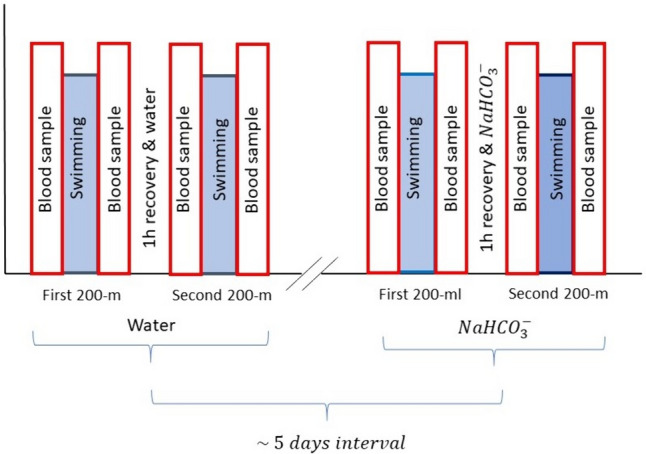
Fourteen national-level male swimmers (age: 21 ± 3 years, body mass (BM):77 ± 10 kg, stature: 181 ± 7 cm) performed four maximal 200-m front-crawl tests. On one of the two days, the swimmers swam two 200-m tests with a 1-h recovery break, during which they drank water (WATER); on the other day, they performed the same protocol but consumed 0.3 g min NaHCO solution during the recovery break (NaHCO).
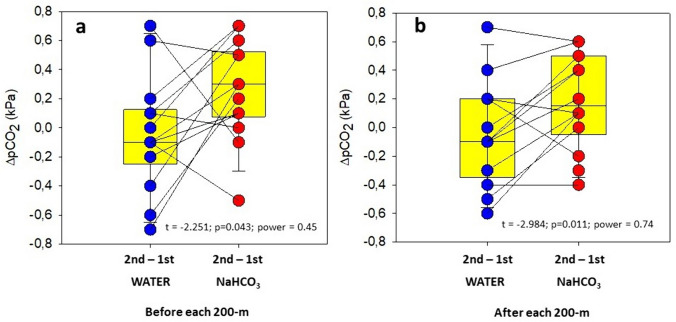
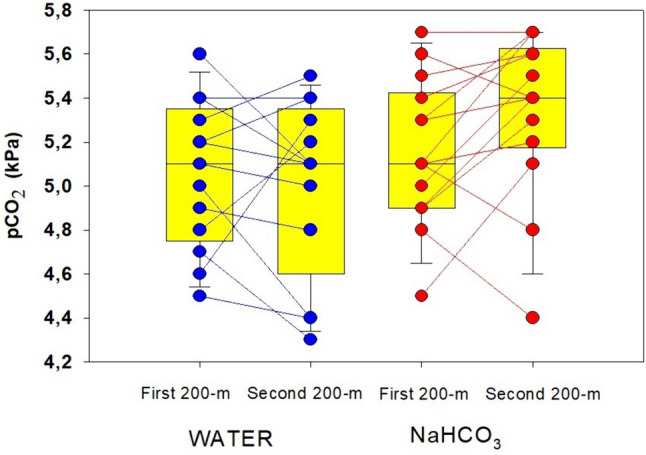
The ingestion of NaHCO before the second test had no effect on swim time despite a greater [ ] (19.2 ± 2.3 mmol L) than that measured during the first test (NaHCO) (14.5 ± 1.1 mmol L) and the other two tests (WATER) (12.7 ± 2.4 and 14.8 ± 1.5 mmol L; F = 18.554; p = 0.000) and a higher blood pH (7.46 ± 0.03) than that measured during the first test (NaHCO) (7.39 ± 0.02) and the other two tests (WATER) (7.16 ± 0.04 and 7.20 ± 0.05); (F = 5.255; p = 0.004). An increase in blood pCO (0.2 ± 0.3 kPa) between both tests (NaHCO) compared to unchanged pCO values (- 0.1 ± 0.3 kPa) between the other two tests (WATER) (t = - 2.984; p = 0.011; power = 0.741) was confirmed.
NaHCO ingestion during the recovery period between two 200-m front-crawl time trials had a strong buffering effect that did not positively affect performance. An increase in pCO may have counterbalanced this impact.
本研究旨在确定在 200 米爬泳后 1 小时恢复期内摄入碳酸氢钠(NaHCO)如何影响随后的试验中的血液气体水平、酸碱平衡和表现。
14 名国家级男游泳运动员(年龄:21±3 岁,体重(BM):77±10 公斤,身高:181±7 厘米)进行了四次最大 200 米爬泳测试。在其中两天,游泳运动员在 1 小时恢复期内进行了两次 200 米测试,在此期间他们饮用了水(WATER);在另一天,他们进行了相同的方案,但在恢复期内摄入了 0.3 g·min 的 NaHCO 溶液(NaHCO)。
尽管第二次测试时的 [ ](19.2±2.3 mmol·L)高于第一次测试(NaHCO)(14.5±1.1 mmol·L)和其他两次测试(WATER)(12.7±2.4 和 14.8±1.5 mmol·L;F=18.554;p=0.000),且血液 pH 值(7.46±0.03)高于第一次测试(NaHCO)(7.39±0.02)和其他两次测试(WATER)(7.16±0.04 和 7.20±0.05),但在第二次测试中摄入 NaHCO 对游泳时间没有影响(F=5.255;p=0.004)。与其他两次测试(WATER)之间不变的 pCO 值(-0.1±0.3 kPa)相比,两次测试(NaHCO)之间的血液 pCO 升高(0.2±0.3 kPa)得到了证实(t=-2.984;p=0.011;功率=0.741)。
在两次 200 米爬泳计时赛之间的恢复期内摄入 NaHCO 具有很强的缓冲作用,不会对表现产生积极影响。pCO 的增加可能抵消了这种影响。