Department of Neuroscience, Karolinska Institutet, Stockholm, Sweden.
Department of Biological Psychology, Vrije Universiteit Amsterdam, Amsterdam, The Netherlands.
Sci Rep. 2024 Jun 6;14(1):13030. doi: 10.1038/s41598-024-63566-y.
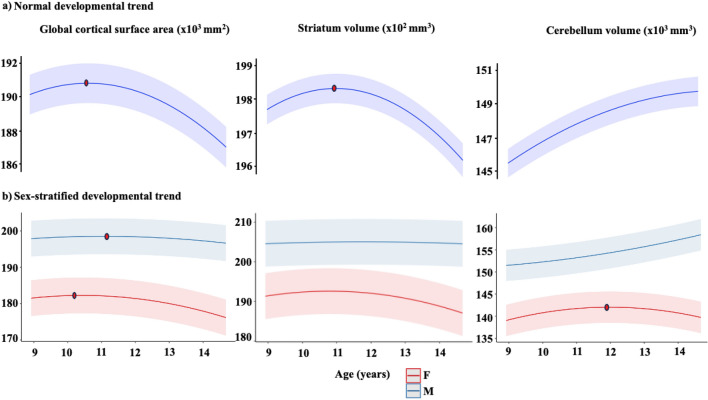
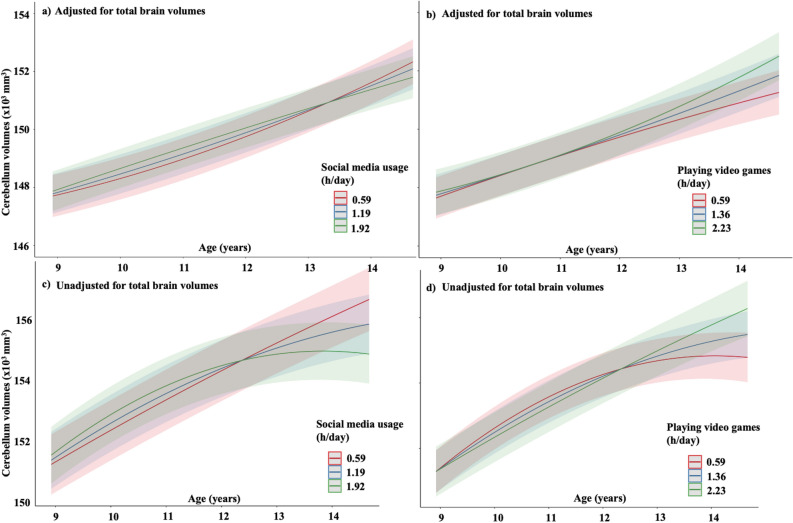
Digital media (DM) takes an increasingly large part of children's time, yet the long-term effect on brain development remains unclear. We investigated how individual effects of DM use (i.e., using social media, playing video games, or watching television/videos) on the development of the cortex (i.e., global cortical surface area), striatum, and cerebellum in children over 4 years, accounting for both socioeconomic status and genetic predisposition. We used a prospective, multicentre, longitudinal cohort of children from the Adolescent Brain and Cognitive Development Study, aged 9.9 years when entering the study, and who were followed for 4 years. Annually, children reported their DM usage through the Youth Screen Time Survey and underwent brain magnetic resonance imaging scans every 2 years. Quadratic-mixed effect modelling was used to investigate the relationship between individual DM usage and brain development. We found that individual DM usage did not alter the development of cortex or striatum volumes. However, high social media usage was associated with a statistically significant change in the developmental trajectory of cerebellum volumes, and the accumulated effect of high-vs-low social media users on cerebellum volumes over 4 years was only β = - 0.03, which was considered insignificant. Nevertheless, the developmental trend for heavy social media users was accelerated at later time points. This calls for further studies and longer follow-ups on the impact of social media on brain development.
数字媒体(DM)在儿童的时间中占据越来越大的比重,但它对大脑发育的长期影响尚不清楚。我们研究了儿童在超过 4 年的时间里,个体使用 DM(即使用社交媒体、玩电子游戏或看电视/视频)对大脑皮层(即总皮质表面积)、纹状体和小脑发育的影响,同时考虑了社会经济地位和遗传倾向。我们使用了来自青少年大脑与认知发展研究的前瞻性、多中心、纵向队列研究中的儿童数据,他们在进入研究时年龄为 9.9 岁,并在 4 年内进行了随访。每年,儿童通过青少年屏幕时间调查报告他们的 DM 使用情况,并每两年进行一次大脑磁共振成像扫描。二次混合效应模型用于研究个体 DM 使用与大脑发育之间的关系。我们发现,个体 DM 使用并不会改变大脑皮层或纹状体的体积发育。然而,高社交媒体使用与小脑体积发育轨迹的统计学显著变化相关,高社交媒体使用者与低社交媒体使用者在 4 年内对小脑体积的累积效应仅为 β=−0.03,这被认为是无意义的。然而,重度社交媒体使用者的发育趋势在后期加快了。这需要进一步研究和更长时间的随访,以了解社交媒体对大脑发育的影响。