Department of Medicine, Division of Allergy and Clinical Immunology, Johns Hopkins University School of Medicine, 5501 Hopkins Bayview Circle, Room 3B.65B, Baltimore, MD, 21224-6821, USA.
Department of Anesthesiology and Critical Care Medicine, Johns Hopkins University School of Medicine, 720 Rutland Avenue, Ross 361, Baltimore, MD, 21287, USA.
Respir Res. 2024 Jun 6;25(1):235. doi: 10.1186/s12931-024-02861-8.
Abnormal remodeling of distal pulmonary arteries in patients with pulmonary arterial hypertension (PAH) leads to progressively increased pulmonary vascular resistance, followed by right ventricular hypertrophy and failure. Despite considerable advancements in PAH treatment prognosis remains poor. We aim to evaluate the potential for using the cytokine resistin as a genetic and biological marker for disease severity and survival in a large cohort of patients with PAH.
Biospecimens, clinical, and genetic data for 1121 adults with PAH, including 808 with idiopathic PAH (IPAH) and 313 with scleroderma-associated PAH (SSc-PAH), were obtained from a national repository. Serum resistin levels were measured by ELISA, and associations between resistin levels, clinical variables, and single nucleotide polymorphism genotypes were examined with multivariable regression models. Machine-learning (ML) algorithms were applied to develop and compare risk models for mortality prediction.
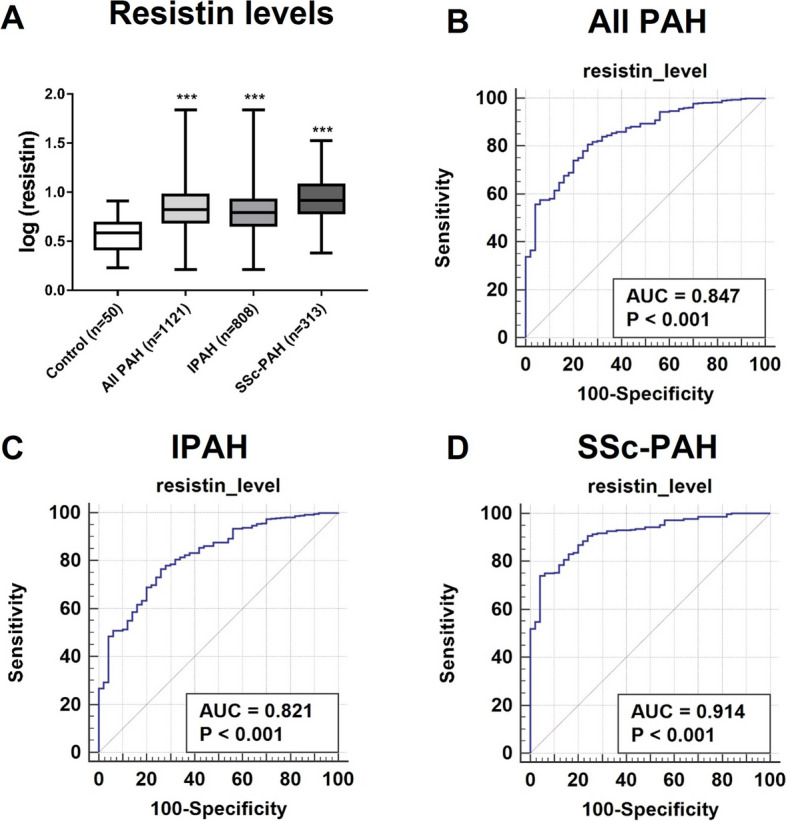
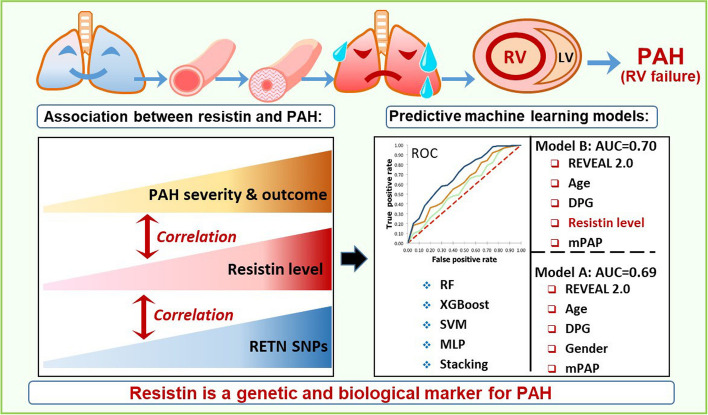
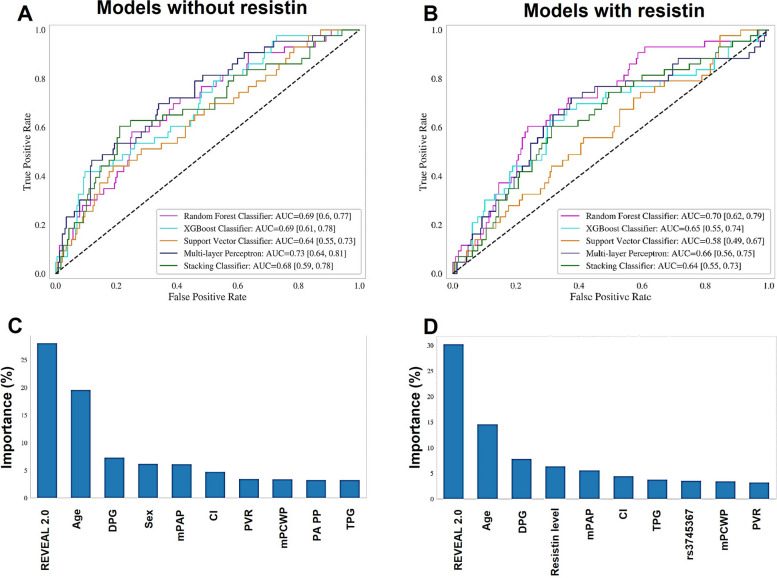
Resistin levels were significantly higher in all PAH samples and PAH subtype (IPAH and SSc-PAH) samples than in controls (P < .0001) and had significant discriminative abilities (AUCs of 0.84, 0.82, and 0.91, respectively; P < .001). High resistin levels (above 4.54 ng/mL) in PAH patients were associated with older age (P = .001), shorter 6-min walk distance (P = .001), and reduced cardiac performance (cardiac index, P = .016). Interestingly, mutant carriers of either rs3219175 or rs3745367 had higher resistin levels (adjusted P = .0001). High resistin levels in PAH patients were also associated with increased risk of death (hazard ratio: 2.6; 95% CI: 1.27-5.33; P < .0087). Comparisons of ML-derived survival models confirmed satisfactory prognostic value of the random forest model (AUC = 0.70, 95% CI: 0.62-0.79) for PAH.
This work establishes the importance of resistin in the pathobiology of human PAH. In line with its function in rodent models, serum resistin represents a novel biomarker for PAH prognostication and may indicate a new therapeutic avenue. ML-derived survival models highlighted the importance of including resistin levels to improve performance. Future studies are needed to develop multi-marker assays that improve noninvasive risk stratification.
肺动脉高压(PAH)患者远端肺血管的异常重塑导致肺血管阻力逐渐增加,继而出现右心室肥厚和衰竭。尽管 PAH 的治疗取得了相当大的进展,但预后仍然不佳。我们旨在评估细胞因子抵抗素作为一种遗传和生物学标志物,用于评估大量 PAH 患者疾病严重程度和生存的潜力。
从一个国家存储库中获取了 1121 名成人 PAH 患者的生物样本、临床和遗传数据,其中 808 名患者患有特发性 PAH(IPAH),313 名患者患有硬皮病相关 PAH(SSc-PAH)。通过 ELISA 测量血清抵抗素水平,并使用多变量回归模型检查抵抗素水平与临床变量和单核苷酸多态性基因型之间的关联。应用机器学习(ML)算法来开发和比较死亡率预测的风险模型。
PAH 样本和 PAH 亚型(IPAH 和 SSc-PAH)样本中的抵抗素水平均显著高于对照组(P <.0001),且具有显著的区分能力(AUC 分别为 0.84、0.82 和 0.91,P <.001)。PAH 患者的高抵抗素水平(高于 4.54 ng/mL)与年龄较大(P =.001)、6 分钟步行距离较短(P =.001)和心脏功能降低(心指数,P =.016)有关。有趣的是,rs3219175 或 rs3745367 突变体携带者的抵抗素水平更高(调整后的 P =.0001)。PAH 患者的高抵抗素水平也与死亡风险增加相关(风险比:2.6;95%CI:1.27-5.33;P <.0087)。ML 衍生的生存模型比较证实,随机森林模型(AUC=0.70,95%CI:0.62-0.79)对 PAH 具有令人满意的预后价值。
这项工作确立了抵抗素在人类 PAH 的病理生物学中的重要性。与在啮齿动物模型中的功能一致,血清抵抗素代表了一种用于 PAH 预后预测的新型生物标志物,并且可能指示了一种新的治疗途径。ML 衍生的生存模型强调了纳入抵抗素水平以改善性能的重要性。需要进一步的研究来开发改善非侵入性风险分层的多标志物检测。