Division of Pediatric Cardiology, Department of Pediatrics, Johns Hopkins University, 720 Rutland Ave. Ross RM 1143, Baltimore, MD, 21205, USA.
Division of Pulmonary and Critical Care Medicine, Department of Medicine, Johns Hopkins University, Baltimore, MD, USA.
BMC Med. 2020 Oct 6;18(1):268. doi: 10.1186/s12916-020-01734-3.
Pulmonary arterial hypertension (PAH) is a fatal disease that results from cardio-pulmonary dysfunction with the pathology largely unknown. Insulin-like growth factor binding protein 2 (IGFBP2) is an important member of the insulin-like growth factor family, with evidence suggesting elevation in PAH patients. We investigated the diagnostic and prognostic value of serum IGFBP2 in PAH to determine if it could discriminate PAH from healthy controls and if it was associated with disease severity and survival.
Serum IGFBP2 levels, as well as IGF1/2 levels, were measured in two independent PAH cohorts, the Johns Hopkins Pulmonary Hypertension program (JHPH, N = 127), NHLBI PAHBiobank (PAHB, N = 203), and a healthy control cohort (N = 128). The protein levels in lung tissues were determined by western blot. The IGFBP2 mRNA expression levels in pulmonary artery smooth muscle cells (PASMC) and endothelial cells (PAEC) were assessed by RNA-seq, secreted protein levels by ELISA. Association of biomarkers with clinical variables was evaluated using adjusted linear or logistic regression and Kaplan-Meier analysis.
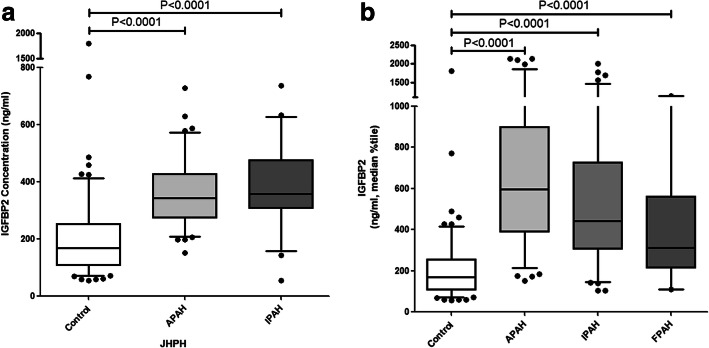
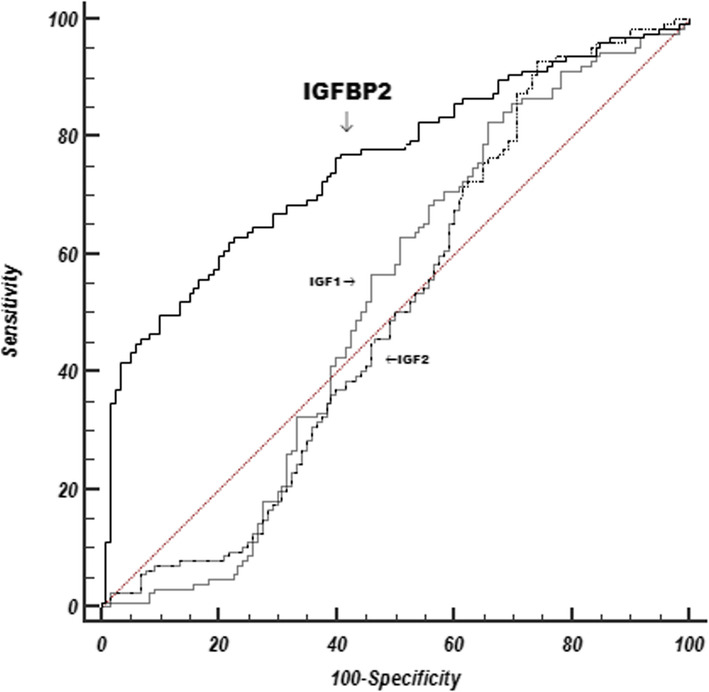
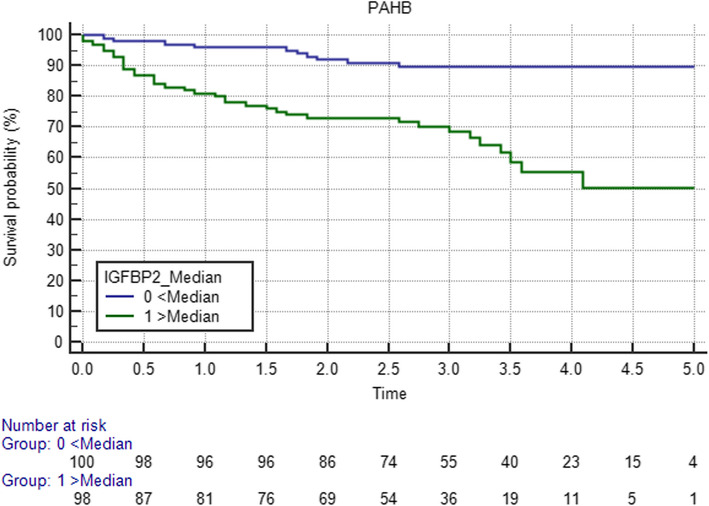
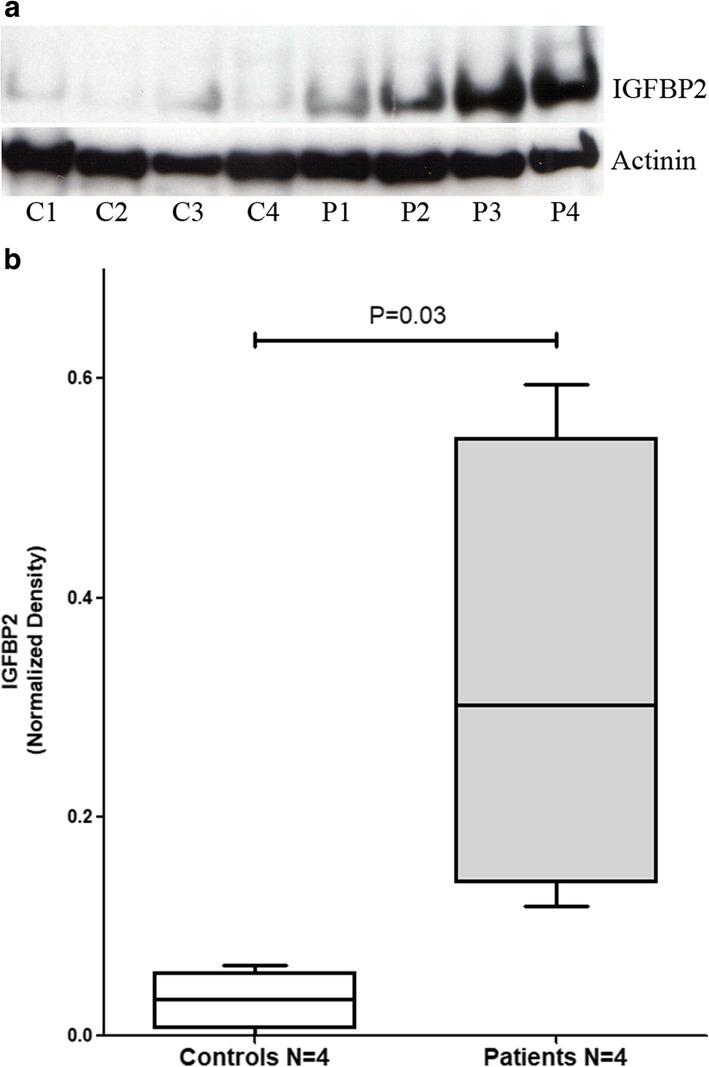
In both PAH cohorts, serum IGFBP2 levels were significantly elevated (p < 0.0001) compared to controls and discriminated PAH from controls with an AUC of 0.76 (p < 0.0001). A higher IGFBP2 level was associated with a shorter 6-min walk distance (6MWD) in both cohorts after adjustment for age and sex (coefficient - 50.235 and - 57.336 respectively). Cox multivariable analysis demonstrated that higher serum IGFBP2 was a significant independent predictor of mortality in PAHB cohort only (HR, 3.92; 95% CI, 1.37-11.21). IGF1 levels were significantly increased only in the PAHB cohort; however, neither IGF1 nor IGF2 had equivalent levels of associations with clinical variables compared with IGFBP2. Western blotting shown that IGFBP2 protein was significantly increased in the PAH vs control lung tissues. Finally, IGFBP2 mRNA expression and secreted protein levels were significantly higher in PASMC than in PAEC.
IGFBP2 protein expression was increased in the PAH lung, and secreted by PASMC. Elevated circulating IGFBP2 was associated with PAH severity and mortality and is a potentially valuable prognostic marker in PAH.
肺动脉高压(PAH)是一种由心肺功能障碍引起的致命疾病,其病理机制尚不清楚。胰岛素样生长因子结合蛋白 2(IGFBP2)是胰岛素样生长因子家族的重要成员,有证据表明 PAH 患者的 IGFBP2 水平升高。我们研究了血清 IGFBP2 在 PAH 中的诊断和预后价值,以确定其是否可以区分 PAH 患者与健康对照者,以及是否与疾病严重程度和生存相关。
在两个独立的 PAH 队列(约翰霍普金斯肺动脉高压计划[JHPH],N=127;NHLBI PAHBiobank,PAHB,N=203)和健康对照组(N=128)中测量了血清 IGFBP2 水平以及 IGF1/2 水平。通过 Western blot 测定肺组织中的蛋白水平。通过 RNA-seq 评估肺动脉平滑肌细胞(PASMC)和内皮细胞(PAEC)中的 IGFBP2 mRNA 表达水平,通过 ELISA 测定分泌蛋白水平。使用调整后的线性或逻辑回归和 Kaplan-Meier 分析评估生物标志物与临床变量的相关性。
在两个 PAH 队列中,与对照组相比,血清 IGFBP2 水平均显著升高(p<0.0001),且 AUC 为 0.76(p<0.0001),可区分 PAH 与对照组。在调整年龄和性别后,两个队列中的 IGFBP2 水平越高,6 分钟步行距离(6MWD)越短(系数分别为-50.235 和-57.336)。Cox 多变量分析表明,只有在 PAHB 队列中,较高的血清 IGFBP2 是死亡率的独立显著预测因子(HR,3.92;95%CI,1.37-11.21)。仅在 PAHB 队列中 IGF1 水平显著升高;然而,与 IGFBP2 相比,IGF1 和 IGF2 与临床变量的关联程度均无相当水平。Western blot 显示,PAH 肺组织中的 IGFBP2 蛋白显著增加。最后,PASMC 中的 IGFBP2 mRNA 表达和分泌蛋白水平明显高于 PAEC。
PAH 肺组织中 IGFBP2 蛋白表达增加,并由 PASMC 分泌。循环 IGFBP2 升高与 PAH 严重程度和死亡率相关,是 PAH 潜在有价值的预后标志物。