Clinical Epidemiology Unit, Makerere University College of Health Sciences, PO Box 7475, Kampala, Uganda.
Infectious Diseases Research Collaboration, Kampala, Uganda.
Malar J. 2024 Jun 6;23(1):180. doi: 10.1186/s12936-024-05008-8.
Disruptions in malaria control due to COVID-19 mitigation measures were predicted to increase malaria morbidity and mortality in Africa substantially. In Uganda, long-lasting insecticidal nets (LLINs) are distributed nationwide every 3-4 years, but the 2020-2021 campaign was altered because of COVID-19 restrictions so that the timing of delivery of new nets was different from the original plans made by the National Malaria Control Programme.
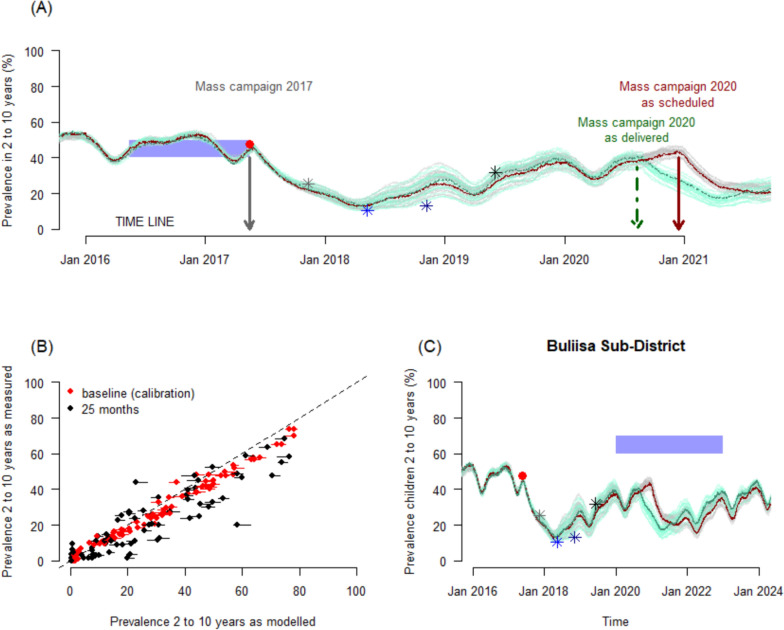
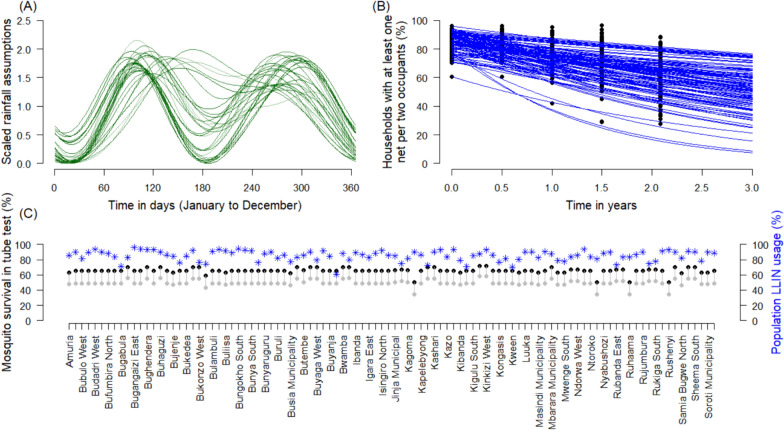
A transmission dynamics modelling exercise was conducted to explore how the altered delivery of LLINs in 2020-2021 impacted malaria burden in Uganda. Data were available on the planned LLIN distribution schedule for 2020-2021, and the actual delivery. The transmission model was used to simulate 100 health sub-districts, and parameterized to match understanding of local mosquito bionomics, net use estimates, and seasonal patterns based on data collected in 2017-2019 during a cluster-randomized trial (LLINEUP). Two scenarios were compared; simulated LLIN distributions matching the actual delivery schedule, and a comparable scenario simulating LLIN distributions as originally planned. Model parameters were otherwise matched between simulations.
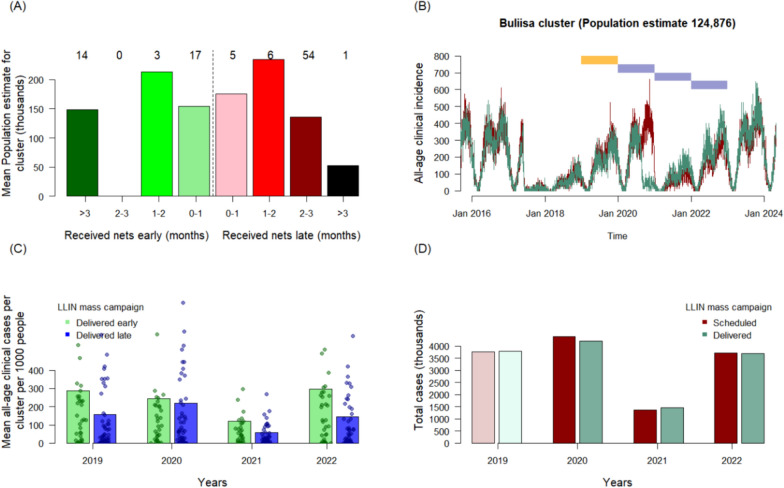
Approximately 70% of the study population received LLINs later than scheduled in 2020-2021, although some areas received LLINs earlier than planned. The model indicates that malaria incidence in 2020 was substantially higher in areas that received LLINs late. In some areas, early distribution of LLINs appeared less effective than the original distribution schedule, possibly due to attrition of LLINs prior to transmission peaks, and waning LLIN efficacy after distribution. On average, the model simulations predicted broadly similar overall mean malaria incidence in 2021 and 2022. After accounting for differences in cluster population size and LLIN distribution dates, no substantial increase in malaria burden was detected.
The model results suggest that the disruptions in the 2020-2021 LLIN distribution campaign in Uganda did not substantially increase malaria burden in the study areas.
由于 COVID-19 缓解措施导致疟疾控制中断,预计非洲的疟疾发病率和死亡率将大幅上升。在乌干达,长效驱虫蚊帐(LLINs)每 3-4 年在全国范围内分发一次,但由于 COVID-19 限制,2020-2021 年的运动发生了变化,新蚊帐的交付时间与国家疟疾控制规划最初的计划不同。
进行了一项传播动力学建模研究,以探讨 2020-2021 年长效驱虫蚊帐的交付变化如何影响乌干达的疟疾负担。有关于 2020-2021 年计划的长效驱虫蚊帐分发时间表的数据,以及实际交付的数据。该传播模型用于模拟 100 个卫生分地区,并根据 2017-2019 年在一项集群随机试验(LLINEUP)中收集的数据,对当地蚊子生物学、蚊帐使用估计和季节性模式进行参数化。比较了两种情况;模拟与实际交付时间表相匹配的长效驱虫蚊帐分布,以及模拟按原计划分发长效驱虫蚊帐的可比情况。模拟之间匹配了模型参数。
尽管某些地区比计划提前收到了长效驱虫蚊帐,但 2020-2021 年约有 70%的研究人群收到长效驱虫蚊帐的时间晚于计划。模型表明,2020 年在较晚收到长效驱虫蚊帐的地区疟疾发病率明显更高。在某些地区,早期分发长效驱虫蚊帐的效果似乎不如原分发时间表,可能是由于传播高峰期前长效驱虫蚊帐的损耗,以及分发后长效驱虫蚊帐的效果减弱。平均而言,模型模拟预测 2021 年和 2022 年总体疟疾发病率大致相似。在考虑到集群人口规模和长效驱虫蚊帐分发日期的差异后,未发现疟疾负担有实质性增加。
模型结果表明,乌干达 2020-2021 年长效驱虫蚊帐分发运动的中断并没有使研究地区的疟疾负担大幅增加。