Department of Social and Behavioral Health, School of Public Health, University of Nevada Las Vegas, Las Vegas, NV, USA.
Department of Pediatrics, Chobanian & Avedisian School of Medicine, Boston University, Boston, MA, USA.
J Health Popul Nutr. 2024 Jun 6;43(1):78. doi: 10.1186/s41043-024-00573-9.
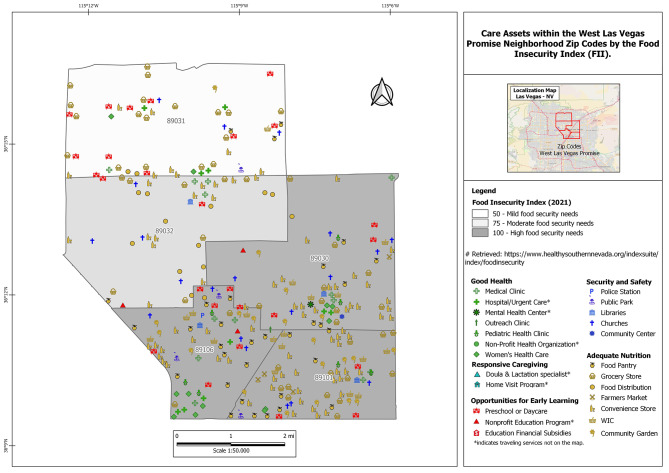
Zip codes classified by the Food Insecurity Index with moderate and high food insecurity (FI) risk can be a threat to the health and well-being of children during the first 1,000 days (from pregnancy to 2 years). The presence of nurturing care assets (i.e., stable environments that promote health and nutrition, learning opportunities, security and safety, and responsive relationships) can contribute to supporting families and their communities, and ultimately reduce systemic barriers to food security. We aimed to identify and characterize nurturing care assets in under-resourced communities with moderate and high FI risk.
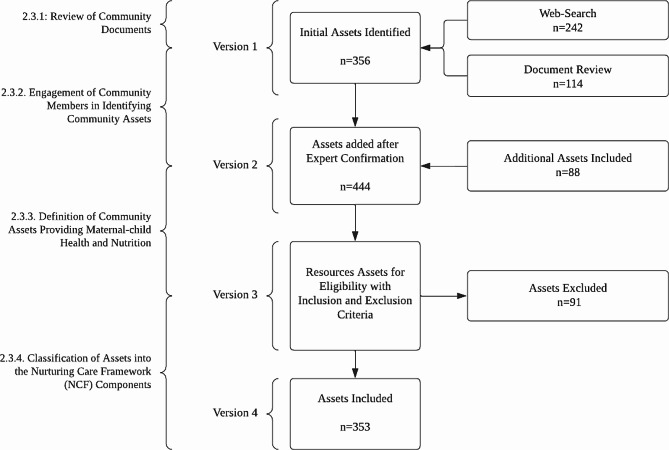
Four steps were used to conduct a Community Asset Mapping (CAM): (1) review of community documents across five zip codes in Clark County, Nevada (2), engagement of community members in identifying community assets (3), definition of the assets providing nurturing care services, and (4) classification of assets to nurturing care components, i.e., good health, adequate nutrition, safety and security, opportunities for early learning, and responsive caregiving. The Food Insecurity Index was used to determine FI risk in each zip code. Analyses explored whether disparities in nurturing care assets across zip codes with moderate and high FI exist.
We identified 353 nurturing care assets across zip codes. A more significant number of nurturing care assets were present in zip codes with high FI risk. The adequate nutrition component had the most assets overall (n = 218, 61.8%), while the responsive caregiving category had the least (n = 26, 7.4%). Most of the adequate nutrition resources consisted of convenience stores (n = 96), food pantries (n = 33), and grocery stores (n = 33). Disparities in the number and type of good health, early learning, and security and safety assets were identified within zip codes with high FI risk compared to moderate FI risk.
The quantity and type of nurturing care assets can exacerbate existing demographic disparities across zip codes, which are tied to barriers to access to food in under-resourced communities in Clark County, Nevada. Co-creating a nurturing care asset-based zip code strategy to address high FI risk will require strengthening systems across existing nurturing care assets.
根据食品不安全指数(Food Insecurity Index)进行分类的邮政编码,其中中高度食品不安全(FI)风险可能会威胁儿童在前 1000 天(从怀孕到 2 岁)的健康和福祉。养育关怀资产(即促进健康和营养、学习机会、安全保障以及回应性关系的稳定环境)的存在可以帮助支持家庭及其社区,并最终减少获得食品安全的系统性障碍。我们旨在识别和描述中高度 FI 风险的资源匮乏社区中的养育关怀资产。
使用社区资产绘图(Community Asset Mapping,CAM)进行了四个步骤:(1)在内华达州克拉克县的五个邮政编码中审查社区文件,(2)让社区成员参与识别社区资产,(3)定义提供养育关怀服务的资产,以及(4)将资产分类到养育关怀组成部分,即良好的健康、充足的营养、安全和保障、早期学习机会和回应性的养育。食品不安全指数用于确定每个邮政编码的 FI 风险。分析探讨了中高度 FI 风险邮政编码之间的养育关怀资产是否存在差异。
我们在邮政编码中识别出 353 个养育关怀资产。在 FI 风险较高的邮政编码中,养育关怀资产的数量更多。充足的营养成分总体上拥有最多的资产(n=218,61.8%),而回应性的养育关怀类别则拥有最少的资产(n=26,7.4%)。充足营养资源中,便利商店(n=96)、食品储藏室(n=33)和杂货店(n=33)居多。在高 FI 风险邮政编码中,与中 FI 风险相比,在健康、早期学习和安全保障资产的数量和类型方面存在差异。
在克拉克县内的资源匮乏社区中,在中高度 FI 风险的邮政编码中,养育关怀资产的数量和类型可能会加剧现有的人口统计学差异,这些差异与获取食物的障碍有关。为了解决高 FI 风险问题,共同创建一个基于养育关怀资产的邮政编码战略将需要加强现有养育关怀资产的系统。