Yao Kai, Jiang Ruoke, Wang Ping, Zhang Jing, Shao Bing, Ding Xiaojing
Beijing Key Laboratory of Diagnostic and Traceability Technologies for Food Poisoning, Beijing Center for Disease Prevention and Control, Beijing, 100013, China.
Heliyon. 2024 May 23;10(11):e31797. doi: 10.1016/j.heliyon.2024.e31797. eCollection 2024 Jun 15.
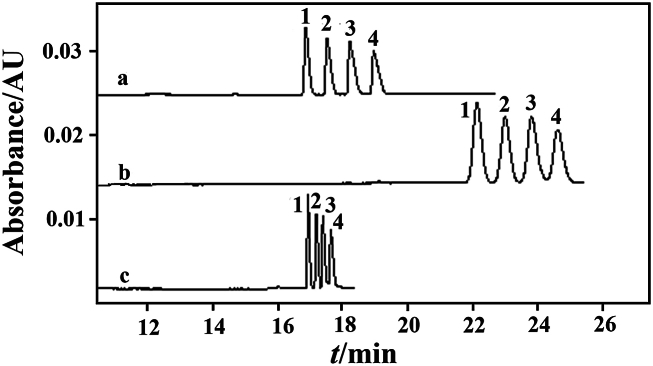
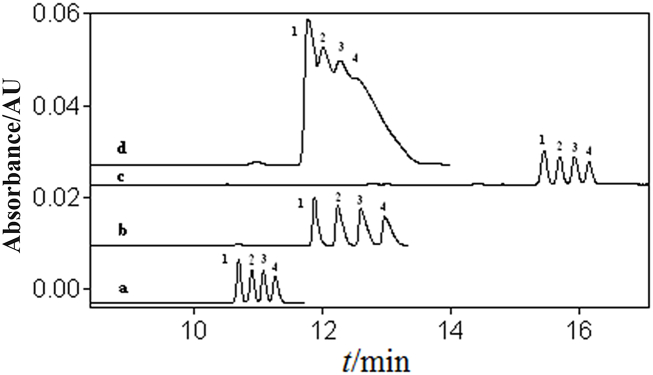
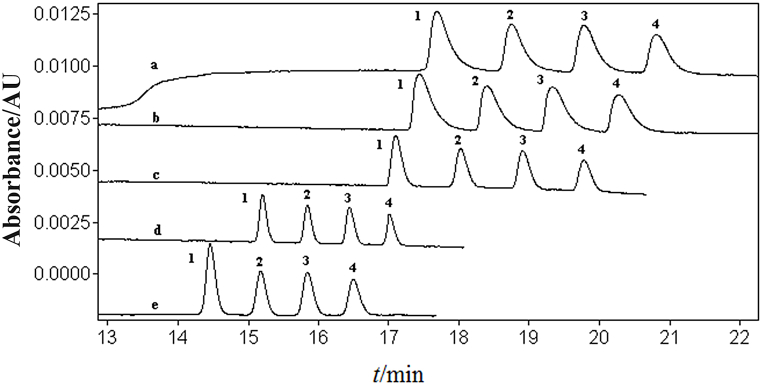
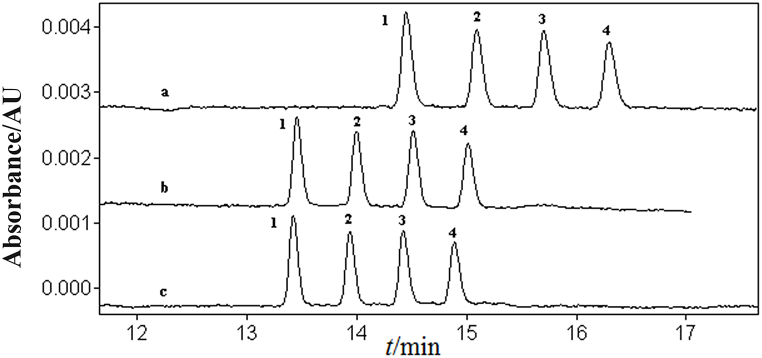
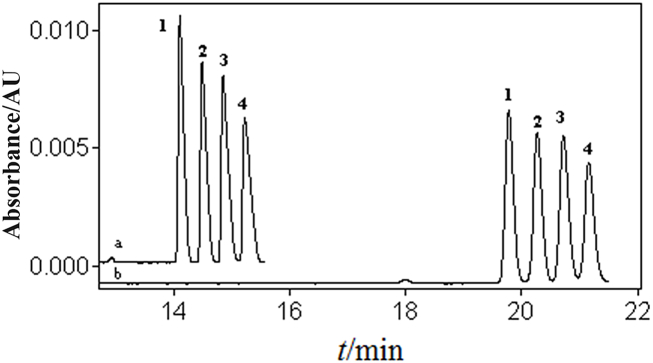
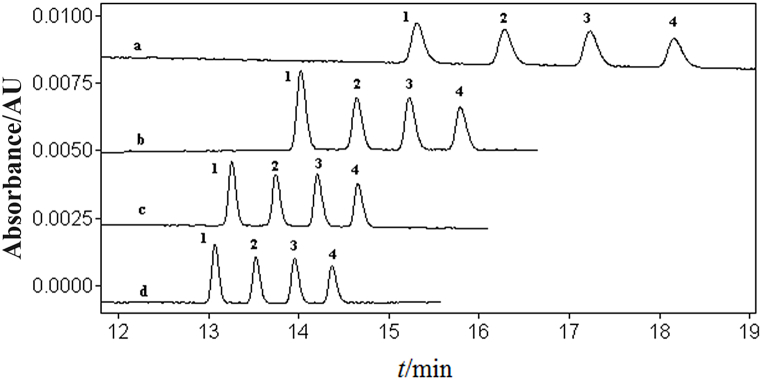
A new method was established for the simultaneous analysis of four homologous benzalkonium chlorides (dodecyldimethylbenzyl ammonium chloride, tetradecyldimethylbenzyl ammonium chloride, hexadecyldimethylbenzyl ammonium chloride, and octadecyldimethylbenzyl ammonium chloride) in compound chemical disinfectants using non-aqueous capillary electrophoresis (CE) based on a micellar electrokinetic chromatography mode with direct ultraviolet detection. The separation was performed on an uncoated fused quartz capillary with a total length of 60.2 cm and a diameter of 25 μm. The separation buffer consisted of a mixture of methanol/acetonitrile (60:40, v/v) containing 70 mmol/L sodium acetate, 60 mmol/L trifluoroacetic acid and 20 mmol/L sodium dodecyl sulfate. The sample buffer was a methanol solution containing only 2 mmol/L trifluoroacetic acid. The separation voltage was set at 8 kV with a working current of approximately 2.3 μA. The detection wavelength was 214 nm. Under optimal conditions, the limit of detection and limit of quantification for these four benzalkonium chlorides (BACs) were 1.0 mg/L and 5.0 mg/L, respectively. Good linearities were observed in the concentration ranges from 5.0 to 100.0 mg/L, with correlation coefficients above 0.999 for all compounds. The recoveries of these four BACs ranged from 92.5 % to 109.1 % with relative standard deviations below 4.7 %. With the new method, all four BACs could be analyzed in a single injection. In contrast, the aqueous CE method in the National Standard GB/T 26369-2020 only allowed for the simultaneous analysis of the first three homologous. The new method demonstrated the improved peak shape compared to the aqueous CE method and then was successfully applied to the analysis of 19 commercially available samples, such as object table disinfectants, hand sanitizers, and disinfectant wipes, which claimed to contain quaternary ammonium compound. The results obtained using the new method were compared with those of the aqueous CE of the National Standard Method, and no statistically significant differences were observed. The new method is simple in pre-treatment and provides accurate results, making it highly suitable for routine analysis.
建立了一种新方法,用于基于胶束电动色谱模式和直接紫外检测的非水毛细管电泳(CE)同时分析复合化学消毒剂中的四种同源苯扎氯铵(十二烷基二甲基苄基氯化铵、十四烷基二甲基苄基氯化铵、十六烷基二甲基苄基氯化铵和十八烷基二甲基苄基氯化铵)。分离在总长60.2 cm、内径25μm的未涂层熔融石英毛细管上进行。分离缓冲液由含有70 mmol/L醋酸钠、60 mmol/L三氟乙酸和20 mmol/L十二烷基硫酸钠的甲醇/乙腈(60:40,v/v)混合物组成。样品缓冲液是仅含有2 mmol/L三氟乙酸的甲醇溶液。分离电压设定为8 kV,工作电流约为2.3 μA。检测波长为214 nm。在最佳条件下,这四种苯扎氯铵(BACs)的检测限和定量限分别为1.0 mg/L和5.0 mg/L。在5.0至100.0 mg/L的浓度范围内观察到良好的线性关系,所有化合物的相关系数均高于0.999。这四种BACs的回收率在92.5%至109.1%之间,相对标准偏差低于4.7%。采用新方法,一次进样即可分析所有四种BACs。相比之下,国家标准GB/T 26369-2020中的水相CE方法仅允许同时分析前三种同源物。与水相CE方法相比,新方法的峰形得到改善,随后成功应用于19种市售样品的分析,如声称含有季铵化合物的物体表面消毒剂、洗手液和消毒湿巾。将新方法获得的结果与国家标准方法的水相CE结果进行比较,未观察到统计学上的显著差异。新方法预处理简单,结果准确,非常适合常规分析。