Lemes Lorena Caligiuri, Triches Maria Isabel, Carvalho Cristiano, Cardoso Viviane de Freitas, Sato Tatiana de Oliveira
Department of Physiotherapy, Universidade Federal de São Carlos, Fisioterapia, São Carlos, SP, Brazil.
Department of Biosciences, Universidade Federal de São Paulo, Postgraduate Program in Bioproducts and Bioprocesses, Santos, SP, Brazil.
Sleep Sci. 2024 Feb 20;17(2):e185-e193. doi: 10.1055/s-0044-1779606. eCollection 2024 Jun.
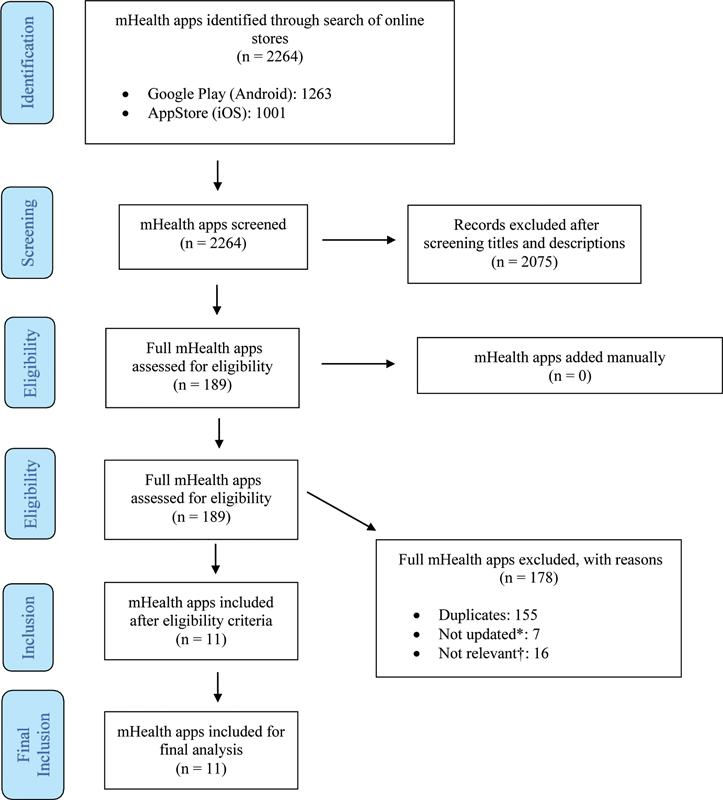
Decreased sleep time is detrimental to physical and mental health, exerting negative impacts on daily functioning and quality of life. Mobile health (mHealth) applications can be useful for improving sleep quality. To perform a systematic search of mHealth applications for monitoring sleep time at Brazilian online stores and evaluate the selected applications in terms of engagement, functionality, aesthetics, and quality of information. A systematic search was performed at the Google Play Store and the App Store developed or updated between 2020 and 2022. The mobile app rating scale (MARS) was used to assess their quality. The characteristics and information of these applications were presented. Data were analyzed descriptively. Among the 2,264 relevant mHealth apps identified, 11 were eligible for inclusion. There was one app that offered only sleep time recordings, three offered sleep recordings and educational content, three monitored sleep time with audiovisual resources, two offered sleep time recordings with a focus on monitoring snoring, and two offered sleep time monitoring with individual content customizations. The apps scored fair on MARS, with a mean of 3.5 points (standard deviation: 0.8) on a scale of 1 to 5. Most apps scored low due to poor evidence-based information, aesthetics, and engagement. Although the use of mHealth technologies for monitoring sleep time has considerable potential for investigation, it is a relatively new, underexplored topic. Collaboration between researchers, clinical professionals, patients, and application developers is necessary for the creation of new evidence-based mHealth applications focused on Brazilian users.
睡眠时间减少对身心健康有害,会对日常功能和生活质量产生负面影响。移动健康(mHealth)应用程序有助于改善睡眠质量。 对巴西在线商店中用于监测睡眠时间的移动健康应用程序进行系统搜索,并从参与度、功能、美观性和信息质量方面对所选应用程序进行评估。 在谷歌应用商店和2020年至2022年期间开发或更新的应用商店中进行了系统搜索。使用移动应用程序评分量表(MARS)来评估它们的质量。展示了这些应用程序的特点和信息。对数据进行了描述性分析。 在识别出的2264个相关移动健康应用程序中,有11个符合纳入条件。有一个应用程序仅提供睡眠时间记录,三个提供睡眠记录和教育内容,三个使用视听资源监测睡眠时间,两个提供以监测打鼾为重点的睡眠时间记录,两个提供具有个性化内容定制的睡眠时间监测。这些应用程序在MARS上的得分中等,在1至5分的量表上平均得分为3.5分(标准差:0.8)。由于循证信息、美观性和参与度较差,大多数应用程序得分较低。 尽管使用移动健康技术监测睡眠时间有很大的研究潜力,但这是一个相对较新的、未充分探索的主题。研究人员、临床专业人员、患者和应用程序开发者之间的合作对于创建专注于巴西用户的新的循证移动健康应用程序是必要的。