Department of Public Health, School of Medicine, Hyogo Medical University, Nishinomiya, 663-8501, Japan.
Hyogo Regional Center for the Japan Environment and Children's Study, Hyogo Medical University, Nishinomiya, 663-8501, Japan.
J Anesth. 2024 Oct;38(5):609-621. doi: 10.1007/s00540-024-03359-9. Epub 2024 Jun 7.
The effects of general anesthesia on neurodevelopment in children remain controversial. We explored the relationship between general anesthesia and neurodevelopment in children participating in the Japan Environment and Children's Study (JECS).
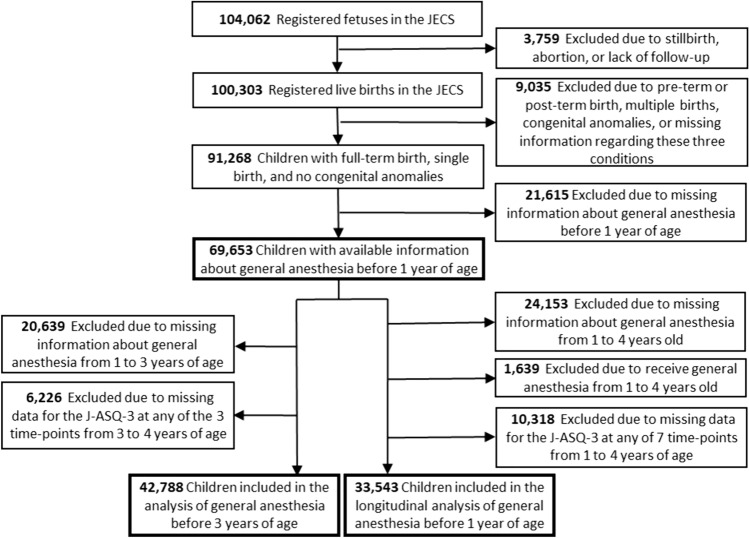
This study enrolled children born between 37 and 41 weeks of pregnancy via single-vaginal delivery to pregnant women registered in the JECS between January 2011 and March 2014. Data were collected from mother-completed questionnaires and medical transcripts. Neurodevelopment in five domains was assessed every 6 months between 12 and 48 months of age, using the Ages and Stages Questionnaires. The associations between general anesthesia exposure during early childhood and neurodevelopment in children were evaluated at each time point. Adjusted odds ratios and 95% confidence intervals were estimated after covariate adjustment using logistic regression models.
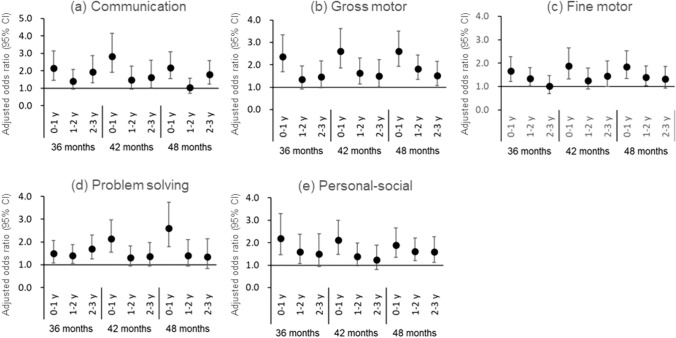
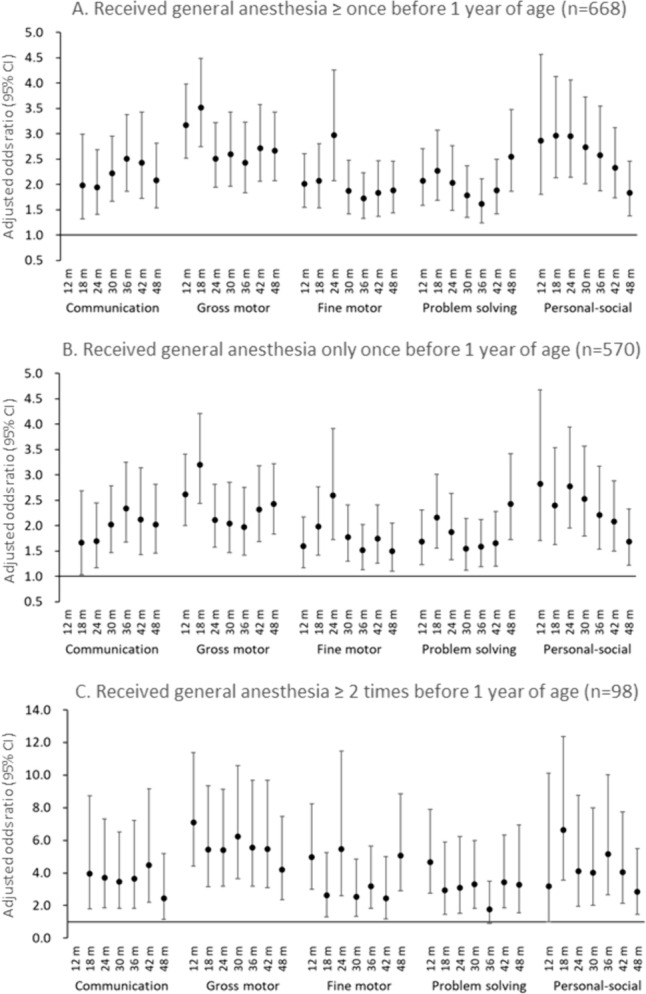
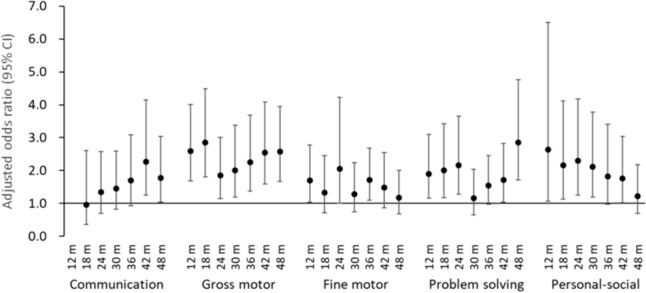
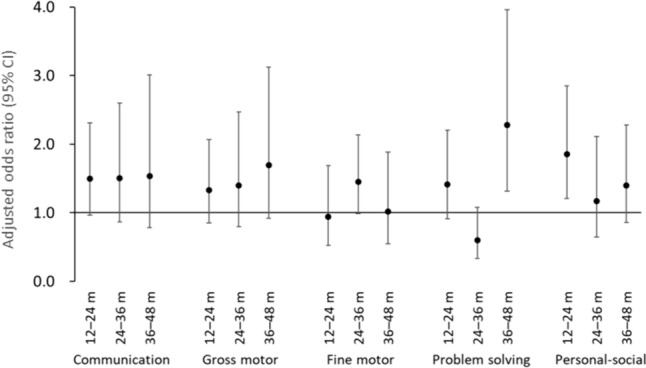
Children who received general anesthesia before age 1 year had higher risks of neurodevelopmental delay in all five domains throughout the observational period. The largest risk was for gross motor delay at 18 months (adjusted odds ratio: 3.51; 95% confidence interval: 2.75-4.49). The effects on the incidence of neurodevelopmental delays after age 3 were not observed except for problem solving at 48 months. The risk of neurodevelopmental delay in children who first received general anesthesia after age 1 was considerably small.
This study suggests that general anesthesia administration before age 1 is associated with neurodevelopmental delay during 1-4 years of age. The risk of general anesthesia after age 1 may be small.
全麻对儿童神经发育的影响仍存在争议。本研究旨在探讨日本环境与儿童研究(JECS)中接受全麻的儿童与神经发育之间的关系。
本研究纳入了 2011 年 1 月至 2014 年 3 月间在 JECS 注册的足月单胎阴道分娩的孕妇所生的儿童。通过母亲完成的调查问卷和医疗记录收集数据。在 12 至 48 个月龄期间,使用年龄与阶段问卷(Ages and Stages Questionnaires)每 6 个月评估儿童的五个领域的神经发育情况。在每个时间点评估儿童在幼儿期暴露于全麻与神经发育之间的关联。采用逻辑回归模型进行协变量调整后,估计调整后的比值比和 95%置信区间。
在整个观察期间,1 岁前接受全麻的儿童在五个领域的神经发育延迟风险均较高。18 个月时,大运动发育延迟的风险最大(调整后的比值比:3.51;95%置信区间:2.75-4.49)。3 岁后除 48 个月时解决问题的能力延迟外,未观察到神经发育延迟发生率的影响。首次接受全麻的年龄超过 1 岁的儿童的神经发育延迟风险较小。
本研究表明,1 岁前接受全麻与 1-4 岁时的神经发育延迟有关。1 岁后接受全麻的风险可能较小。