Department of Endodontics, Faculty of Dentistry, Aydın Adnan Menderes University, Aydın, 09100, Turkey.
Department of Endodontics, Faculty of Dentistry, Dokuz Eylül University, İzmir, Turkey.
Clin Oral Investig. 2024 Jun 8;28(7):362. doi: 10.1007/s00784-024-05760-w.
This randomized clinical trial aimed to compare the effect of intracanal medicaments on the incidence of postoperative pain and flare-up with posttreatment apical periodontitis (PTAP) of retreatment cases.
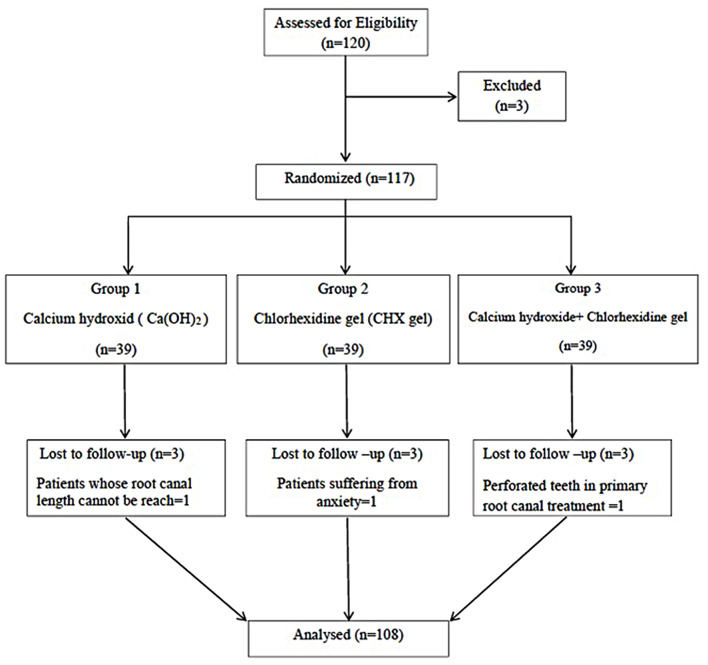
One hundred twenty patients diagnosed with PTAP with single-rooted teeth with single-canal without spontaneous pain or swellings were included and randomly divided into three groups according to the intracanal medicament used. Intracanal medicaments were placed into the root canals following the removal of previous root canal fillings and re-instrumentation. Calcium hydroxide (Ca (OH)), chlorhexidine gel (CHX), calcium hydroxide and chlorhexidine gel combinations were used as intracanal medicaments. Postoperative pain scores were recorded at 6 and 12 h and 1, 2, 3, 4, 5, 6, and 7 days using a visual analog scale (VAS). Sensitivity on percussion, spontaneous pain, swelling, antibiotic and analgesic requirements of the patients were evaluated during clinical examinations performed postoperatively after 2 and 7 days.
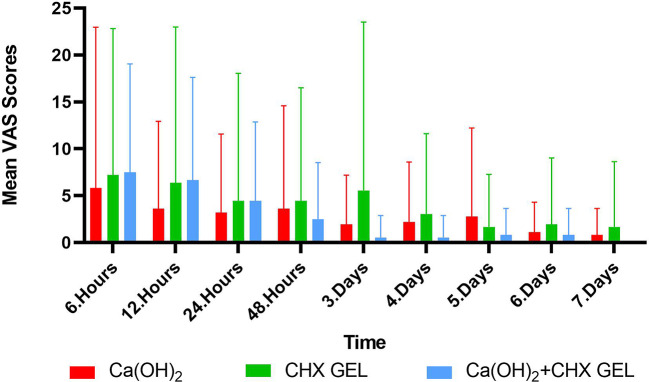
There were no statistically significant differences between groups in terms of VAS scores following the intracanal medicament application (p > 0.05). However, compared to the patients of 20-34 and 50-65 age groups, greater VAS scores were observed in patients of 35-49 age groups at 12 h, and 3, 4, 7 days (p < 0.05). Flare-up was observed in only one patient in the CHX gel group, and no flare-up was observed in other groups.
Similar postoperative pain incidence in all experimental groups indicates that all three medicaments are clinically acceptable in inter-appointment management of retreatment cases in terms of post-endodontic pain and flare-up.
In this randomized clinical trial, three different intracanal medicaments were utilized in nonsurgical endodontic retreatment and their effect on postoperative pain and flare-up incidence was examined. Thus, this study will be a significant contribution in the decision-making during clinical practice; since there are a limited number of prospective clinical trials in the literature about the severity of pain following retreatment procedures including intracanal medicament use.
本随机临床试验旨在比较根管内药物对再治疗病例的术后疼痛和激惹(flare-up)发生率与治疗后根尖周炎(PTAP)的影响。
纳入 120 名患有 PTAP 的单根牙齿单根管患者,无自发疼痛或肿胀,根据使用的根管内药物随机分为三组。在去除先前的根管填充物和重新器械处理后,将根管内药物放置在根管内。氢氧化钙(Ca(OH))、洗必泰凝胶(CHX)、氢氧化钙和洗必泰凝胶混合物用作根管内药物。使用视觉模拟量表(VAS)在术后 6、12 小时以及术后第 1、2、3、4、5、6 和 7 天记录术后疼痛评分。术后第 2 和 7 天进行临床检查时,评估叩诊敏感性、自发疼痛、肿胀、患者抗生素和镇痛需求。
在根管内药物应用后,各组之间的 VAS 评分无统计学差异(p>0.05)。然而,与 20-34 岁和 50-65 岁年龄组的患者相比,35-49 岁年龄组的患者在 12 小时、3、4、7 天时 VAS 评分更高(p<0.05)。CHX 凝胶组仅 1 例患者出现激惹,其他组未见激惹。
所有实验组的术后疼痛发生率相似,表明在根管再治疗的非手术间隔期管理中,这三种药物在控制根管治疗后疼痛和激惹方面均具有临床可接受性。
在本随机临床试验中,在非手术根管再治疗中使用了三种不同的根管内药物,研究了它们对术后疼痛和激惹发生率的影响。因此,本研究将为临床实践中的决策提供重要贡献;因为文献中关于包括使用根管内药物在内的再治疗程序后疼痛严重程度的前瞻性临床试验数量有限。