Department of Obstetrics and Gynecology, Kyungpook National University Chilgok Hospital, Daegu, Korea.
Department of Genomic Medicine, Seoul National University Hospital, Seoul, Korea.
BMC Womens Health. 2024 Jun 7;24(1):331. doi: 10.1186/s12905-024-03171-3.
Postoperative urinary retention (POUR), a common condition after prolapse surgery with potential serious sequelae if left untreated, lacks a clearly established optimal timing for catheter removal. This study aimed to develop and validate a predictive model for postoperative urinary retention lasting > 2 and > 4 days after prolapse surgery.
We conducted a retrospective review of 1,122 patients undergoing prolapse surgery. The dataset was divided into training and testing cohorts. POUR was defined as the need for continuous intermittent catheterization resulting from a failed spontaneous voiding trial, with passing defined as two consecutive voids ≥ 150 mL and a postvoid residual urine volume ≤ 150 mL. We performed logistic regression and the predicted model was validated using both training and testing cohorts.
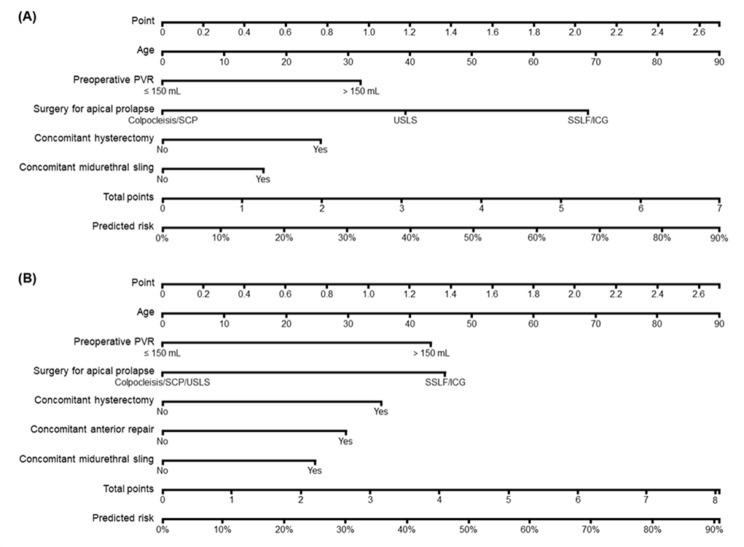
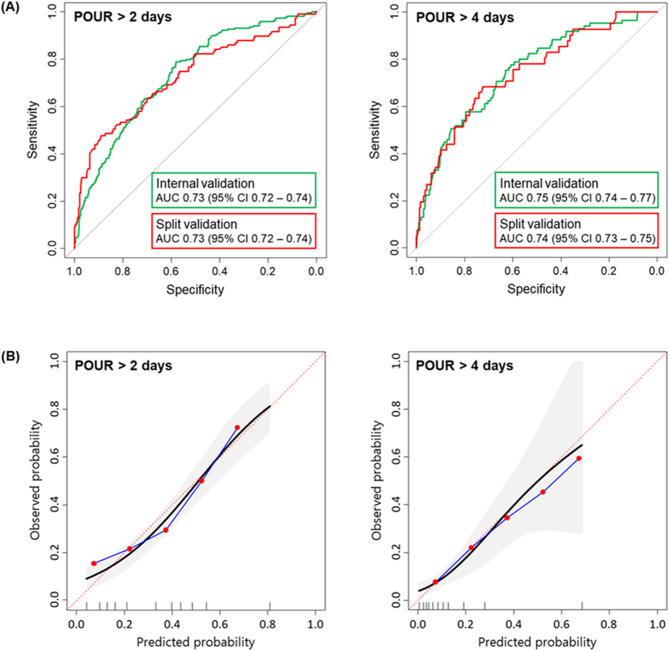
Among patients, 31% and 12% experienced POUR lasting > 2 and > 4 days, respectively. Multivariable logistic model identified 6 predictors. For predicting POUR, internal validation using cross-validation approach showed good performance, with accuracy lasting > 2 (area under the curve [AUC] 0.73) and > 4 days (AUC 0.75). Split validation using pre-separated dataset also showed good performance, with accuracy lasting > 2 (AUC 0.73) and > 4 days (AUC 0.74). Calibration curves demonstrated that the model accurately predicted POUR lasting > 2 and > 4 days (from 0 to 80%).
The proposed prediction model can assist clinicians in personalizing postoperative bladder care for patients undergoing prolapse surgery by providing accurate individual risk estimates.
脱垂手术后发生的术后尿潴留(POUR)是一种常见的情况,如果不加以治疗,可能会产生严重的后果,而目前对于导尿管拔除的最佳时机仍没有明确的界定。本研究旨在建立和验证一种预测脱垂手术后持续 2 天和 4 天以上的术后尿潴留的模型。
我们对 1122 例接受脱垂手术的患者进行了回顾性研究。数据集分为训练集和测试集。POUR 定义为因自发排尿试验失败而需要持续间歇性导尿,通过定义为两次连续排尿量≥150ml 和残余尿量≤150ml。我们进行了逻辑回归分析,并使用训练集和测试集对预测模型进行了验证。
在患者中,分别有 31%和 12%的患者发生了持续 2 天和 4 天以上的 POUR。多变量逻辑模型确定了 6 个预测因素。对于预测 POUR,使用交叉验证方法的内部验证显示出良好的性能,持续 2 天以上的准确性(曲线下面积[AUC]为 0.73)和持续 4 天以上的准确性(AUC 为 0.75)。使用预先分离的数据进行分割验证也显示出良好的性能,持续 2 天以上的准确性(AUC 为 0.73)和持续 4 天以上的准确性(AUC 为 0.74)。校准曲线表明,该模型能够准确预测持续 2 天和 4 天以上的 POUR(从 0 到 80%)。
该预测模型可以帮助临床医生通过提供准确的个体风险估计,为接受脱垂手术的患者提供个性化的术后膀胱护理。