El Hamamy Ahmad, Iqbal Zahid, Mai Le Ngoc, Ranjan Arya, Zhang YuXing, Lin Hung Wen, Tan Chunfeng, Patrizz Anthony, McCullough Louise D, Li Jun
University of Texas Health Science Center at Houston.
University of South Florida.
Res Sq. 2024 May 31:rs.3.rs-4438544. doi: 10.21203/rs.3.rs-4438544/v1.
Cerebral amyloid angiopathy (CAA) is characterized by the deposition of amyloid-beta peptides within cerebral blood vessels, leading to neurovascular complications. Ischemic strokes result from acute disruptions in cerebral blood flow, triggering metabolic disturbances and neurodegeneration. Both conditions often co-occur and are associated with respiratory dysfunctions. The retrotrapezoid nucleus (RTN), which is crucial for CO sensing and breathing regulation in the brainstem, may play a key role in breathing disorders seen in these conditions. This study aims to investigate the role of Transforming Growth Factor Beta (TGF-β) signaling in the RTN on respiratory and cognitive functions in CAA, both with and without concurrent ischemic stroke.
Adult male Tg-SwDI (CAA model) mice and C57BL/6 wild-type controls underwent stereotaxic injections of lentivirus targeting TGF-β2R2 in the RTN. Stroke was induced by middle cerebral artery occlusion using a monofilament. Respiratory functions were assessed using whole-body plethysmography, while cognitive functions were evaluated through the Barnes Maze and Novel Object Recognition Test (NORT). Immunohistochemical analysis was conducted to measure TGF-βR2 and GFAP expressions in the RTN.
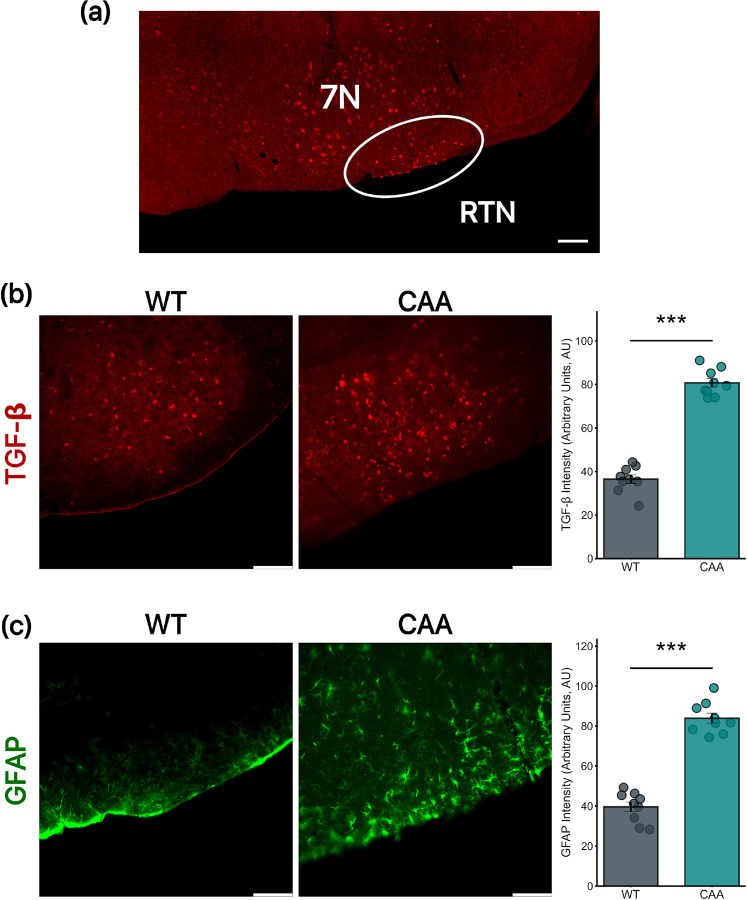
CAA mice exhibited significant respiratory dysfunctions, including reduced respiratory rates and increased apnea frequency, as well as impaired cognitive performance. TGF-βR2 knockdown in the RTN improved respiratory functions and cognitive outcomes in CAA mice. In CAA mice with concurrent stroke, TGF-βR2 knockdown similarly enhanced respiratory and cognitive functions. Immunohistochemistry confirmed reduced TGF-βR2 and GFAP expressions in the RTN following knockdown.
Our findings demonstrate that increased TGF-β signaling and gliosis in the RTN contribute to respiratory and cognitive dysfunctions in CAA and CAA with stroke. Targeting TGF-βR2 signaling in the RTN offers a promising therapeutic strategy to mitigate these impairments. This study is the first to report a causal link between brainstem gliosis and both respiratory and cognitive dysfunctions in CAA and stroke models.
脑淀粉样血管病(CAA)的特征是淀粉样β肽在脑血管内沉积,导致神经血管并发症。缺血性中风是由脑血流的急性中断引起的,引发代谢紊乱和神经退行性变。这两种情况常同时发生,并与呼吸功能障碍有关。延髓头端腹外侧网状核(RTN)对脑干中的二氧化碳感知和呼吸调节至关重要,可能在这些情况下出现的呼吸障碍中起关键作用。本研究旨在探讨RTN中转化生长因子β(TGF-β)信号传导对CAA伴或不伴并发缺血性中风时呼吸和认知功能的作用。
成年雄性Tg-SwDI(CAA模型)小鼠和C57BL/6野生型对照小鼠在RTN接受立体定向注射靶向TGF-β2R2的慢病毒。使用单丝闭塞大脑中动脉诱导中风。使用全身体积描记法评估呼吸功能,同时通过巴恩斯迷宫和新物体识别测试(NORT)评估认知功能。进行免疫组织化学分析以测量RTN中TGF-βR2和胶质纤维酸性蛋白(GFAP)的表达。
CAA小鼠表现出明显的呼吸功能障碍,包括呼吸频率降低和呼吸暂停频率增加以及认知能力受损。RTN中TGF-βR2基因敲低改善了CAA小鼠的呼吸功能和认知结果。在并发中风的CAA小鼠中,TGF-βR2基因敲低同样增强了呼吸和认知功能。免疫组织化学证实基因敲低后RTN中TGF-βR2和GFAP表达降低。
我们的研究结果表明,RTN中TGF-β信号传导增加和胶质细胞增生导致CAA以及伴中风的CAA出现呼吸和认知功能障碍。靶向RTN中的TGF-βR2信号传导提供了一种有前景的治疗策略来减轻这些损伤。本研究首次报道了在CAA和中风模型中脑干胶质细胞增生与呼吸和认知功能障碍之间的因果关系。