Liu Meng-Fan, Ma Rui-Xia, Cao Xian-Bao, Zhang Hua, Zhou Shui-Hong, Jiang Wei-Hong, Jiang Yan, Sun Jing-Wu, Yang Qin-Tai, Li Xue-Zhong, Sun Ya-Nan, Shi Li, Wang Min, Song Xi-Cheng, Chen Fu-Quan, Zhang Xiao-Shu, Wei Hong-Quan, Yu Shao-Qing, Zhu Dong-Dong, Ba Luo, Cao Zhi-Wei, Xiao Xu-Ping, Wei Xin, Lin Zhi-Hong, Chen Feng-Hong, Shan Chun-Guang, Wang Guang-Ke, Ye Jing, Qu Shen-Hong, Zhao Chang-Qing, Wang Zhen-Lin, Li Hua-Bin, Liu Feng, Cui Xiao-Bo, Ye Sheng-Nan, Liu Zheng, Xu Yu, Cai Xiao, Huang Wei, Zhang Ru-Xin, Zhao Yu-Lin, Yu Guo-Dong, Shi Guang-Gang, Lu Mei-Ping, Shen Yang, Zhao Yu-Tong, Pei Jia-Hong, Xie Shao-Bing, Yu Long-Gang, Liu Ye-Hai, Gu Shao-Wei, Yang Yu-Cheng, Cheng Lei, Liu Jian-Feng
Graduate School of Beijing University of Chinese Medicine Beijing China.
Department of Otorhinolaryngology Head and Neck Surgery China-Japan Friendship Hospital Beijing China.
World J Otorhinolaryngol Head Neck Surg. 2024 Mar 28;10(2):113-120. doi: 10.1002/wjo2.167. eCollection 2024 Jun.
This cross-sectional study aimed to determine the epidemiology of olfactory and gustatory dysfunctions related to COVID-19 in China.
This study was conducted by 45 tertiary Grade-A hospitals in China. Online and offline questionnaire data were obtained from patients infected with COVID-19 between December 28, 2022, and February 21, 2023. The collected information included basic demographics, medical history, smoking and drinking history, vaccination history, changes in olfactory and gustatory functions before and after infection, and other postinfection symptoms, as well as the duration and improvement status of olfactory and gustatory disorders.
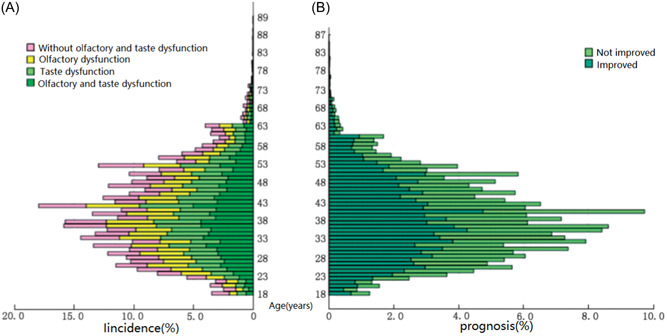
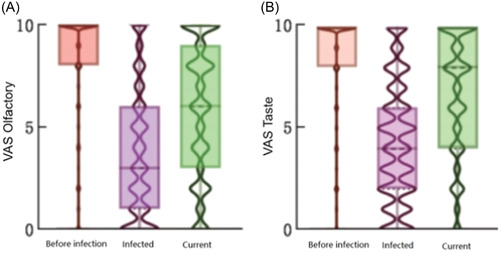
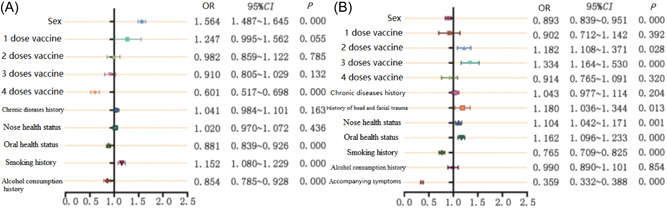
Complete questionnaires were obtained from 35,566 subjects. The overall incidence of olfactory and taste dysfunction was 67.75%. Being female or being a cigarette smoker increased the likelihood of developing olfactory and taste dysfunction. Having received four doses of the vaccine or having good oral health or being a alcohol drinker decreased the risk of such dysfunction. Before infection, the average olfactory and taste VAS scores were 8.41 and 8.51, respectively; after infection, they decreased to 3.69 and 4.29 and recovered to 5.83 and 6.55 by the time of the survey. The median duration of dysosmia and dysgeusia was 15 and 12 days, respectively, with 0.5% of patients having symptoms lasting for more than 28 days. The overall self-reported improvement rate was 59.16%. Recovery was higher in males, never smokers, those who received two or three vaccine doses, and those that had never experienced dental health issues, or chronic accompanying symptoms.
The incidence of dysosmia and dysgeusia following infection with the SARS-CoV-2 virus is high in China. Incidence and prognosis are influenced by several factors, including sex, SARS-CoV-2 vaccination, history of head-facial trauma, nasal and oral health status, smoking and drinking history, and the persistence of accompanying symptoms.
本横断面研究旨在确定中国与新型冠状病毒肺炎(COVID-19)相关的嗅觉和味觉功能障碍的流行病学特征。
本研究由中国45家三级甲等医院开展。通过线上和线下方式,收集了2022年12月28日至2023年2月21日期间感染COVID-19患者的问卷数据。收集的信息包括基本人口统计学特征、病史、吸烟和饮酒史、疫苗接种史、感染前后嗅觉和味觉功能的变化、其他感染后症状,以及嗅觉和味觉障碍的持续时间和改善情况。
共获得35566名受试者的完整问卷。嗅觉和味觉功能障碍的总体发生率为67.75%。女性或吸烟者发生嗅觉和味觉功能障碍的可能性增加。接种四剂疫苗、口腔健康状况良好或饮酒者发生此类功能障碍的风险降低。感染前,嗅觉和味觉的视觉模拟评分(VAS)平均分别为8.41和8.51;感染后,分别降至3.69和4.29,到调查时恢复至5.83和6.55。嗅觉减退和味觉障碍的中位持续时间分别为15天和12天,0.5%的患者症状持续超过28天。总体自我报告的改善率为59.16%。男性、从不吸烟者、接种两剂或三剂疫苗者、从未有过牙齿健康问题或慢性伴随症状者的恢复情况更好。
在中国,感染严重急性呼吸综合征冠状病毒2(SARS-CoV-2)病毒后嗅觉减退和味觉障碍的发生率较高。发病率和预后受多种因素影响,包括性别、SARS-CoV-2疫苗接种情况、头面部外伤史、鼻和口腔健康状况、吸烟和饮酒史以及伴随症状的持续时间。