Smell and Taste Center, Department of Otorhinolaryngology: Head and Neck Surgery, University of Pennsylvania Perelman School of Medicine, Hospital of the University of Pennsylvania, 3400 Spruce Street, Philadelphia, PA 19104, USA.
Trends Mol Med. 2022 Sep;28(9):781-794. doi: 10.1016/j.molmed.2022.06.005. Epub 2022 Jun 20.
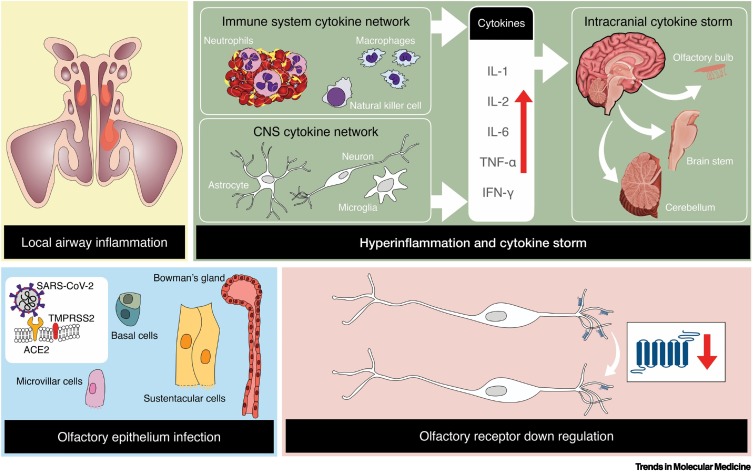
Decreased smell function is related to brain health, future mortality, and quality of life. Most people inflicted with the SARS-CoV-2 virus evidence some measurable smell dysfunction during its acute phase, although many are unaware of the loss. Long-term deficits occur in up to 30% of COVID-19 cases, although total anosmia is relatively rare. This review explores what is presently known about the nature and pathophysiology of olfactory dysfunction due to the SARS-CoV-2 virus, including reversible inflammation within the olfactory cleft, downregulation of olfactory receptor proteins, and long-lasting peripheral and central damage to olfactory structures. It also addresses the question as to whether long-term smell loss might increase the likelihood of future development of cognitive and neurological deficits.
嗅觉功能下降与大脑健康、未来死亡率和生活质量有关。大多数感染 SARS-CoV-2 病毒的人在其急性期都有一定程度的可测量嗅觉功能障碍,尽管许多人没有意识到这种损失。多达 30%的 COVID-19 病例会出现长期缺陷,尽管完全嗅觉丧失相对较少见。这篇综述探讨了目前已知的 SARS-CoV-2 病毒引起的嗅觉功能障碍的性质和病理生理学,包括嗅裂内的可逆性炎症、嗅觉受体蛋白的下调以及对嗅觉结构的持久外周和中枢损伤。它还探讨了长期嗅觉丧失是否会增加未来出现认知和神经功能缺陷的可能性。