Shah Sharaf A, Abidi Syed Hani, Soomro Altaf A, Farooqui Nida, Ansari Tehreem, Khanani Rafiq
Infectious Disease, Bridge Consultant Foundation, Karachi, PAK.
Biomedical Sciences, Nazarbayev University School of Medicine, Astana, KAZ.
Cureus. 2024 Jun 8;16(6):e61972. doi: 10.7759/cureus.61972. eCollection 2024 Jun.
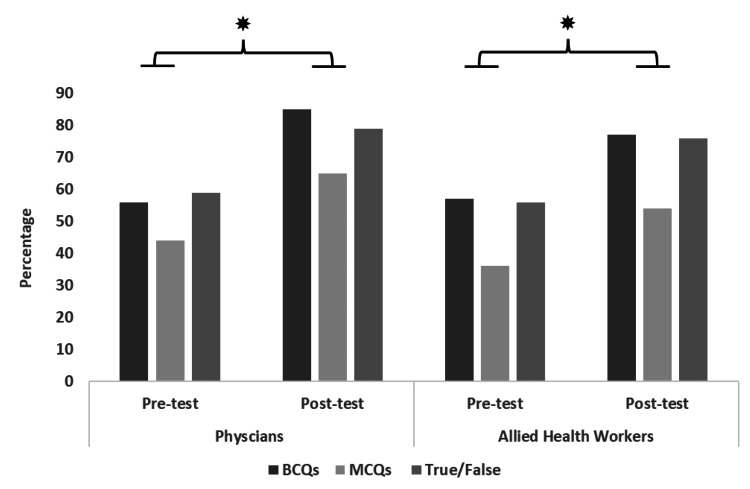
Introduction In Pakistan, HIV training programs, especially for health professionals working in HIV treatment centers, are limited. Consequently, there is little data about HIV awareness among physicians and allied health workers and how it may affect their care for people living with HIV (PLWH). Recently, the Global Fund to Fight AIDS, Tuberculosis, and Malaria (GFATM) grant Principal Recipient UNDP engaged an NGO experienced in HIV/AIDS training, on a competitive basis, to develop a training manual and conduct training of all categories of HIV treatment centers staff. The goal of this study was to assess the training program's influence on trainees' (both physicians and allied health staff) knowledge and abilities and describe its major lessons. Methodology This was a one-group pre-post test study, carried out between January 17 and February 22, 2023. The study was carried out in three phases. In the first phase, a team of experts developed an antiretroviral treatment (ART) training manual. In the second phase, 9- and three-day training workshops were conducted in six different cities of Pakistan, which were attended by physicians and allied health staff working in different HIV treatment centers across Pakistan. The workshops had plenary lectures, discussions, role plays, video cases, and case studies. In the third phase, a quiz, comprising multiple/best choice questions (MCQs/BCQs) and true and false questions, was administered before (pre) and after the workshop (post) to assess the impact of these training sessions in enhancing the level of HIV knowledge, especially related to ART. The workshop was attended by a total of 256 health workers from different cities in Pakistan. The participants had backgrounds in medical science, psychology, laboratory science, nursing, and computer science. Pre-and post-test responses were statistically analyzed to determine the impact of the training program on participant's knowledge. For this, the Shapiro-Wilk test was applied to test data normality, followed by the application of paired t-test or Wilcoxon Signed Rank Test for normally and non-normally distributed data, respectively. Finally, a chi-square test was applied to examine the significant (p<0.05) association between training workshops and improvement in the participant's level of understanding of HIV. In all statistical tests, p<0.05 was considered significant. Results The results from our study showed that before the training session, both physicians and allied staff possessed limited knowledge about HIV-related domains. After the workshops, participants from all cities demonstrated a uniform enhancement of knowledge related to different HIV-related domains, evident from the improvement in post-test scores compared to pre-test scores (p<0.0001). The chi-square test showed a significant association between training workshops and improvement in the participant's level of understanding about HIV (p-values for BCQ, MCQ, and true and false: 0.001, 0.0047, and 0.0024, respectively). Conclusions Pre- and post-test evaluation provides an objective, data-driven method for measuring the impact of educational interventions in improving healthcare workers' awareness about HIV. The results emphasize the role of continuous workshops and training programs in enhancing the knowledge and understanding of healthcare and allied health workers regarding HIV.
引言 在巴基斯坦,针对卫生专业人员,尤其是在艾滋病毒治疗中心工作的人员的艾滋病毒培训项目有限。因此,关于医生和相关卫生工作者对艾滋病毒的认知情况以及这可能如何影响他们对艾滋病毒感染者(PLWH)的护理,几乎没有相关数据。最近,抗击艾滋病、结核病和疟疾全球基金(GFATM)赠款的主要受援方联合国开发计划署(UNDP)在竞争的基础上,聘请了一个在艾滋病毒/艾滋病培训方面经验丰富的非政府组织,来编写一份培训手册并对各类艾滋病毒治疗中心的工作人员进行培训。本研究的目的是评估该培训项目对学员(医生和相关卫生人员)知识和能力的影响,并描述其主要经验教训。
方法 这是一项单组前后测试研究,于2023年1月17日至2月22日进行。该研究分三个阶段进行。在第一阶段,一个专家团队编写了一份抗逆转录病毒治疗(ART)培训手册。在第二阶段,在巴基斯坦的六个不同城市举办了为期九天和三天的培训研讨会,来自巴基斯坦各地不同艾滋病毒治疗中心的医生和相关卫生人员参加了这些研讨会。研讨会有全体会议讲座、讨论、角色扮演、视频案例和案例研究。在第三阶段,在研讨会之前(预测试)和之后(后测试)进行了一场包含多项/最佳选择题(MCQs/BCQs)和是非题的测验,以评估这些培训课程在提高艾滋病毒知识水平,特别是与抗逆转录病毒治疗相关的知识水平方面的影响。共有来自巴基斯坦不同城市的256名卫生工作者参加了研讨会。参与者的背景包括医学、心理学、实验室科学、护理和计算机科学。对预测试和后测试的回答进行了统计分析,以确定培训项目对参与者知识的影响。为此,应用夏皮罗-威尔克检验来检验数据的正态性,然后分别对正态分布和非正态分布的数据应用配对t检验或威尔科克森符号秩检验。最后,应用卡方检验来检验培训研讨会与参与者对艾滋病毒理解水平提高之间的显著(p<0.05)关联。在所有统计检验中,p<0.05被视为显著。
结果 我们的研究结果表明,在培训课程之前,医生和相关工作人员对与艾滋病毒相关领域的知识都很有限。研讨会之后,所有城市的参与者在与不同艾滋病毒相关领域的知识方面都有一致的提高,这从后测试分数与预测试分数相比的提高中可以明显看出(p<0.0001)。卡方检验表明培训研讨会与参与者对艾滋病毒理解水平的提高之间存在显著关联(BCQ、MCQ和是非题的p值分别为0.001、0.0047和0.0024)。
结论 前后测试评估提供了一种客观的、数据驱动的方法,用于衡量教育干预措施在提高医护人员对艾滋病毒认识方面的影响。结果强调了持续举办研讨会和培训项目在增强医护人员和相关卫生工作者对艾滋病毒的知识和理解方面的作用。