Department of Global Public Health, Karolinska Institutet, Stockholm, Stockholm County, Sweden.
Department of Medicine, R. D. Gardi Medical College, Ujjain, Madhya Pradesh, India.
BMJ Open. 2020 Apr 12;10(4):e033612. doi: 10.1136/bmjopen-2019-033612.
People living with HIV and AIDS (PLWHA) experience stigma and discrimination throughout their life. The consequences of stigma and discrimination are severe when enacted by healthcare providers (HCPs), and result in a delay in or poor adherence to treatment. Studies have demonstrated the presence of stigmatising behaviours among HCPs, yet only a few have presented the impact of interventions on the knowledge and attitude of practising (clinicians and nurses) and future (students) HCPs.
To evaluate knowledge, attitudes and infection risk perceptions related to HIV/AIDS among practising and future HCPs in central India. In addition, the impact of the 'HIV-related stigma-reduction workshop' using a pre-intervention and post-intervention study design was evaluated.
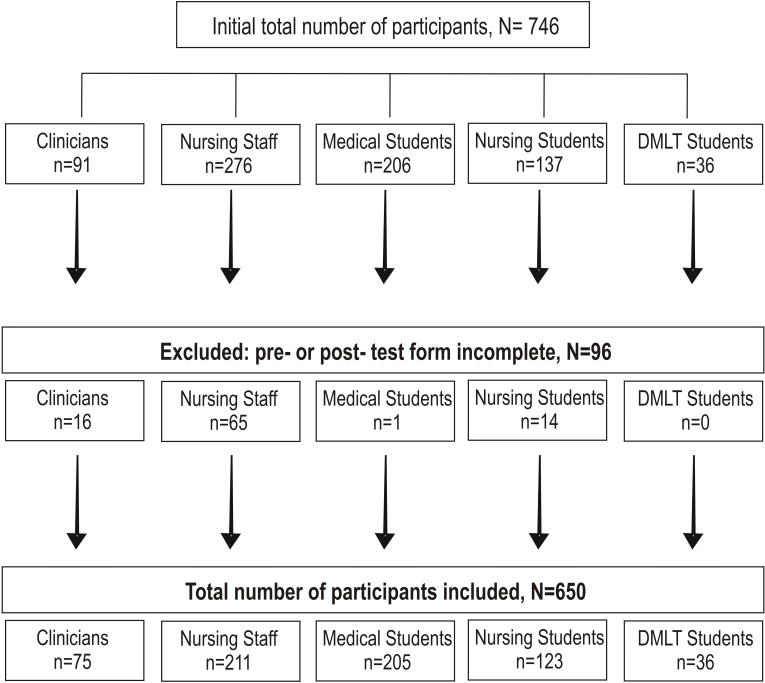
The study was conducted in 2016 at two tertiary-care hospitals and three healthcare colleges in central India. Overall, 650 HCPs (75 clinicians and 211 nurses) and students (205 medical, 123 nursing and 36 Diploma in Medical and Laboratory Technology (DMLT)) voluntarily participated in the study.
The educational intervention comprised of training in epidemiology, the transmission and treatment of the HIV infection, the rights of PLWHA, the duties of HCPs and the use of standard precautions.
At pre-intervention, DMLT students had the lowest and clinicians the highest knowledge scores (24% and 45%, respectively). The stigmatised attitude was reflected in all groups, the lowest among clinicians (21%) and the highest among DMLT students (34%). Improvement in the post-intervention knowledge scores was the highest in medical students (36%) and the lowest among clinicians (16%). The participants' attitudes improved between 3% and 17% across all groups.
Significant post-intervention improvements were seen in both knowledge and attitudes in all groups. Students had a higher tendency to improve than HCPs. Further long-term studies are needed to evaluate the sustainability of the improvements in knowledge and attitudes of the participants.
艾滋病毒感染者和艾滋病患者(PLWHA)在其一生中都会经历污名化和歧视。医护人员(HCPs)实施污名化和歧视的后果是严重的,会导致治疗的延迟或不遵医嘱。研究表明,HCPs 中存在污名化行为,但只有少数研究报告了干预措施对实习(临床医生和护士)和未来(学生)HCPs 的知识和态度的影响。
评估印度中部实习和未来医护人员与艾滋病毒/艾滋病相关的知识、态度和感染风险认知。此外,还使用干预前后研究设计评估了“HIV 相关耻辱感减少研讨会”的效果。
这项研究于 2016 年在印度中部的两家三级保健医院和三家医疗保健学院进行。共有 650 名医护人员(75 名临床医生和 211 名护士)和学生(205 名医学、123 名护理和 36 名医学和实验室技术文凭(DMLT))自愿参加了研究。
教育干预包括培训流行病学、HIV 感染的传播和治疗、PLWHA 的权利、HCPs 的职责以及标准预防措施的使用。
在干预前,DMLT 学生的知识得分最低(24%),而临床医生的得分最高(45%)。所有群体都反映出污名化的态度,临床医生的态度最低(21%),DMLT 学生的态度最高(34%)。在干预后,医学学生的知识得分提高幅度最大(36%),临床医生的得分提高幅度最小(16%)。所有群体的态度都提高了 3%至 17%。
所有群体的知识和态度在干预后都有显著提高。学生比医护人员更有提高的倾向。需要进一步进行长期研究,以评估参与者知识和态度改善的可持续性。