Claus-Walker Rachel A, Slanzon Giovana S, Elder Lily A, Hinnant Holly R, Mandella Chris M, Parrish Lindsay M, Trombetta Sophie C, McConnel Craig S
Department of Veterinary Clinical Sciences, Field Disease Investigation Unit, Washington State University, Pullman, WA, United States.
Front Microbiol. 2024 May 24;15:1388489. doi: 10.3389/fmicb.2024.1388489. eCollection 2024.
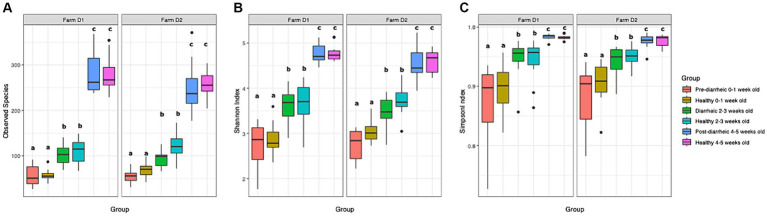
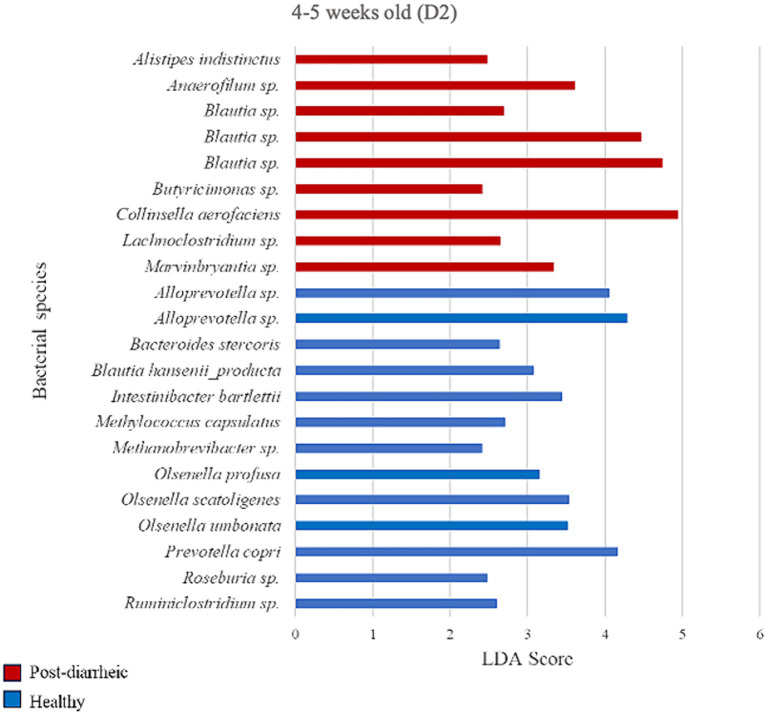
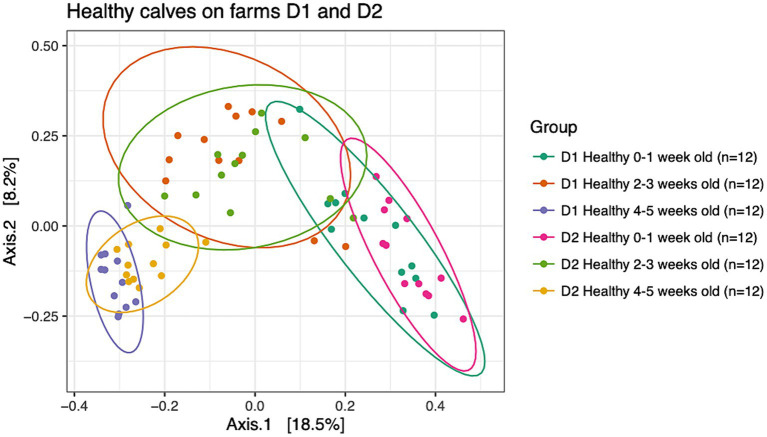
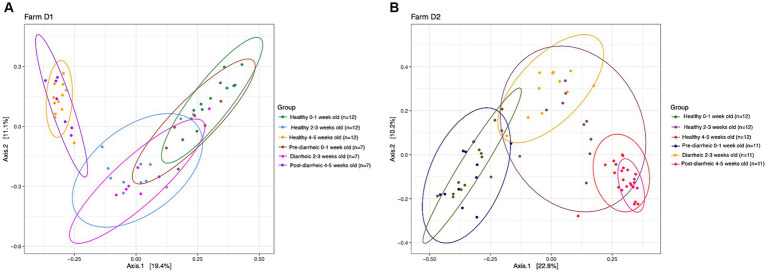
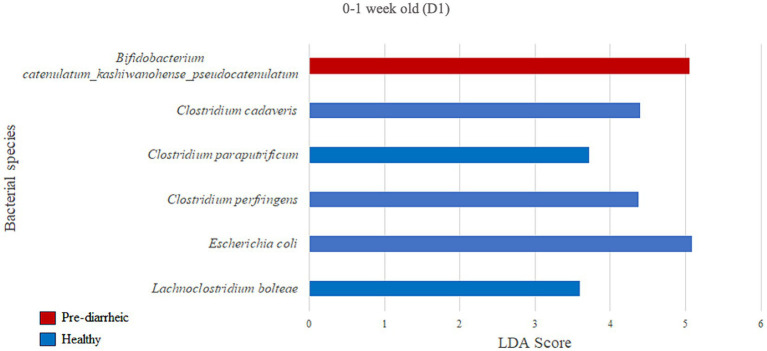
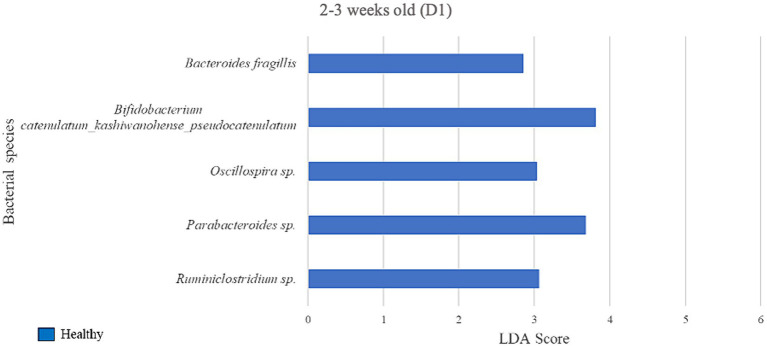
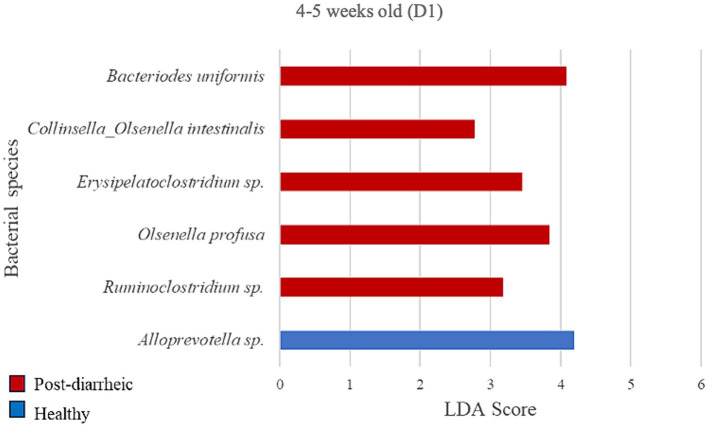
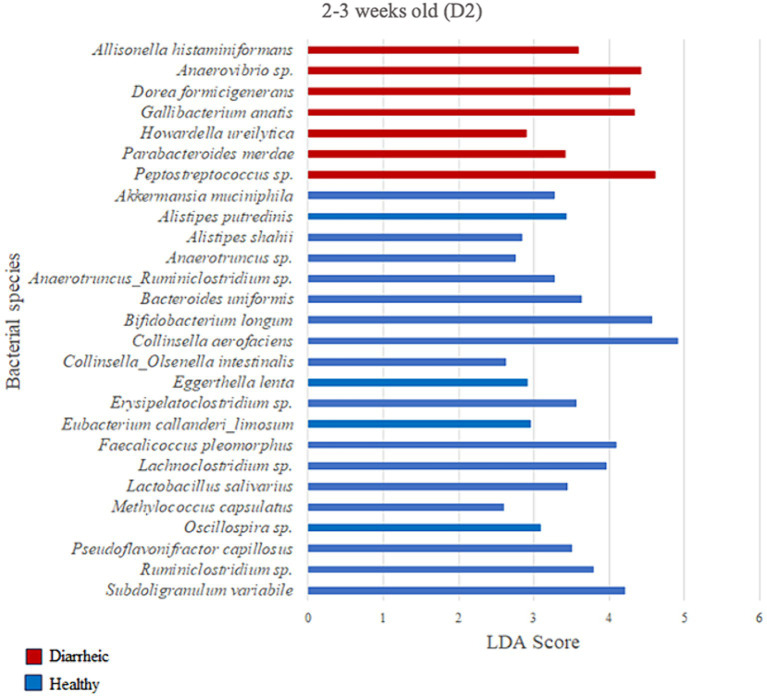
Little is known about shifts in the fecal microbiome of dairy calves preceding and following the incidence of gastrointestinal disease. The objective of this cohort study was to describe the fecal microbiome of preweaned dairy calves before, during, and after gastrointestinal disease. A total of 111 Holstein dairy calves were enrolled on 2 dairies (D1 and D2) and followed until 5 weeks old. Health assessments were performed weekly and fecal samples were collected every other week. Of the 111 calves, 12 calves from D1 and 12 calves from D2 were retrospectively defined as healthy, and 7 calves from D1 and 11 calves from D2 were defined as diarrheic. Samples from these calves were sequenced targeting the 16S rRNA gene and compared based on health status within age groups and farms: healthy (0-1 week old) vs. pre-diarrheic (0-1 week old), healthy (2-3 weeks old) vs. diarrheic (2-3 weeks old), and healthy (4-5 weeks old) vs. post-diarrheic (4-5 weeks old) calves. Healthy and diarrheic samples clustered together based on age rather than health status on both farms. Based on linear discriminant analysis, a few species were identified to be differently enriched when comparing health status within age groups and farm. Among them, sp. was differently enriched in pre-diarrheic calves at D1 (0-1 week old) whereas healthy calves of the same age group and farm showed a higher abundance of . sp. was identified as a biomarker of fecal samples from healthy calves (2-3 weeks old) on D1 when compared with diarrheic calves of the same age group and farm. Feces from diarrheic calves on D2 (2-3 weeks old) were characterized by taxa from and genera whereas fecal samples of age-matched healthy calves were characterized by and . After resolution of uncomplicated diarrhea (4-5 weeks old), was more abundant in D2 calves whereas was more abundant in D1 calves. Taken together, these findings suggest that the age of the preweaned calf is the major driver of changes to fecal microbiome composition and diversity even in the face of uncomplicated gastrointestinal disease.
关于胃肠道疾病发生前后奶牛犊粪便微生物群的变化,人们了解甚少。这项队列研究的目的是描述断奶前奶牛犊在胃肠道疾病发生前、期间和之后的粪便微生物群。共有111头荷斯坦奶牛犊在两个奶牛场(D1和D2)登记入组,并跟踪至5周龄。每周进行健康评估,每隔一周采集粪便样本。在这111头犊牛中,来自D1的12头犊牛和来自D2的12头犊牛被回顾性定义为健康,来自D1的7头犊牛和来自D2的11头犊牛被定义为腹泻。对这些犊牛的样本进行16S rRNA基因靶向测序,并根据年龄组和农场内的健康状况进行比较:健康(0 - 1周龄)与腹泻前期(0 - 1周龄)、健康(2 - 3周龄)与腹泻(2 - 3周龄)、健康(4 - 5周龄)与腹泻后(4 - 5周龄)犊牛。在两个农场中,健康和腹泻样本根据年龄而非健康状况聚集在一起。基于线性判别分析,在比较年龄组和农场内的健康状况时,发现有几种物种的富集情况不同。其中,某菌在D1(0 - 1周龄)腹泻前期犊牛中富集情况不同,而同一年龄组和农场的健康犊牛中该菌的丰度更高。与同一年龄组和农场的腹泻犊牛相比,某菌被确定为D1(2 - 3周龄)健康犊牛粪便样本的生物标志物。D2(2 - 3周龄)腹泻犊牛的粪便以某属和某属的分类群为特征,而年龄匹配的健康犊牛的粪便样本以某属和某属为特征。在单纯性腹泻缓解后(4 - 5周龄),某菌在D2犊牛中更为丰富,而某菌在D1犊牛中更为丰富。综上所述,这些发现表明,即使面对单纯性胃肠道疾病,断奶前犊牛年龄仍是粪便微生物群组成和多样性变化的主要驱动因素。