Data Support, Processing and Analysis Department (DATA), French National Public Health Agency, Saint-Maurice, France.
Obstetric, Perinatal and Pediatric Epidemiology Research Team, Center of Research in Epidemiology and Statistics (CRESS), INSERM, Université Paris Cité, Paris, France.
Int J Epidemiol. 2024 Apr 11;53(3). doi: 10.1093/ije/dyae080.
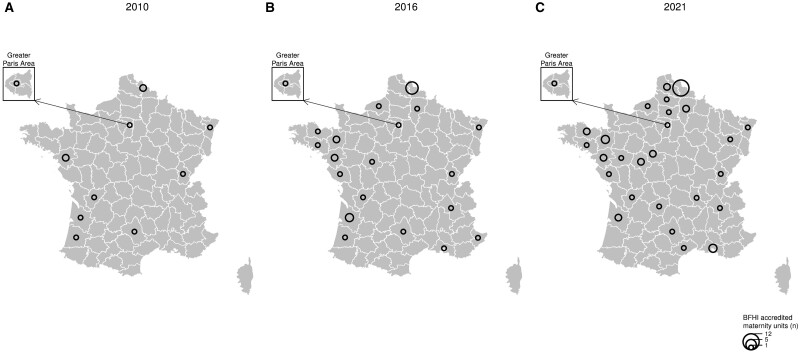
The Baby-Friendly Hospital Initiative (BFHI) is associated with improved breastfeeding outcomes in many high-income countries including the UK and the USA, but its effectiveness has never been evaluated in France. We investigated the impact of the BFHI on breastfeeding rates in French maternity units in 2010, 2016 and 2021 to assess if the BFHI aids to reduce inequalities in breastfeeding.
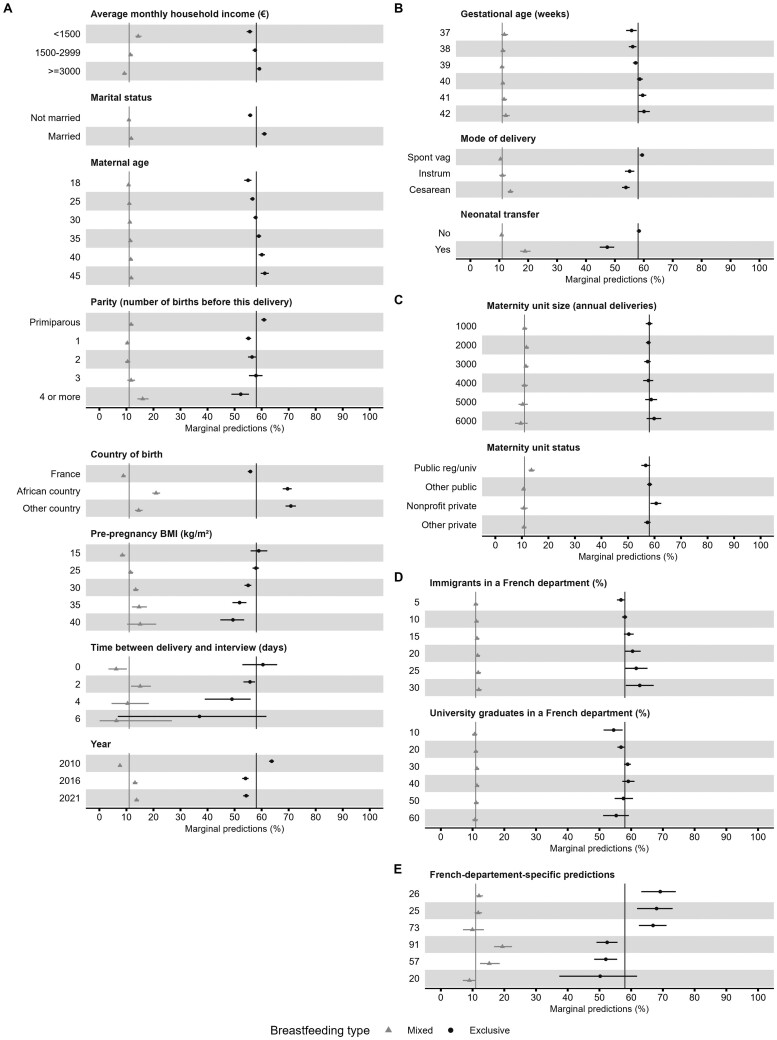
We examined breastfeeding in maternity units (exclusive, mixed and any breastfeeding) in mothers of singleton full-term newborns using the 2010 (n = 13 075), 2016 (n = 10 919) and 2021 (n = 10 209) French National Perinatal Surveys. We used mixed-effect hierarchical multinomial regression models adjusting for neonatal, maternal, maternity unit and French administrative department characteristics, and tested certain interactions.
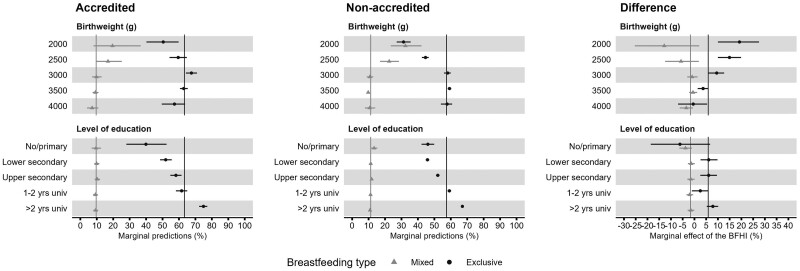
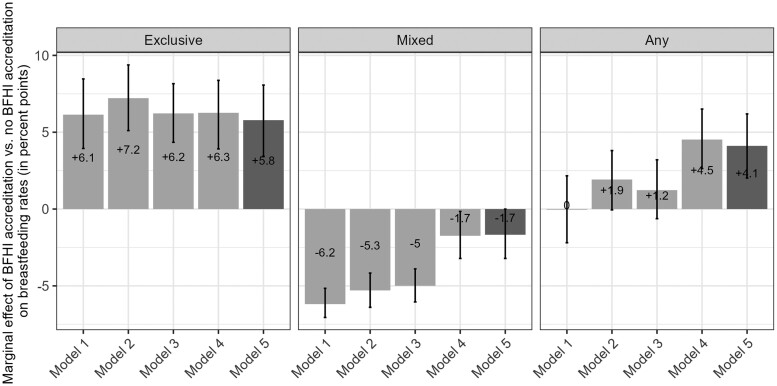
The adjusted rate of exclusive breastfeeding was higher by +5.8 (3.4-8.1) points among mothers delivering in BFHI-accredited maternity units compared with those delivering in non-accredited units. When compared with average-weight newborns, this difference was sharper for infants with low birthweight: +14.9 (10.0-19.9) points when their birthweight was 2500 g. Mixed breastfeeding was lower by -1.7 points (-3.2-0) in BFHI-accredited hospitals, with no notable difference according to the neonatal or maternal characteristics.
Mothers delivering in BFHI-accredited maternity units had higher exclusive breastfeeding rates and lower mixed breastfeeding rates than those delivering in non-accredited maternity units. The positive impact of the BFHI was stronger among low-birthweight neonates, who are less often breastfed, helping reduce the gap for this vulnerable group while favouring mothers with higher education levels.
婴儿友好医院倡议(BFHI)与许多高收入国家(包括英国和美国)母乳喂养结果的改善有关,但它在法国的有效性从未得到过评估。我们调查了 BFHI 对 2010 年、2016 年和 2021 年法国产科单位母乳喂养率的影响,以评估 BFHI 是否有助于减少母乳喂养方面的不平等。
我们使用 2010 年(n=13075)、2016 年(n=10919)和 2021 年(n=10209)法国国家围产期调查的数据,研究了单胎足月新生儿母亲在产科单位(纯母乳喂养、混合喂养和任何母乳喂养)的母乳喂养情况。我们使用混合效应分层多项回归模型,根据新生儿、产妇、产科单位和法国行政部门的特点进行调整,并测试了某些交互作用。
与非认证产科单位相比,在 BFHI 认证产科单位分娩的母亲的纯母乳喂养率高出+5.8(3.4-8.1)个百分点。与平均体重新生儿相比,出生体重为 2500 克的低体重儿的这一差异更为明显:+14.9(10.0-19.9)个百分点。在 BFHI 认证医院,混合母乳喂养率降低了-1.7 个百分点(-3.2-0),新生儿或产妇特征无明显差异。
在 BFHI 认证产科单位分娩的母亲的纯母乳喂养率高于非认证产科单位,混合母乳喂养率较低。BFHI 的积极影响在低出生体重儿中更为明显,他们母乳喂养的比例较低,这有助于缩小这一脆弱群体的差距,同时有利于教育程度较高的母亲。