Kroeker Jenna, Wess Anas, Yang Yuwei, Al-Zeer Bader, Uppal Harjot, Balmes Patricia, Som Robin, Courval Valerie, Lakha Nasira, Brisson Angie, Sakai Jennifer, Garraway Naisan, Tang Raymond, Rose Peter, Joos Emilie
Trauma and Acute Care Surgery, Vancouver General Hospital, Vancouver, British Columbia, Canada.
Surgery, Maimonides Medical Center, Brooklyn, New York, USA.
Trauma Surg Acute Care Open. 2024 Jun 5;9(1):e001323. doi: 10.1136/tsaco-2023-001323. eCollection 2024.
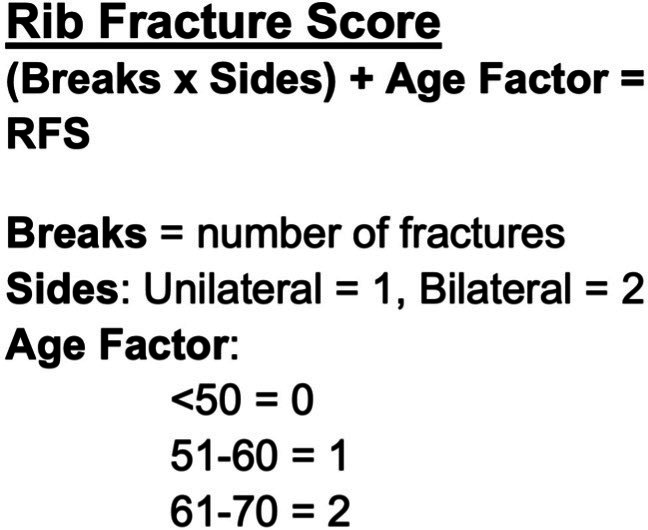
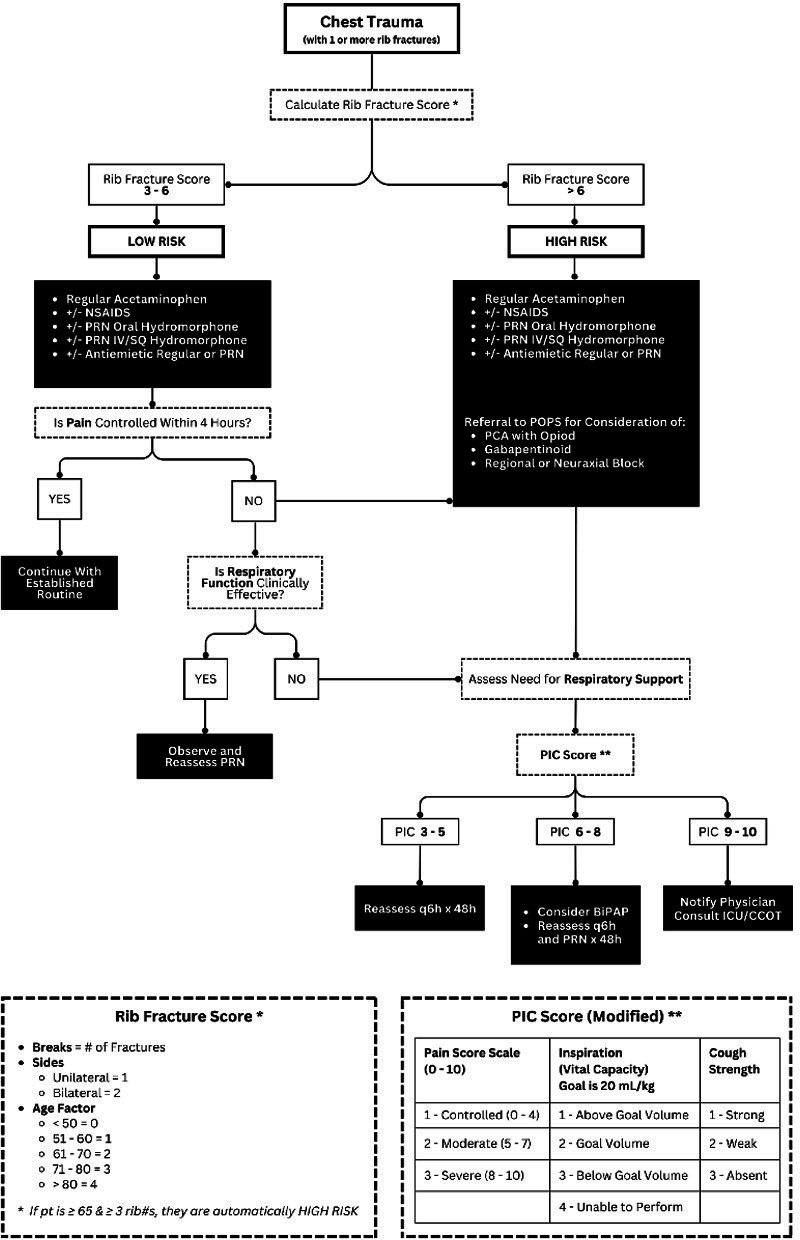
Traumatic rib fractures present a considerable risk to patient well-being, contributing to morbidity and mortality in trauma patients. To address the risks associated with rib fractures, evidence-based interventions have been implemented, including effective pain management, pulmonary hygiene, and early walking. Vancouver General Hospital, a level 1 trauma center in British Columbia, Canada, developed a comprehensive multidisciplinary chest trauma clinical practice guideline (CTCPG) to optimize the management of patients with rib fractures. This prospective cohort study aimed to assess the impact of the CTCPG on pain management interventions and patient outcomes.
The study involved patients admitted between January 1, 2021 and December 31, 2021 (post-CTCPG cohort) and a historical control group admitted between November 1, 2018 and December 31, 2019 (pre-CTCPG cohort). Patient data were collected from patient charts and the British Columbia Trauma Registry, including demographics, injury characteristics, pain management interventions, and relevant outcomes.
Implementation of the CTCPG resulted in an increased use of multimodal pain therapy (99.4% vs 96.1%; p=0.03) and a significant reduction in the incidence of delirium in the post-CTCPG cohort (OR 0.43, 95% CI 0.21 to 0.80, p=0.0099). There were no significant differences in hospital length of stay, ICU (intensive care unit) days, non-invasive positive pressure ventilation requirement, ventilator days, pneumonia incidence, or mortality between the two cohorts.
Adoption of a CTCPG improved chest trauma management by enhancing pain management and reducing the incidence of delirium. Further research, including multicenter studies, is warranted to validate these findings and explore additional potential benefits of the CTCPG in the management of chest trauma patients.
IIb.
创伤性肋骨骨折对患者的健康构成相当大的风险,是创伤患者发病和死亡的原因之一。为应对与肋骨骨折相关的风险,已实施了循证干预措施,包括有效的疼痛管理、肺部护理和早期活动。加拿大不列颠哥伦比亚省的一级创伤中心温哥华总医院制定了一项全面的多学科胸部创伤临床实践指南(CTCPG),以优化肋骨骨折患者的管理。这项前瞻性队列研究旨在评估CTCPG对疼痛管理干预措施和患者预后的影响。
该研究纳入了2021年1月1日至2021年12月31日期间入院的患者(CTCPG后队列)和一个历史对照组,即2018年11月1日至2019年12月31日期间入院的患者(CTCPG前队列)。患者数据从患者病历和不列颠哥伦比亚省创伤登记处收集,包括人口统计学、损伤特征、疼痛管理干预措施和相关预后。
CTCPG的实施导致多模式疼痛治疗的使用增加(99.4%对96.1%;p=0.03),并且CTCPG后队列中谵妄的发生率显著降低(比值比0.43,95%置信区间0.21至0.80,p=0.0099)。两个队列在住院时间、重症监护病房(ICU)天数、无创正压通气需求、呼吸机使用天数、肺炎发生率或死亡率方面没有显著差异。
采用CTCPG通过加强疼痛管理和降低谵妄发生率改善了胸部创伤管理。有必要进行进一步的研究,包括多中心研究,以验证这些发现,并探索CTCPG在胸部创伤患者管理中的其他潜在益处。
IIb。