Kim Michelle, Moore James E
1University of Maryland School of Medicine, R. Adams Cowley Shock Trauma Center, Baltimore, MD USA.
2Consultant Anaesthetist, Intensive Care Physician & Director of Trauma Services, Wellington Hospital, Wellington, New Zealand.
Curr Anesthesiol Rep. 2020;10(1):61-68. doi: 10.1007/s40140-020-00374-w. Epub 2020 Jan 15.
This article provides an overview of the common and important chest injuries that the anesthesiologist may encounter in patients following trauma including blunt injury, pneumothorax, hemothorax, blunt aortic injury, and blunt cardiac injury.
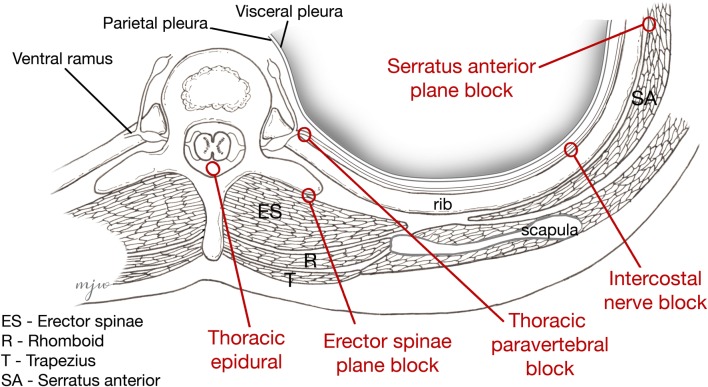
Rib fractures are frequently associated with chest injury and are associated with significant pain and other complications. Regional anesthesia techniques combined with a multimodal analgesic strategy can improve patient outcomes and reduce complications. There is increasing evidence for paravertebral blocks for this indication, and the myofascial plane blocks are a popular emerging technique. Recent changes to recommended management of tension pneumothorax are also described.
Chest trauma is commonly encountered, and anesthesiologists have the potential to significantly improve morbidity and mortality in this group of patients.
本文概述了麻醉医生在创伤患者中可能遇到的常见且重要的胸部损伤,包括钝性损伤、气胸、血胸、钝性主动脉损伤和钝性心脏损伤。
肋骨骨折常与胸部损伤相关,且伴有严重疼痛和其他并发症。区域麻醉技术与多模式镇痛策略相结合可改善患者预后并减少并发症。有越来越多的证据支持在此适应证下使用椎旁阻滞,肌筋膜平面阻滞是一种流行的新兴技术。还描述了张力性气胸推荐治疗的近期变化。
胸部创伤很常见,麻醉医生有潜力显著改善这类患者的发病率和死亡率。