
多发性硬化症管理临床决策支持系统的范围综述:利用信息技术和海量健康数据
Scoping review of clinical decision support systems for multiple sclerosis management: Leveraging information technology and massive health data.
作者信息
Demuth Stanislas, Ed-Driouch Chadia, Dumas Cédric, Laplaud David, Edan Gilles, Vince Nicolas, De Sèze Jérôme, Gourraud Pierre-Antoine
机构信息
INSERM CIC 1434, Clinical Investigation Center, University Hospital of Strasbourg, Strasbourg, France.
INSERM, CR2TI-Center for Research in Transplantation and Translational Immunology, Nantes Université, Nantes, France.
出版信息
Eur J Neurol. 2025 Jan;32(1):e16363. doi: 10.1111/ene.16363. Epub 2024 Jun 11.
BACKGROUND AND PURPOSE
Multiple sclerosis (MS) is a complex autoimmune disease of the central nervous system, with numerous therapeutic options, but a lack of biomarkers to support a mechanistic approach to precision medicine. A computational approach to precision medicine could proceed from clinical decision support systems (CDSSs). They are digital tools aiming to empower physicians through the clinical applications of information technology and massive data. However, the process of their clinical development is still maturing; we aimed to review it in the field of MS.
METHODS
For this scoping review, we screened systematically the PubMed database. We identified 24 articles reporting 14 CDSS projects and compared their technical and software development aspects.
RESULTS
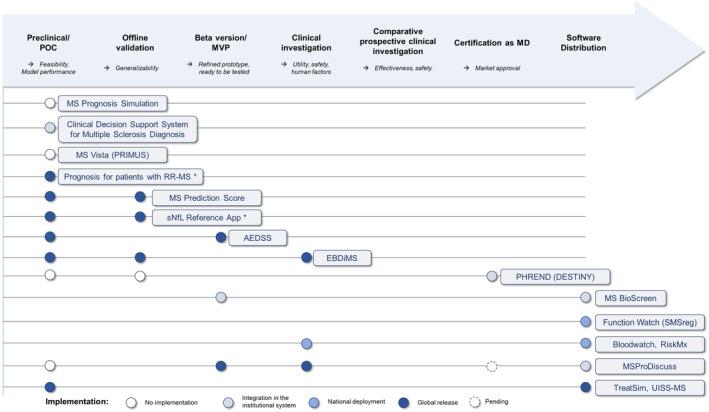
The projects position themselves in various contexts of usage with various algorithmic approaches: expert systems, CDSSs based on similar patients' data visualization, and model-based CDSSs implementing mathematical predictive models. So far, no project has completed its clinical development up to certification for clinical use with global release. Some CDSSs have been replaced at subsequent project iterations. The most advanced projects did not necessarily report every step of clinical development in a dedicated article (proof of concept, offline validation, refined prototype, live clinical evaluation, comparative prospective evaluation). They seek different software distribution options to integrate into health care: internal usage, "peer-to-peer," and marketing distribution.
CONCLUSIONS
This review illustrates the potential of clinical applications of information technology and massive data to support MS management and helps clarify the roadmap for future projects as a multidisciplinary and multistep process.
背景与目的
多发性硬化症(MS)是一种复杂的中枢神经系统自身免疫性疾病,有多种治疗选择,但缺乏生物标志物来支持精准医学的机制性方法。精准医学的计算方法可以从临床决策支持系统(CDSS)入手。它们是旨在通过信息技术和海量数据的临床应用来增强医生能力的数字工具。然而,其临床开发过程仍在不断完善;我们旨在对MS领域的这一过程进行综述。
方法
对于这项范围综述,我们系统筛选了PubMed数据库。我们识别出24篇报告14个CDSS项目的文章,并比较了它们的技术和软件开发方面。
结果
这些项目在不同的使用场景中采用了各种算法方法:专家系统、基于相似患者数据可视化的CDSS,以及实施数学预测模型的基于模型的CDSS。到目前为止,还没有项目完成其临床开发直至获得全球发布的临床使用认证。一些CDSS在后续项目迭代中被取代。最先进的项目不一定在专门的文章中报告临床开发的每一步(概念验证、离线验证、优化原型、实时临床评估、比较前瞻性评估)。它们寻求不同的软件分发选项以融入医疗保健:内部使用、“点对点”和市场分发。
结论
本综述阐述了信息技术和海量数据在支持MS管理方面临床应用的潜力,并有助于阐明未来项目作为一个多学科、多步骤过程的路线图。



 Zotero 插件