Giebel Godwin Denk, Raszke Pascal, Nowak Hartmuth, Palmowski Lars, Adamzik Michael, Heinz Philipp, Tokic Marianne, Timmesfeld Nina, Brunkhorst Frank, Wasem Jürgen, Blase Nikola
Institute for Healthcare Management and Research, University of Duisburg-Essen, Essen, Germany.
Department of Anesthesiology, Intensive Care and Pain Therapy, University Hospital Knappschaftskrankenhaus Bochum, Bochum, Germany.
J Med Internet Res. 2025 Feb 3;27:e63377. doi: 10.2196/63377.
Digitalization is currently revolutionizing health care worldwide. A promising technology in this context is artificial intelligence (AI). The application of AI can support health care providers in their daily work in various ways. The integration of AI is particularly promising in clinical decision support systems (CDSSs). While the opportunities of this technology are numerous, the problems should not be overlooked.
This study aimed to identify challenges and barriers in the context of AI-based CDSSs from the perspectives of experts across various disciplines.
Semistructured expert interviews were conducted with different stakeholders. These included representatives of patients, physicians and caregivers, developers of AI-based CDSSs, researchers (studying AI in health care and social and health law), quality management and quality assurance representatives, a representative of an ethics committee, a representative of a health insurance fund, and medical product consultants. The interviews took place on the web and were recorded, transcribed, and subsequently subjected to a qualitative content analysis based on the method by Kuckartz. The analysis was conducted using MAXQDA software. Initially, the problems were separated into "general," "development," and "clinical use." Finally, a workshop within the project consortium served to systematize the identified problems.
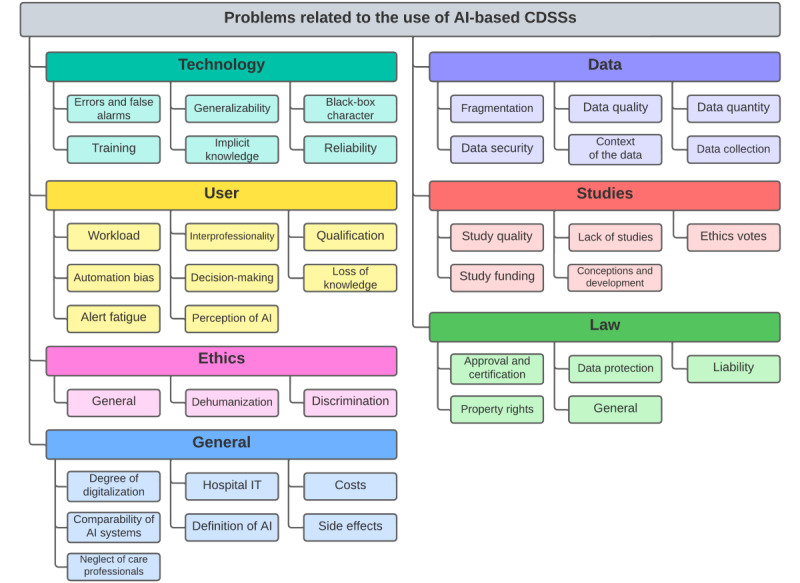
A total of 15 expert interviews were conducted, and 309 expert statements with reference to problems and barriers in the context of AI-based CDSSs were identified. These emerged in 7 problem categories: technology (46/309, 14.9%), data (59/309, 19.1%), user (102/309, 33%), studies (17/309, 5.5%), ethics (20/309, 6.5%), law (33/309, 10.7%), and general (32/309, 10.4%). The problem categories were further divided into problem areas, which in turn comprised the respective problems.
A large number of problems and barriers were identified in the context of AI-based CDSSs. These can be systematized according to the point at which they occur ("general," "development," and "clinical use") or according to the problem category ("technology," "data," "user," "studies," "ethics," "law," and "general"). The problems identified in this work should be further investigated. They can be used as a basis for deriving solutions to optimize development, acceptance, and use of AI-based CDSSs.
INTERNATIONAL REGISTERED REPORT IDENTIFIER (IRRID): RR2-10.2196/preprints.62704.
数字化目前正在彻底改变全球医疗保健行业。在这一背景下,一项很有前景的技术是人工智能(AI)。人工智能的应用可以在多个方面支持医疗保健提供者的日常工作。人工智能在临床决策支持系统(CDSS)中的整合尤其具有前景。虽然这项技术的机遇众多,但问题也不容忽视。
本研究旨在从各学科专家的角度识别基于人工智能的临床决策支持系统背景下的挑战和障碍。
对不同利益相关者进行了半结构化专家访谈。这些利益相关者包括患者、医生和护理人员的代表、基于人工智能的临床决策支持系统的开发者、研究人员(研究医疗保健以及社会和健康法领域的人工智能)、质量管理和质量保证代表、伦理委员会代表、健康保险基金代表以及医疗产品顾问。访谈通过网络进行,并进行了录音、转录,随后根据库卡茨的方法进行了定性内容分析。分析使用MAXQDA软件进行。最初,问题被分为“一般”“开发”和“临床应用”三类。最后,项目联盟内部举办了一次研讨会,对识别出的问题进行系统化整理。
共进行了15次专家访谈,识别出309条关于基于人工智能的临床决策支持系统背景下的问题和障碍的专家陈述。这些问题出现在7个问题类别中:技术(46/309,14.9%)、数据(59/309,19.1%)、用户(102/309,33%)、研究(17/309,5.5%)、伦理(20/309,6.5%)、法律(33/309,10.7%)和一般(32/309,10.4%)。这些问题类别又进一步细分为问题领域,而问题领域又包含各自的问题。
在基于人工智能的临床决策支持系统背景下识别出了大量问题和障碍。这些问题可以根据其出现的阶段(“一般”“开发”和“临床应用”)或问题类别(“技术”“数据”“用户”“研究”“伦理”“法律”和“一般”)进行系统化整理。本研究中识别出的问题应进一步研究。它们可作为推导解决方案的基础,以优化基于人工智能的临床决策支持系统的开发、接受度和使用。
国际注册报告识别号(IRRID):RR2-10.2196/preprints.62704。