Behavioral Neuroscience BranchNational Institute on Drug Abuse-Intramural Research Program, National Insitutes of Health, Department of Health and Human Services, Baltimore, Maryland, United States.
J Neurophysiol. 2024 Aug 1;132(2):322-334. doi: 10.1152/jn.00177.2024. Epub 2024 Jun 12.
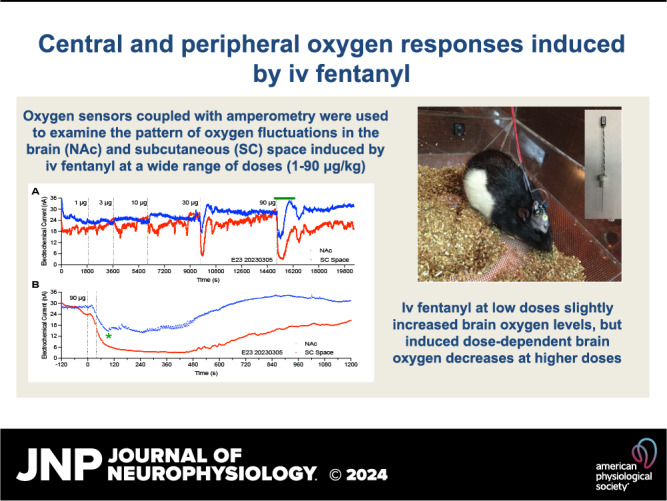
Fentanyl is the leading contributor to drug overdose deaths in the United States. Its potency, rapid onset of action, and lack of effective reversal treatment make the drug much more lethal than other opioids. Although it is understood that fentanyl is dangerous at higher doses, the literature surrounding fentanyl's physiological effects remains contradictory at lower doses. To explore this discrepancy, we designed a study incorporating electrochemical assessment of oxygen in the brain (nucleus accumbens) and subcutaneous space, multisite thermorecording (brain, skin, muscle), and locomotor activity at varying doses of fentanyl (1.0, 3.0, 10, 30, and 90 µg/kg) in rats. In the nucleus accumbens, lower doses of fentanyl (3.0 and 10 µg/kg) led to an increase in oxygen levels while higher doses (30 and 90 µg/kg) led to a biphasic pattern, with an initial dose-dependent decrease followed by an increase. In the subcutaneous space, oxygen decreases started to appear at relatively lower doses (>3 µg/kg), had shorter onset latencies, and were stronger and prolonged. In the temperature experiment, lower doses of fentanyl (1.0, 3.0, and 10 µg/kg) led to an increase in brain, skin, and muscle temperatures, while higher doses (30 and 90 µg/kg) resulted in a dose-dependent biphasic temperature change, with an increase followed by a prolonged decrease. We also compared oxygen and temperature responses induced by fentanyl over six consecutive days and found no evidence of tolerance in both parameters. In conclusion, we report that fentanyl's effects are highly dose-dependent, drawing attention to the importance of better characterization to adequately respond in emergent cases of illicit fentanyl misuse. By using electrochemical oxygen sensors in freely moving rats, we show that intravenous fentanyl induces opposite changes in brain oxygen at varying doses, increasing at lower doses (<10 µg/kg) and inducing a biphasic response, decrease followed by increase, at higher doses (>10-90 µg/kg). In contrast, fentanyl-induced dose-dependent oxygen decreases in the subcutaneous space. We consider the mechanisms underlying distinct oxygen responses in the brain and periphery and discuss naloxone's role in alleviating fentanyl-induced brain hypoxia.
芬太尼是导致美国药物过量死亡的主要原因。其效力高、作用迅速,且缺乏有效的逆转治疗,使其比其他阿片类药物更致命。尽管人们知道芬太尼在高剂量下是危险的,但低剂量下芬太尼的生理效应仍然存在争议。为了探索这种差异,我们设计了一项研究,纳入了不同剂量(1.0、3.0、10、30 和 90µg/kg)芬太尼在大鼠中的电化学评估脑(伏隔核)和皮下氧、多部位热敏记录(脑、皮肤、肌肉)和运动活性。在伏隔核中,较低剂量(3.0 和 10µg/kg)的芬太尼导致氧水平增加,而较高剂量(30 和 90µg/kg)则导致双相模式,初始剂量依赖性降低,随后增加。在皮下空间,氧减少开始出现在相对较低的剂量(>3µg/kg),潜伏期较短,且更强且持续时间更长。在温度实验中,较低剂量(1.0、3.0 和 10µg/kg)的芬太尼导致脑、皮肤和肌肉温度升高,而较高剂量(30 和 90µg/kg)导致剂量依赖性双相温度变化,先增加后持续降低。我们还比较了芬太尼在连续六天引起的氧和温度反应,在这两个参数中均未发现耐受的证据。总之,我们报告说芬太尼的作用高度依赖于剂量,这引起了人们对更好地描述其作用的关注,以便在非法芬太尼滥用的紧急情况下做出适当反应。通过在自由活动的大鼠中使用电化学氧传感器,我们表明静脉内芬太尼在不同剂量下引起大脑氧的相反变化,在较低剂量(<10µg/kg)下增加,并引起双相反应,先减少后增加,在较高剂量(>10-90µg/kg)下。相比之下,芬太尼引起的皮下氧剂量依赖性减少。我们考虑了大脑和外周氧反应的不同机制,并讨论了纳洛酮在缓解芬太尼引起的脑缺氧中的作用。