Cecchini Marta, Filippini Tommaso, Whelton Paul K, Iamandii Inga, Di Federico Silvia, Boriani Giuseppe, Vinceti Marco
CREAGEN - Environmental, Genetic and Nutritional Epidemiology Research Center, Section of Public Health, Department of Biomedical, Metabolic and Neural Sciences (M.C., T.F., I.I., S.D.F., M.V.), University of Modena and Reggio Emilia, Modena, Italy.
School of Public Health, University of California Berkeley, Berkeley, CA (T.F.).
Hypertension. 2024 Aug;81(8):1701-1715. doi: 10.1161/HYPERTENSIONAHA.124.22703. Epub 2024 Jun 12.
Alcohol consumption has been associated with higher blood pressure and an increased risk of hypertension. However, the possible exposure thresholds and effect-modifiers are uncertain.
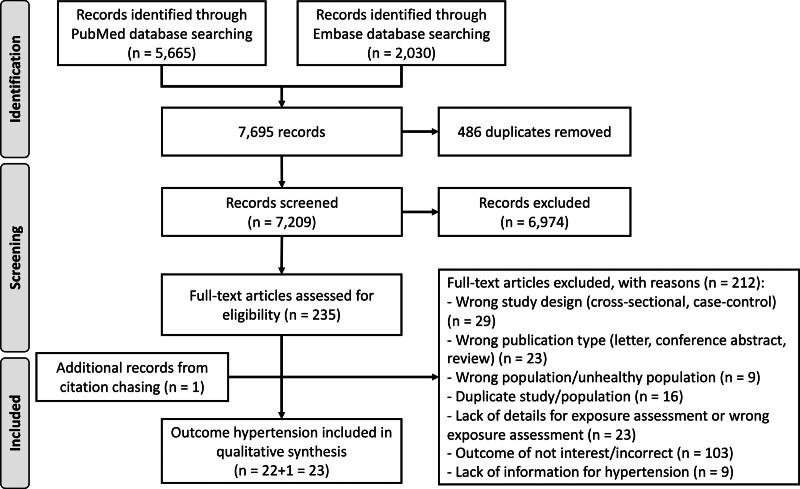
We assessed the dose-response relationship between usual alcohol intake and hypertension incidence in nonexperimental cohort studies. After performing a systematic literature search through February 20, 2024, we retrieved 23 eligible studies. We computed risk ratios and 95% CI of hypertension incidence using a nonlinear meta-analytic model based on restricted cubic splines, to assess the dose-response association with alcohol consumption.
We observed a positive and almost linear association between alcohol intake and hypertension risk with risk ratios of 0.89 (0.84-0.94), 1.11 (1.07-1.15), 1.22 (1.14-1.30), and 1.33 (1.18-1.49) for 0, 24, 36 and 48 g/d, respectively, using 12 g alcohol/d as the reference value. In sex-specific analyses, the association was almost linear in men over the entire range of exposure but only observed above 12 g/d in women, although with a steeper association at high levels of consumption compared with men. The increased risk of hypertension above 12 to 24 g alcohol/d was similar in Western and Asian populations and considerably greater in White than in Black populations, mainly due to the positive association in women at moderate-to-high intake.
Overall, our results lend support to a causal association between alcohol consumption and risk of hypertension, especially above an alcohol intake of 12 g/d, and are consistent with recommendations to avoid or limit alcohol intake. Sex and ethnicity appear to be major effect-modifiers of such association.
饮酒与血压升高及高血压风险增加有关。然而,可能的暴露阈值和效应修饰因素尚不确定。
我们在非实验性队列研究中评估了通常饮酒量与高血压发病率之间的剂量反应关系。在对截至2024年2月20日的文献进行系统检索后,我们获得了23项符合条件的研究。我们使用基于受限立方样条的非线性荟萃分析模型计算高血压发病率的风险比和95%置信区间,以评估与饮酒量的剂量反应关联。
我们观察到饮酒量与高血压风险之间呈正相关且几乎呈线性关系,以每天12克酒精为参考值,每天饮酒量为0、24、36和48克时的风险比分别为0.89(0.84 - 0.94)、1.11(1.07 - 1.15)、1.22(1.14 - 1.30)和1.33(1.18 - 1.49)。在按性别进行的分析中,男性在整个暴露范围内的关联几乎呈线性,而女性仅在饮酒量高于12克/天时观察到关联,尽管在高饮酒量水平下女性的关联比男性更陡峭。每天饮酒量超过12至24克时高血压风险的增加在西方和亚洲人群中相似,在白人中比黑人中显著更高,主要是由于中度至高度饮酒的女性中存在正相关。
总体而言,我们的结果支持饮酒与高血压风险之间存在因果关联,尤其是饮酒量超过12克/天时,并且与避免或限制饮酒的建议一致。性别和种族似乎是这种关联的主要效应修饰因素。